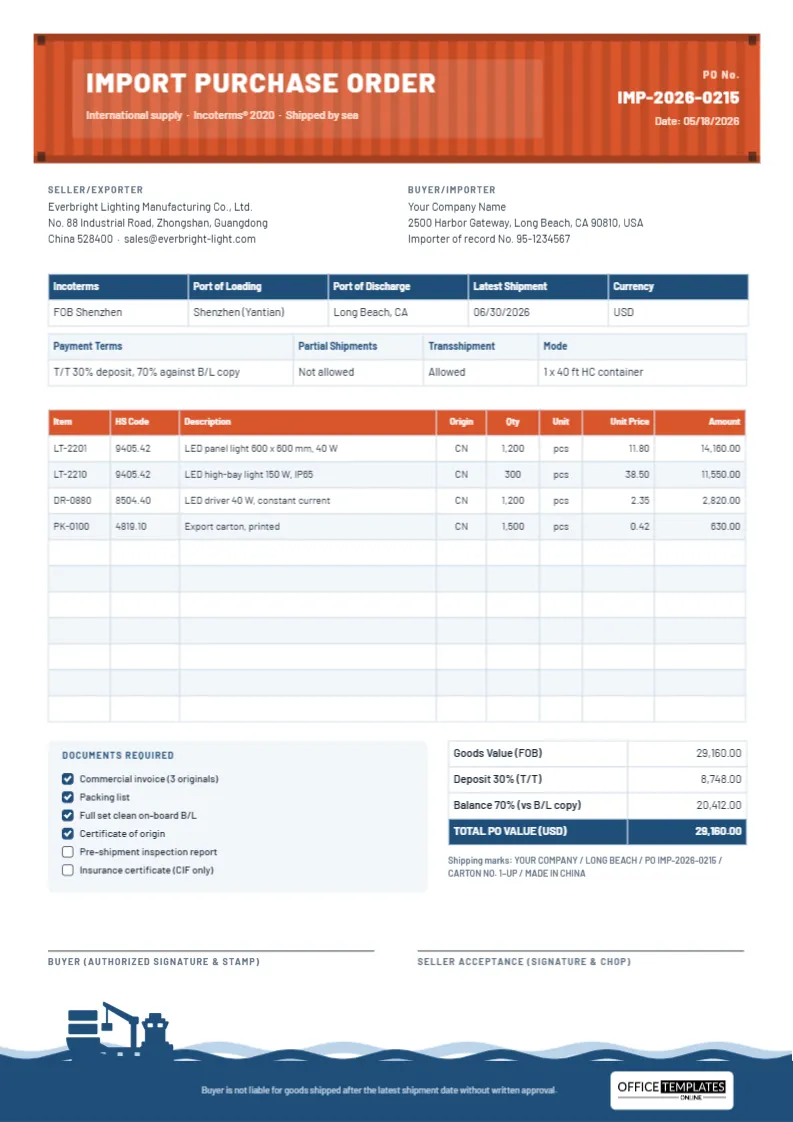
Buying from a factory on the other side of the world adds a layer of questions that a local order never raises. Who pays for the sea freight? When does the risk pass to you? Which port does the container leave from, and what documents must travel with it so customs can clear the goods? An import purchase order answers those questions before the supplier starts production. This template puts trade terms, ports, payment, and documents on the same page as the product list.
Incoterms in Plain Language
Incoterms® are standard trade terms published by the International Chamber of Commerce. The sample order uses FOB Shenzhen. Here is a simplified view of some of the most common terms; for anything important, read the official rules or ask your freight forwarder.
| Term | Seller’s job, in short | Buyer’s job, in short |
|---|---|---|
| EXW (Ex Works) | Make the goods available at its premises | Almost everything else: export, freight, import |
| FCA (Free Carrier) | Deliver the goods to the buyer’s carrier at a named place | Main transport, insurance, import |
| FOB (Free On Board) | Deliver the goods on board the vessel at the named port of loading | Sea freight, insurance, import clearance and duties |
| CIF (Cost, Insurance & Freight) | Pay freight and minimum insurance to the destination port | Import clearance, duties, onward delivery |
| DDP (Delivered Duty Paid) | Deliver to the buyer’s premises, duties paid | Unload and receive |
FOB and CIF are intended for sea and inland waterway transport. Always state the version year, as the template does with Incoterms® 2020.
The Header Is a Shipping Container
The template is A4 portrait (210 x 297 mm). Its header is drawn as the side of a rust-orange shipping container, complete with corrugated ribs, darker top and bottom rails, and corner castings. On the container, IMPORT PURCHASE ORDER is set in extra-bold Barlow, with International supply · Incoterms® 2020 · Shipped by sea beneath, and the PO number and date on the right.
At the foot of the page, a navy cargo ship sails on pale blue waves into a navy sea band that carries a reminder about shipment dates and our logo on a white plate. Between the two, the page holds:
- Seller / Exporter and Buyer / Importer details, including an importer of record number.
- Two trade-terms tables: Incoterms, Port of Loading, Port of Discharge, Latest Shipment, Currency; then Payment Terms, Partial Shipments, Transshipment, and Mode.
- An 11-row product table with an orange header: Item, HS Code, Description, Origin, Qty, Unit, Unit Price, and Amount.
- A Documents Required checklist and a totals table showing deposit and balance.
- A line for shipping marks, and signatures for the buyer (with company stamp) and the seller (signature and company chop).
The Payment Split, Worked Out
Many overseas suppliers work on a deposit before production and the balance before releasing the goods. The sample uses T/T 30% deposit, 70% against B/L copy: a bank transfer of 30% to start, and 70% once the supplier sends a copy of the bill of lading proving the goods have been shipped.
- Goods value (FOB): 1,200 LED panels at 11.80, 300 high-bay lights at 38.50, 1,200 drivers at 2.35, and 1,500 export cartons at 0.42, totalling 29,160.00.
- Deposit: 29,160.00 × 30% = 8,748.00.
- Balance: 29,160.00 × 70% = 20,412.00.
Because the order is FOB, freight and insurance from the port of loading are for the buyer to arrange, so they do not appear in the PO total. Work out your own figures and type them in; the tables hold text rather than formulas.
HS Codes and Shipping Marks
The HS Code column holds each product’s Harmonized System classification, which customs authorities use to apply duty rates. The first six digits are international; countries add further digits of their own. The codes in the sample are illustrations only; confirm the right codes for your products with your customs broker. Getting them right on the PO means they flow through to the commercial invoice.
Shipping marks are printed on every carton so goods can be identified at each port and warehouse. The sample marks show the buyer, destination, PO number, carton numbering, and country of origin.
Documents to Tick
The checklist covers the paperwork most importers need: commercial invoices, a packing list, a full set of clean on-board bills of lading, a certificate of origin, a pre-shipment inspection report, and an insurance certificate (only when the seller insures, as under CIF). Tick what your customs broker and bank require for this shipment; the navy boxes are ticked, white ones are not.
Completing the Import PO
- Update the PO number and date on the container.
- Enter full legal names and addresses for the seller and buyer, as they should appear on the shipping documents.
- Fill in the two trade-terms tables. Double-click either one to edit all its cells at once.
- Enter products, HS codes, origin, quantities and prices through the product table’s Edit Table Data window, or with Import CSV from the supplier’s proforma invoice.
- Type the totals, deposit and balance, and edit the shipping marks line.
- Sign, stamp and send; ask the supplier to return a signed and chopped copy.
Adjusting the Artwork
The container is a grouped drawing, so you can recolour it in one step, for example, to the blue or green of your preferred shipping line. The cargo ship is an editable vector with its own colour swatch.
Planning Around Lead Times
An overseas order has several clocks running at once: production time at the factory, the wait for a vessel, the voyage itself, customs clearance, and the final trucking leg. Together they often add up to many weeks. Set the Latest Shipment date by working backwards from the date you need the goods in your warehouse, and leave a margin for holidays at the factory and for congestion at busy ports. Ask your freight forwarder for current transit times on your route before you commit to a date with your own customers. If the supplier cannot meet the shipment date, a written amendment to this PO keeps everyone working to the same plan.
Importer Questions
Can I use this for air freight?
Yes. Change the mode to air, the ports to airports, and choose an Incoterm suitable for any mode, such as FCA.
Which currency should I use?
Whichever you agreed with the supplier. US dollars are common in international trade; the Currency cell makes it explicit.
Ship It With Clear Terms
Agree on the Incoterm, the ports, the payment split, and the documents before production starts, and your import will cross borders with far fewer surprises.