Free Online School Timetable Maker
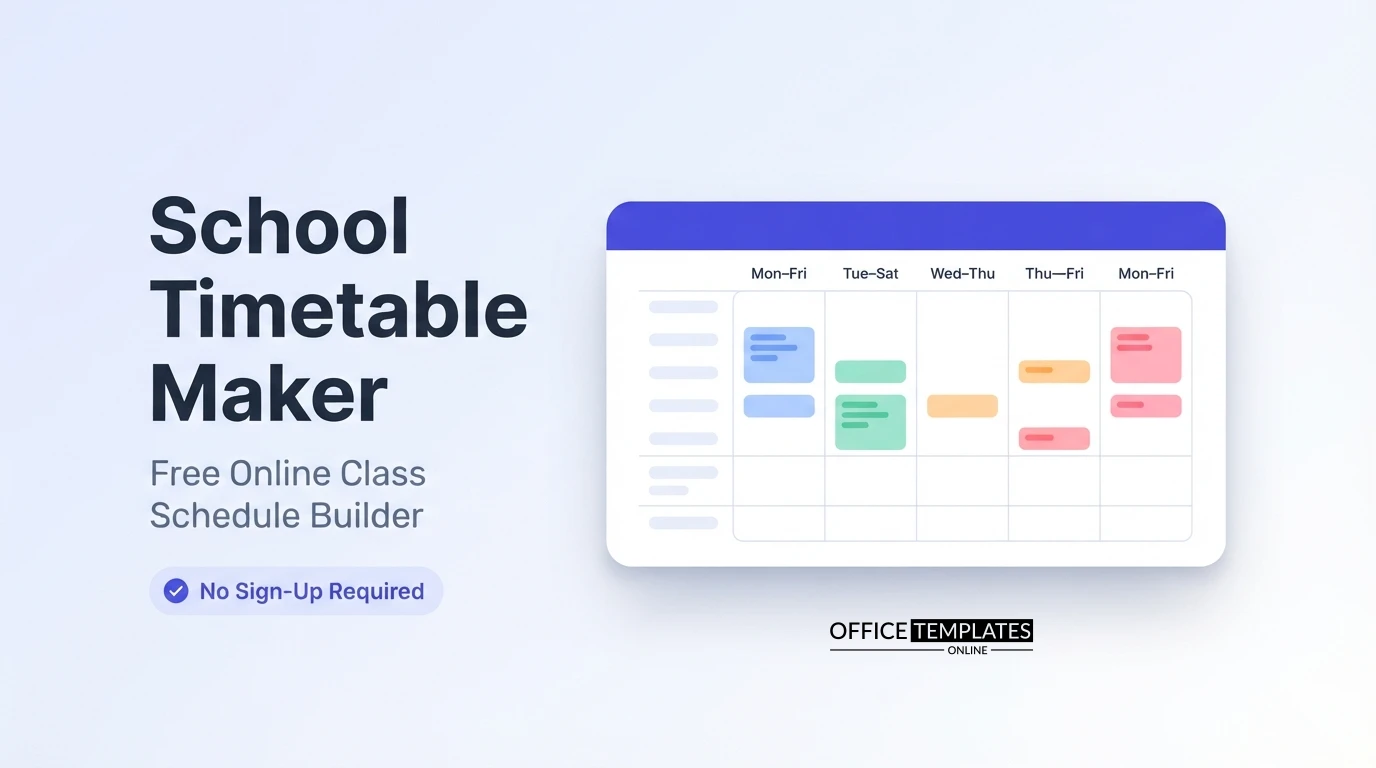
Creating a school timetable by hand or juggling spreadsheets can take hours, and one small change often means starting from scratch. This free online school timetable maker lets teachers, administrators, and academies build a professional class timetable in minutes, directly in your browser. Add your subjects, teachers, classes, and rooms, then drag and drop periods into place, or let the built-in automatic timetable generator create a conflict-free weekly schedule for you.
There’s nothing to download and no account to create — this timetable generator works right here on the page and saves your work locally in your browser as you go. Once your schedule is ready, export it as a PDF, PNG, or image, or print it straight away for the staff room or classroom notice board. Whether you need a timetable for a single class, a whole primary or high school, or a college department, the tool below gives you full control over subjects, teachers, rooms, and design — so you can build the perfect timetable in one sitting.
How to Create a School Timetable Online in 8 Simple Steps
Building a timetable from scratch feels overwhelming, but this school timetable maker breaks it into a few short steps. Here’s how to go from a blank page to a finished, exportable class schedule:
- Add your school details. Enter your school or institute name, logo, academic year, and term. This information appears automatically on your printed and exported timetable.
- Choose your days and periods. Select a Monday–Friday or Monday–Saturday week (or customize your own), then set how many periods you need per day, along with break, lunch, and assembly slots.
- Add your subjects. Type in your subject list manually, paste a list in one go, or use the built-in preset subjects (Mathematics, Science, English, Computer Science, and more) as a starting point — then edit freely to match your curriculum.
- Add your teachers. List your teaching staff, assign the subjects each one teaches, and set availability or workload limits if needed.
- Add your classes, sections, and rooms. Create each class or grade, add sections if you have more than one, and (optionally) list classrooms, labs, or other spaces so the timetable can track room usage too.
- Build the timetable. Click any cell to assign a subject, teacher, and room manually, or use the automatic timetable generator to fill the entire week in seconds based on the rules you’ve set.
- Customize the design. Choose a color theme, adjust fonts and cell sizing, and toggle what’s visible — subject codes, teacher names, room numbers, and more.
- Export or print. Download your finished timetable as a PDF, PNG, or JPG image, print it directly, or save the project file so you can reopen and edit it later.
Because everything happens in your browser, you can move back and forth between these steps as many times as you like before finalizing anything.
Key Features of This Free Timetable Maker
This isn’t a stripped-down demo — it’s a full timetable builder designed to handle real school scheduling needs:
- Drag-and-drop editing. Move subjects between periods and days instantly, duplicate entries, and undo or redo any change.
- Automatic timetable generator. Define your subjects, teachers, and constraints — weekly periods required, teacher availability, maximum daily workload, double periods — and let the generator build a conflict-free schedule for you. You can regenerate the whole timetable or just specific classes or days.
- Conflict detection. The tool automatically flags double-booked teachers, clashing rooms, and overloaded schedules, with a click-to-jump conflict panel so problems are easy to find and fix.
- Double periods and locked entries. Merge two periods into one block for labs or practicals, and lock finished entries so they’re protected while you keep editing the rest.
- Full design control. Choose from ready-made color themes or customize header colors, fonts, cell size, and layout to match your school’s branding.
- Custom terminology. Schools use different words for the same thing — rename “Class” to “Grade,” “Section” to “Form,” or “Period” to “Lesson” so the tool matches how your institution actually talks.
- Export in multiple formats. PDF (with proper page sizing and margins), PNG and JPG images, print-ready layouts, and CSV/Excel for further editing.
- No account, no downloads. The core timetable maker works entirely in your browser. Your work saves automatically as a local draft, and you can maintain a library of saved projects without ever creating a login.
- Works on any device. Use it on a desktop for detailed editing, or check and adjust a timetable from a tablet or phone. A dedicated fullscreen mode gives you extra room to work when you need it.
Who Is This School Timetable Maker For?
Timetabling needs look different depending on the institution, and this tool is built to flex across all of them:
- Primary schools creating simple, subject-based weekly timetables with clear breaks, assemblies, and age-appropriate subject names.
- Secondary and high schools managing multiple classes, sections, and teachers across a full academic week, often with lab periods and elective subjects.
- Colleges and universities scheduling by department, room, and instructor, frequently across six-day weeks with longer or irregular period lengths.
- Coaching centers and tutoring academies that need a fast way to organize multiple batches, subjects, and instructors without dedicated scheduling software.
- Individual teachers who just need a clean personal timetable showing their own weekly classes across different rooms and grades.
- Homeschool parents and small learning pods who want a simple, visual weekly schedule without the complexity of institutional timetabling tools.
Because labels, days, periods, and subjects are all fully editable, the same tool adapts to a two-section primary school or a fifteen-department college — there’s no rigid template forcing you into one structure.
Manual vs. Automatic: Which Timetable Mode Should You Use?
This timetable maker supports two ways of working, and most people end up using both.
Manual mode gives you complete control. You click a cell, assign a subject, teacher, and room, and build the week exactly as you want it. This is the better choice when your school has a lot of fixed constraints that are easier to reason about by eye — a specific teacher who only teaches Tuesdays and Thursdays, a shared room that needs careful sequencing, or a timetable that’s mostly staying the same from last term with just a few tweaks.
Automatic mode does the heavy lifting for you. Once you’ve entered your subjects’ weekly period requirements, teacher availability, and any workload limits, the generator builds a full weekly schedule in seconds, trying to avoid teacher and room clashes, spread subjects evenly across the week, and respect preferences like keeping core subjects in the morning. This is the faster option when you’re starting from scratch or rebuilding a timetable for a new term.
A common workflow is to run the automatic generator first to get a solid draft, then switch to manual mode to fine-tune a handful of cells, lock them in place, and regenerate around them if anything still needs adjusting.
Tips for Building a Better School Timetable
A good timetable is about more than just filling every slot. A few practical habits make a real difference to how well it works day to day:
- Put demanding subjects earlier in the day. Mathematics, science, and other concentration-heavy subjects are generally easier for students to absorb in the morning, before energy dips after lunch.
- Avoid back-to-back sessions of the same difficult subject across different periods in one day — spacing them out helps retention and avoids fatigue.
- Balance subjects across the week rather than clustering all of one subject’s periods into two or three days.
- Build in real breaks. Assembly, recess, and lunch periods aren’t just formalities — protecting them properly prevents a timetable that looks complete but doesn’t actually work in practice.
- Check teacher workload, not just availability. A teacher can be technically “free” for a slot and still be overloaded if they have five consecutive periods with no gap.
- Leave a little flexibility for the first week or two of term, since real-world scheduling conflicts often only show up once the timetable is in use.
- Review the conflict panel before finalizing. It’s much faster to resolve a double-booked teacher or room on screen than after timetables have already been printed and distributed.
- Lock entries once they’re confirmed, especially fixed slots like assemblies or shared facilities, so later edits or regeneration don’t accidentally move them.
Why Use an Online Timetable Maker Instead of Excel or Paper
Spreadsheets and printed grids have been the default for timetabling for years, but they come with real friction. A single teacher swap in Excel often means manually rechecking every other cell for new clashes. Paper timetables can’t be edited once printed, and hand-drawn grids make it hard to keep a consistent, professional look across every class.
Create Your Perfect Templates in Seconds
Choose from ready-made templates related to this topic, edit them online, and download instantly in PDF, PNG, or JPG format - fast, free, and no login needed.



A purpose-built timetable maker solves these problems directly. Conflicts are flagged automatically instead of needing a manual re-check. Subjects, teachers, and rooms are linked, so moving one entry updates the whole picture instead of leaving stale data behind. And because the layout, colors, and branding are handled for you, every class timetable comes out looking consistent — without needing any design skill or extra software.
Frequently Asked Questions
Is this school timetable maker free to use?
Yes. The core timetable builder, manual and automatic scheduling, design customization, and export options are all free to use directly on this page.
Do I need to create an account or sign up?
No. You can start building a timetable immediately with no registration required.
Is my timetable data safe? Where is it stored?
Your timetable data stays in your browser. Nothing is uploaded to a server unless you deliberately export a file, so you stay in full control of your school’s information.
Can I use this on a phone or tablet, or only on desktop?
It works on desktop, tablet, and mobile. Desktop gives you the most editing space, but you can view, adjust, and export timetables from smaller screens too.
Can I edit a timetable after I’ve already created it?
Yes. You can reopen a saved project at any time, make changes, undo or redo edits, and re-export it whenever you need an updated version.
Can I create timetables for more than one class or teacher?
Yes. You can add multiple classes and sections, copy a timetable from one class to another as a starting point, and build teacher-specific or room-specific views as needed.
Can I rename labels like “Class” or “Period” to match my school’s terminology?
Yes. Custom terminology lets you rename these labels — for example, “Grade” instead of “Class,” or “Recess” instead of “Break” — so the tool matches how your school actually refers to things.
Does this work for colleges and universities, or only schools?
It works for any institution that needs a weekly schedule — primary and secondary schools, colleges, universities, and coaching or tutoring centers alike.
What formats can I export my timetable in?
You can export as PDF, PNG, or JPG images, print directly, or save an editable project file to continue working on later.
Your timetable data stays private by design — everything is created and stored in your own browser, and nothing is sent anywhere unless you choose to export or print it yourself.