Children thrive on encouragement they can see. A star chart turns good choices, such as listening, finishing work, or being kind, into bright, visible progress, and gives adults a simple, positive way to notice what is going right. This weekly behaviour chart is designed for home or the classroom, with a rocket theme that makes every star feel like fuel for a launch.
Blast Off Up the Side of the Page
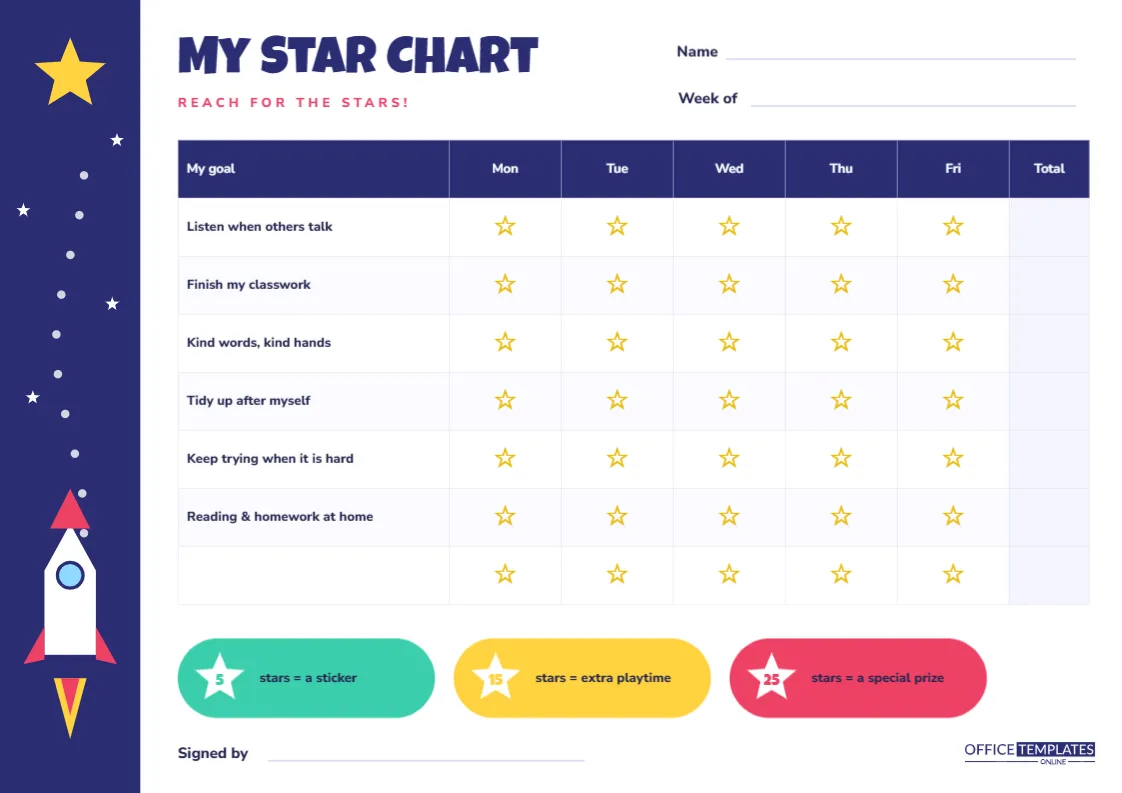
The template is an A4 landscape page (297 x 210 mm). A deep navy strip runs down the left edge like a night sky. At its foot, a white rocket with red fins, a red nose cone, and a round blue window is lifting off on a yellow and red flame. A dotted trail curves up from the rocket to a big yellow star at the top of the strip, with a few small white stars twinkling around it.
The title My Star Chart is set in the chunky, playful Luckiest Guy font, with Reach for the stars! in red underneath and lines for Name and Week of on the right.
The Chart Itself
A navy-headed table has a My goal column, five day columns from Mon to Fri, and a shaded Total column. Each day cell holds an outlined star ready to be coloured in. Six goals are already written in, each phrased positively:
- Listen when others talk
- Finish my classwork
- Kind words, kind hands
- Tidy up after myself
- Keep trying when it is hard
- Reading & homework at home
A seventh row is left blank for a goal chosen with the child.
A Reward Ladder, Not a Single Prize
Below the chart, three bright pill-shaped badges set out the rewards: 5 stars = a sticker in teal, 15 stars = extra playtime in yellow, and 25 stars = a special prize in red, each with the number printed inside a white star. The ladder matters. An early, easy reward keeps motivation high on Monday, and the bigger reward gives the week a goal. With six goals across five days, 30 stars are possible, so 25 leaves room for an off day. A signed-by line lets a parent or teacher confirm the week.
Rewards That Cost Little or Nothing
The best rewards are often time and attention rather than things. Ideas that work well for each level:
| Level | Low-cost reward ideas |
|---|---|
| 5 stars | A sticker, choosing the bedtime story, a high-five certificate, first pick of the fruit bowl |
| 15 stars | Ten extra minutes of play, choosing a family game, a picnic dinner on the floor, being the class helper |
| 25 stars | A trip to the park or library, baking together, choosing the weekend film, a small new book |
Edit the three badges in the editor to match whatever rewards you and the child agree on.
How to Talk About the Stars
A star chart works through the conversation around it. A few phrases make a big difference:
- Be specific: You tidied the craft table without being asked. That’s a star for Tidy up after myself.
- Praise effort: That maths was tricky, and you kept going. That’s what Keep trying looks like.
- Stay calm about empty stars: No star for listening today. Tomorrow’s a new chance.
- Never take stars away: A star once earned stays earned, which keeps the chart positive and fair.
Setting Up the Chart
- Choose three to six goals. Fewer goals are better for younger children.
- Talk about what each goal looks like in practice, so the child knows exactly how to earn it.
- Agree on the rewards together and write them in the badges.
- Put the chart somewhere visible, at the child’s eye level.
- Colour stars at the same time each day, such as after school or at bedtime, and add up the Total column on Friday.
Choosing Goals That Children Can Win
The goals on a star chart should describe what you want to see, not what you want to stop. Kind words, kind hands give a child something to aim for; No hitting only reminds them of the problem. Each goal should also be something the child can realistically manage on most days, because a chart full of empty stars quickly becomes discouraging. If a goal is too big, break it down: Finish my classwork might start as Finish my maths for a child who finds writing hard. Once a goal is earning a star almost every day, celebrate it and swap it for a new one. That way the chart keeps pace with the child’s growth instead of repeating the same week forever.
It also helps to involve the child in naming the blank seventh goal. Children who choose a goal themselves are usually the keenest to earn its stars.
Personalising the Rocket Chart
- Double-click the table to open Edit Table Data and rewrite any goal, remove rows, or add Saturday and Sunday columns in the Table panel.
- Click the badge text to change the reward and the number of stars needed.
- The rocket, trail, and stars on the navy strip are grouped, so the whole scene moves or recolours as one object.
- Type the child’s name and the week before printing, for a chart that feels personal from the start.
Printing the Star Chart
Print on A4 landscape at Actual size. The navy strip is the only large block of colour, so the chart is inexpensive to print weekly. Coloured pencils, crayons or small star stickers all work in the day cells. Teachers can print a copy per pupil for individual targets, or enlarge one to A3 at a print shop for a whole-class goal.
Star Chart Questions
What age is this chart for?
It works best for children from about four to nine. Older children often prefer a habit tracker or goal sheet.
How long should we use a star chart?
Until the goals become habits, usually a few weeks. Then change the goals or retire the chart with a celebration.
Can it work in a classroom?
Yes. Teachers use it for individual behaviour plans, with the goals agreed with the pupil and parents.
Three, Two, One… Stars!
Choose the goals, agree the rewards, and colour the first star today. By Friday, the rocket will be well on its way to that big star at the top.