What did you do today?Nothing. Every parent of a small child knows this conversation. Young children live so fully in the moment that the day’s details are gone by pickup time. A preschool daily diary fills in the gaps: how much lunch was eaten, how long the nap lasted, how the child felt, and what they played. For parents it is reassurance; for staff it is a simple, consistent way to share each child’s day.
A Box of Crayons Across the Top
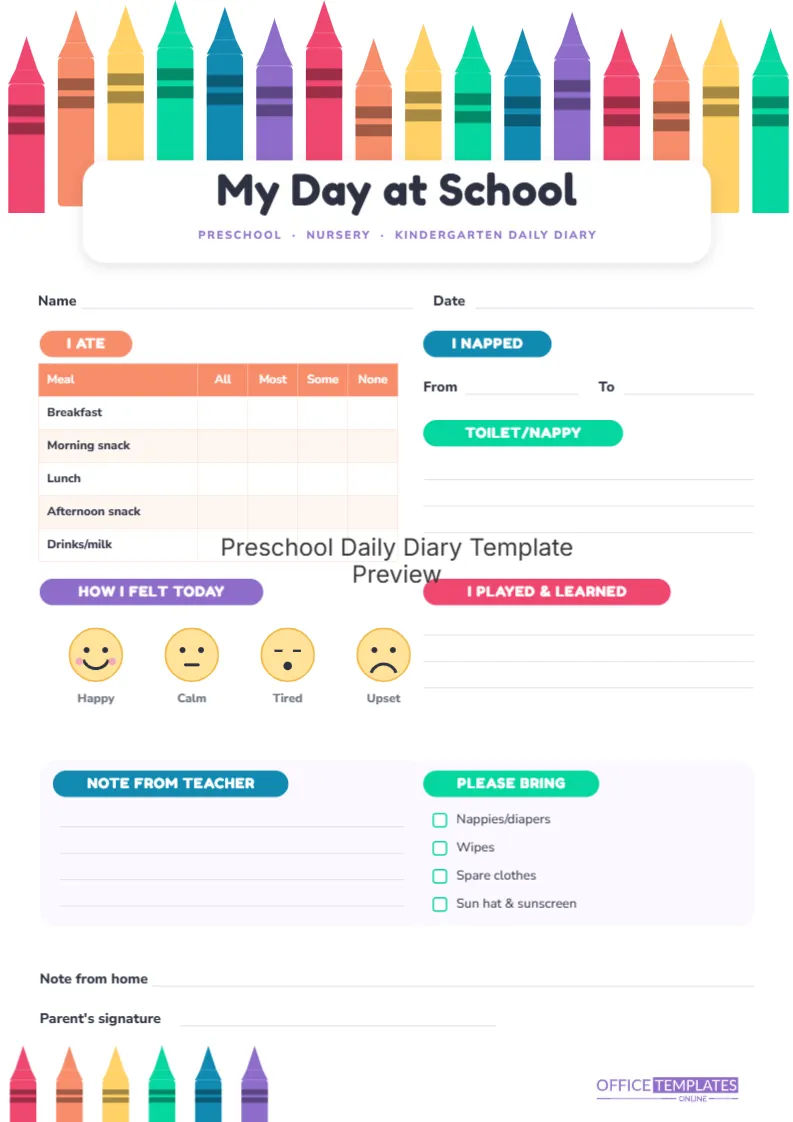
This A4 portrait page (210 x 297 mm) is designed to make both children and adults smile. Along the top edge stands a row of chunky crayons in cherry red, orange, sunshine yellow, mint green, ocean blue, and lilac, each with a pointed tip and wrapper bands, standing at slightly different heights like crayons in a well-used box. A white rounded title card sits in front of them with the title My Day at School in bold, rounded Fredoka One and a lilac line reading Preschool · Nursery · Kindergarten Daily Diary. Six small crayons stand at the bottom left of the page beside our logo, echoing the header.
Everything a Parent Wants to Know
After lines for the child’s Name and the Date, the page is divided into small, colour-labelled sections, each introduced by a rounded pill in one of the crayon colours:
- I Ate (orange): a table listing Breakfast, Morning snack, Lunch, Afternoon snack and Drinks/milk, with columns for All, Most, Some and None.
- I Napped (blue): From and To times.
- Toilet/Nappy (green): lines for times and notes.
- How I Felt Today (purple): four simple faces labelled Happy, Calm, Tired and Upset to circle.
- I Played & Learned (red): lines for activities, songs, crafts and new skills.
- Note from Teacher (blue): a panel for a personal message.
- Please Bring (green): tick boxes for Nappies/diapers, Wipes, Spare clothes, and Sun hat & sunscreen.
At the bottom are lines for a Note from home and a Parent’s signature.
What Each Section Tells Parents
| Section | Why it matters at home |
|---|---|
| I Ate | Helps parents plan dinner: a child who ate little lunch may be very hungry at 5 PM. |
| I Napped | Explains evening moods and helps set bedtime. |
| How I Felt | A quick emotional check that can prompt a gentle conversation. |
| Toilet/Nappy | Essential during potty training, and useful for spotting tummy troubles early. |
| Played & Learned | Gives parents specific questions to ask: Tell me about the dinosaur song! |
| Please Bring | Prevents the Monday morning dash for spare clothes and supplies. |
Tips for Busy Nursery Staff
Filling in a sheet for every child at the end of a long day is demanding, so the layout is built for speed. Tick boxes and faces take seconds. A few habits help keep diaries accurate without eating into play time:
- Fill in the I Ate table straight after each meal rather than at the end of the day.
- Keep the diaries on a clipboard near the nap area to record times as children wake.
- Write one specific, positive sentence in the teacher’s note for every child every day; parents treasure them.
- Use the Please Bring list only when something is actually needed, so it stays meaningful.
- If something important happened, such as a bump, a fever, or a big upset, speak to the parent in person as well as writing it down.
Reading the Diary With Your Child
The sheet is written for adults, but it is also a wonderful conversation starter with the child. On the way home or at dinner, read one section aloud: It says you painted a rainbow today!Which colour did you use first? Point to the face that was circled and ask what made them feel that way. Children who cannot yet describe their day in order can often talk happily about one specific moment when prompted. Over time, many start telling parents what to look for on the sheet before it is even out of the bag, which is a lovely sign that they feel their day matters.
Customize for Your Setting
- Double-click the meal table to open Edit Table Data and rename meals to match your timetable, or add a row for tea.
- Click the Please Bring items to change them: Wellies, Library bag, or Nappy cream might be needed instead.
- Replace Toilet/Nappy with Potty Training or remove it for older kindergarten children.
- Add your nursery’s name by clicking the subtitle line under the title.
- The crayons are grouped, so they move as one object if you want to adjust the header.
Printing and Sending Home
Print on A4 at Actual size. The crayon border is colourful but narrow, so ink use is reasonable for daily printing; many settings print a week’s supply per child at once. If you prefer a lighter print, a greyscale version is still clear because every section is labelled in words. Send the diary home in the child’s bag each day, or keep the sheets in a folder at pickup for parents to read and sign.
Using It at Home Too
Parents who employ a nanny, childminder or grandparent for the day can use the same sheet at home. It gives the carer a simple structure and gives the parent the same reassuring summary a nursery would provide. It also works well in the early weeks of starting nursery, when a child’s routine is changing, and both sides are learning about each other.
Preschool Diary Questions
What age range is this designed for?
From about one to five years old, covering toddler rooms, preschool, nursery and kindergarten.
Can children help fill it in?
Yes. Older preschoolers love circling their own face in How I Felt Today, and some can draw a small picture in the Played & Learned lines.
Is there space for medicine or allergy notes?
Use the teacher’s note panel, or rename the Toilet/Nappy section to Care Notes in the editor.
Colour In the Day
Add your setting’s name, print a stack, and start tomorrow. At pickup, parents will have something better than nothing to talk about on the way home.