Children who learn to handle small amounts of money grow into adults who handle large amounts with confidence. Pocket money is the perfect training ground, but only if it is tracked. Otherwise, it drifts away on snacks and small toys, and nobody quite remembers where it went. This Pocket Money Tracker turns allowance, birthday money and chore earnings into a simple ledger that children can keep themselves.
A Piggy Bank at the Top
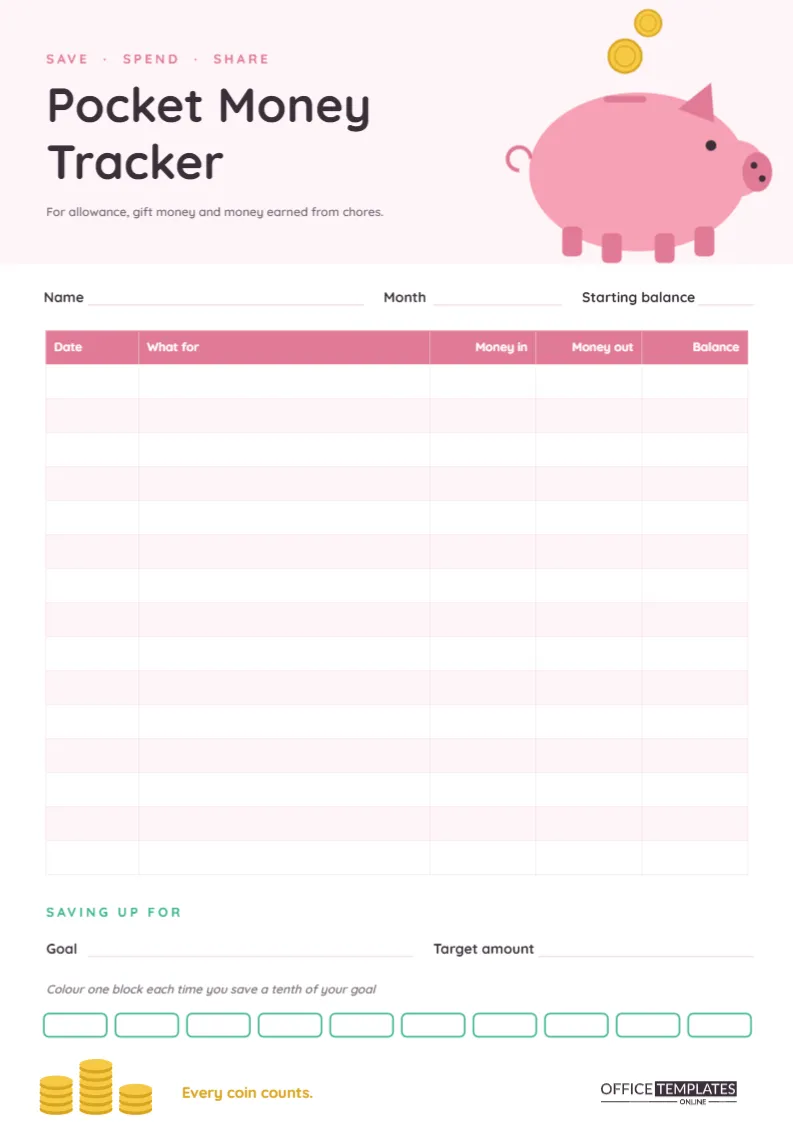
The A4 portrait page (210 x 297 mm) opens with a pale pink header and a friendly pink piggy bank on the right. It has a coin slot on its back, a pointed ear, a round snout, four sturdy legs, and a curly tail, and two gold coins are dropping towards the slot. On the left, a pink line reads Save · Spend · Share above the title Pocket Money Tracker in rounded Quicksand lettering, with the note For allowance, gift money, and money earned from chores.
At the bottom of the page, three small stacks of gold coins stand beside the words Every coin counts. and our logo.
How the Ledger Works
After lines for Name, Month, and Starting balance, a pink-headed table with fifteen rows has five columns: Date, What for, Money in, Money out, and Balance. Amounts are right-aligned, the way accountants write them, so the numbers line up for easy adding. There is no currency symbol printed, so the tracker works with dollars, pounds, euros, rupees, or any other money.
Below the ledger, a Saving Up For section has lines for a Goal and a Target amount, and a row of ten mint-outlined blocks to colour in, one for each tenth of the goal saved.
A Worked Example Month
Here is how the first few lines might look for a nine-year-old who starts the month with 4.00 and is saving for a football.
| Portion | Share of each amount | Used for |
|---|---|---|
| Save | About half | The goal in the Saving Up For box |
| Spend | About 40% | Treats, small toys, outings with friends |
| Share | About 10% | Gifts, charity, or helping someone |
The Balance column is the heart of the tracker: add money in, subtract money out, and the running total always shows exactly what is left. It is also brilliant mental arithmetic practice.
Save, Spend, Share: Splitting the Money
The three words in the header describe a popular way to teach children about money. Each time money comes in, it is divided into three purposes. A common starting split looks like this:
| Date | What for | Money in | Money out | Balance |
|---|---|---|---|---|
| 1st | Weekly pocket money | 5.00 | 0.00 | 9.00 |
| 3rd | Comic | 0.00 | 2.50 | 6.50 |
| 6th | Washed the car | 3.00 | 0.00 | 9.50 |
| 8th | Weekly pocket money | 5.00 | 0.00 | 14.50 |
| 10th | Gave to school charity day | 0.00 | 1.00 | 13.50 |
| 12th | Birthday money from Gran | 10.00 | 0.00 | 23.50 |
Families adjust the percentages to suit their values and the child’s age. What matters is that the decision is made when the money arrives, not at the shop counter.
Setting a Savings Goal That Motivates
Pick a goal the child really wants, with a price that can be reached in weeks, not years. Write it in the Goal line and the price in Target amount. Then divide the target by ten: that is the value of each block. Every time the savings grow by that much, the child colours a block. Watching the row fill up is exactly the encouragement that makes saving feel possible, and reaching the tenth block is a genuine achievement worth celebrating.
Money Conversations the Tracker Makes Easier
The ledger gives families something concrete to talk about, which is much easier than discussing money in the abstract. At the end of each month, sit down together and ask a few questions. What did you spend the most on? Was it worth it? Did anything you bought turn out to be disappointing? How close are you to your goal, and how many weeks will it take at this rate? Children quickly start to notice the difference between wants and needs, and between things that bring lasting enjoyment and things that are forgotten by the weekend. Those small realisations, discovered for themselves on their own tracker, stay with them far longer than advice from an adult.
It is also a good moment to praise good decisions: a month where the child chose to wait for something better, or gave some money to a cause they cared about.
Personalising the Tracker
- Double-click the ledger to open Edit Table Data. Add rows for a busy month, or add a column such as Save/Spend/Share to record which pot each amount came from.
- Change the subtitle to match your family’s system, for example, Allowance, chores, and birthday money.
- Click the piggy bank to recolour it; the pig, its legs and its coins are grouped into one object.
- Older children can rename the page Budget Tracker and use it for a phone top-up or bus pass as well.
Printing and Keeping Records
Print on A4 at Actual size. The pink header and piggy bank use moderate ink; the ledger itself is mostly white. Print one page per month and keep the pages in a folder with the child’s name on it. Looking back over a few months together shows real patterns, such as money disappearing on the same snack every week, which is a far more powerful lesson than any lecture.
Pocket Money Tracker Questions
What age should children start tracking money?
Around six or seven, with help. By nine or ten, most children can keep the ledger themselves.
Should parents check the balance?
A quick weekly look together is ideal. It keeps the maths honest and makes money a normal, comfortable topic.
Can it be used for a class business or fundraiser?
Yes. Rename it and use Money in for sales and Money out for costs; the Balance column works just the same.
Watch the Piggy Bank Grow
Write the starting balance, choose a goal, and record the next coin that comes in. Every line is a small step towards a child who understands money.