Some days need a full planner. Most days just need a list. This daily to-do list is for the ordinary school day: a few assignments, a couple of chores, something to bring tomorrow, and that one thing you really must not forget. It is quick to fill in, satisfying to tick off, and it looks good enough to keep on the desk.
A Clipboard You Never Have to Carry
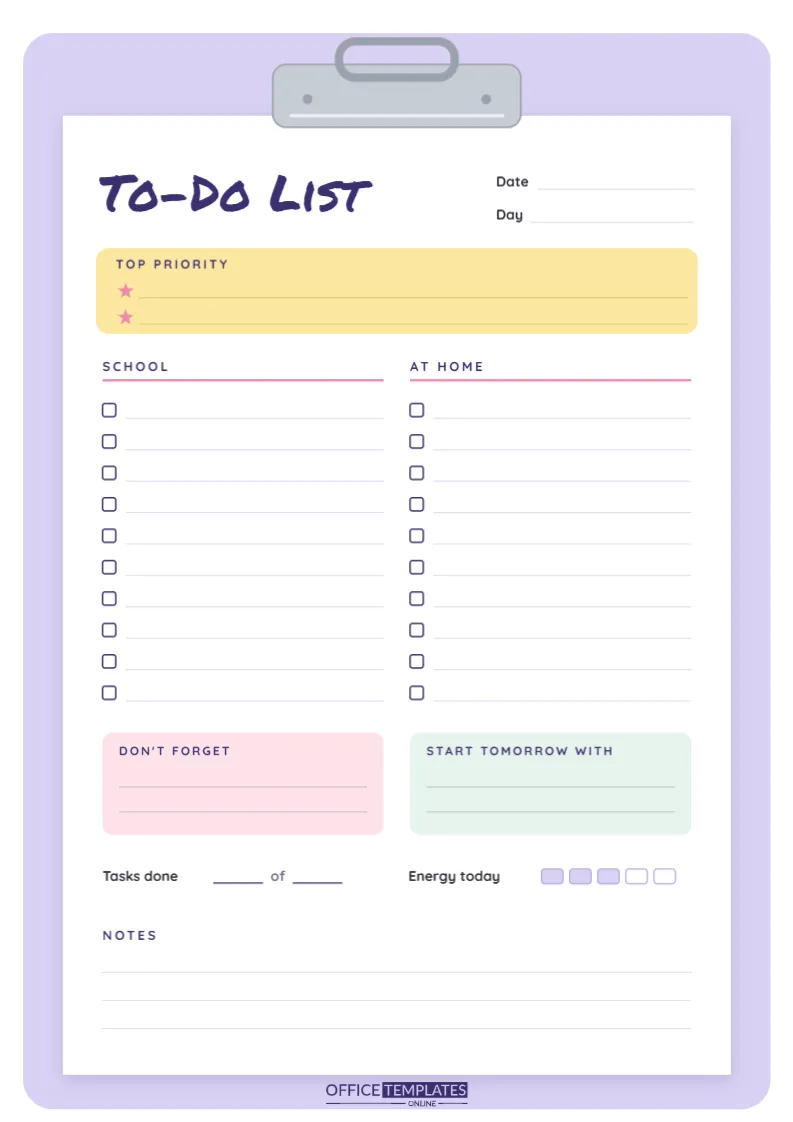
The whole A4 portrait page (210 x 297 mm) is drawn as a lilac clipboard. A soft purple board with rounded corners frames the page, and a silver clip with a looped handle and two rivets holds a white sheet of paper at the top. The paper has a gentle shadow, so it seems to sit on the board. Our logo is printed on the board itself, below the sheet, like a maker’s mark.
The title, To-Do List, is written in Permanent Marker, a bold, hand-drawn font that looks like someone grabbed a marker and wrote it at the top of the page. Date and Day lines sit to its right.
The Parts of the List
- Top Priority: a pale yellow strip with two lines, each marked with a pink star. These are the two jobs that decide whether today was a good day.
- School: ten tick boxes under a pink rule, for assignments, reading, forms, and messages to teachers.
- At Home: ten more tick boxes for chores, practice, family jobs, and anything personal.
- Don’t Forget: a blush-pink note for small but important items.
- Start Tomorrow With: a mint note for the first thing to do tomorrow, so you never start the morning wondering what is next.
- Tasks done ___ of ___: a simple scoreboard for the end of the day.
- Energy today: five small boxes to shade, from exhausted to full of beans.
- Notes: three lines for anything else.
Before and After: Turning a Messy List Into a Plan
Most to-do lists start as a brain dump. Here is a real-looking example of what a student might scribble on a Tuesday, and where each item ends up on this page.
| The scribbled version | Where it goes on the clipboard |
|---|---|
| Science thing?? due thurs | Top Priority: Science poster, finish diagrams (due Thu) |
| Maths ex 5 | School: Maths exercise 5, Q1-10 |
| Ask Ms Lee about trip | School: Ask Ms Lee about trip money |
| Clean room!!! | At Home: Tidy desk and put clothes away |
| Piano | At Home: Piano, 20 minutes |
| Mum’s birthday card | Don’t Forget: Buy card for Mum (Sat) |
| Too tired to start essay | Start Tomorrow With: Essay plan, before school |
The difference is small but powerful: every item becomes a specific action, the important ones rise to the top, and tomorrow already has a starting point.
Why the Energy Meter Is There
A list that ignores how you feel sets you up to fail. On a low-energy day, shade one or two boxes and choose easier tasks first; on a high-energy day, tackle the hardest item on the list early. Over a few weeks, the shaded boxes also reveal patterns, such as Mondays after late weekends or days with double PE, which helps students and parents plan better.
A Ten-Minute Evening Routine With the List
The list works best as the last step of the school day rather than the first step of the next one. After dinner, take a fresh sheet and write the date. Empty the school bag and look through every notebook and message; each piece of homework becomes a line in the School column. Next, add home jobs, practice, and anything a parent has asked for. Then read both columns and choose the two items that matter most for the Top Priority strip. Finally, fill in Start Tomorrow With, so the morning already has a first step. The whole routine takes about ten minutes, and it replaces the familiar bedtime worry of Did I forget something? with a clear, written plan.
Personalise the Clipboard
- Click School or At Home to rename a column, for example, Study and Life, or Class and Club.
- Click the clipboard board and pick another colour: mint, sky blue or peach all work with the white sheet.
- Replace the two headings on the small notes with your own, such as Bring and Buy.
- Type recurring tasks (practise instrument, pack bag) straight onto the lines in the editor before printing, so only the day’s extras need writing by hand.
Print a Pad of Them
The page is designed for printing in batches. Download the PDF, print twenty copies on A4 at Actual size, and staple or clip them together into a pad that sits on the desk. The lilac border is light, so ink use stays modest. If you want an actual clipboard feel, clip the stack to a real board; the printed clip lines up nicely at the top. For tablet users, a PNG download makes a reusable digital to-do page.
Five Small Rules for a Better Daily List
- Fill it in at the same time each day, either the evening before or first thing after school.
- Keep the Top Priority to two items. If everything is a priority, nothing is.
- Write tasks as actions: read chapter 4, not English.
- Move unfinished tasks to tomorrow’s list instead of leaving them forgotten on an old page.
- Count your ticks at the end of the day and celebrate a good score.
To-Do List FAQs
Is this suitable for younger children?
Yes, with a parent’s help. Younger children love ticking boxes; write three or four tasks for them and let them shade the energy meter themselves.
Can I use it for weekends or holidays?
Absolutely. Rename the School column to Projects or Fun, and it becomes a weekend list.
Why only ten boxes per column?
Ten is plenty for one day. A longer list tends to discourage rather than help.
Clip It, Tick It, Done
Print a stack, keep it by your books, and start each afternoon with a fresh sheet. The satisfaction of a full column of ticks is the best study habit there is.