Fridays tend to end in a rush: last lessons, a packed bag, the weekend. Taking ten minutes to look back before the week disappears is one of the most underrated study habits there is. Reflection helps students notice what worked, understand what did not, and walk into Monday with a small plan instead of a vague feeling.
This weekly reflection sheet makes that ten minutes friendly and quick by borrowing the language everyone already uses to describe a week: the weather.
A Weather Report for Your Week
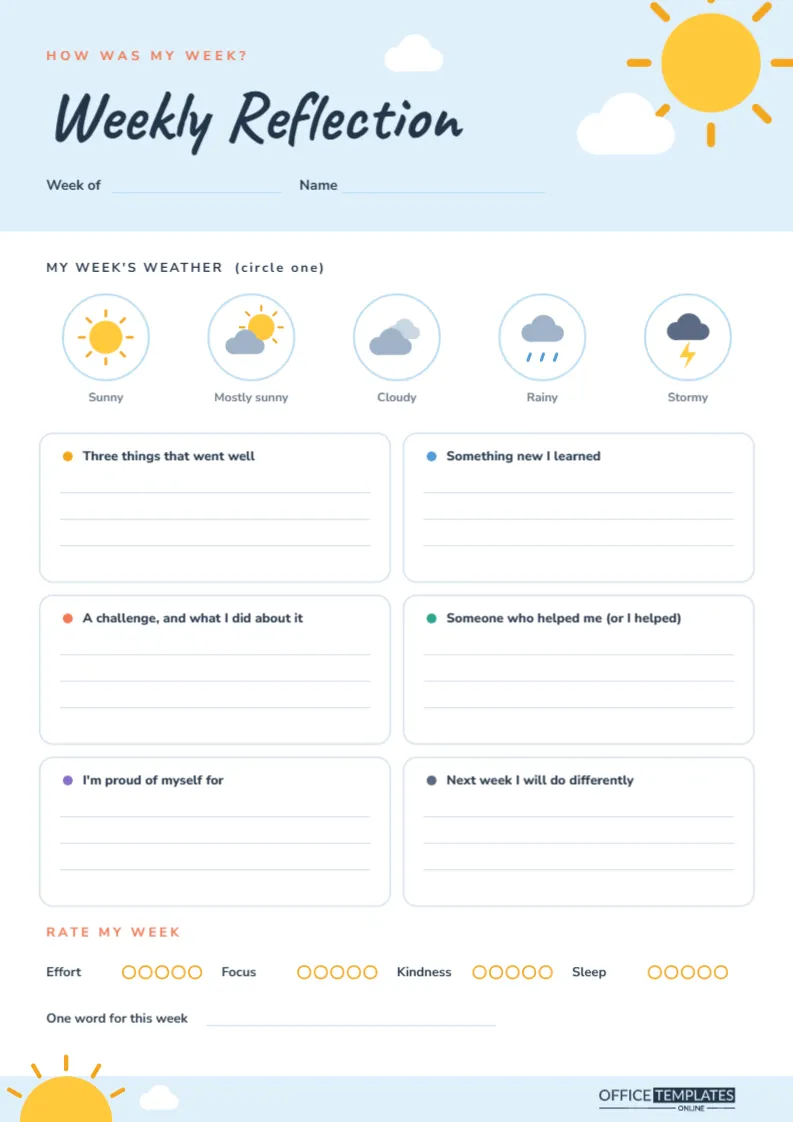
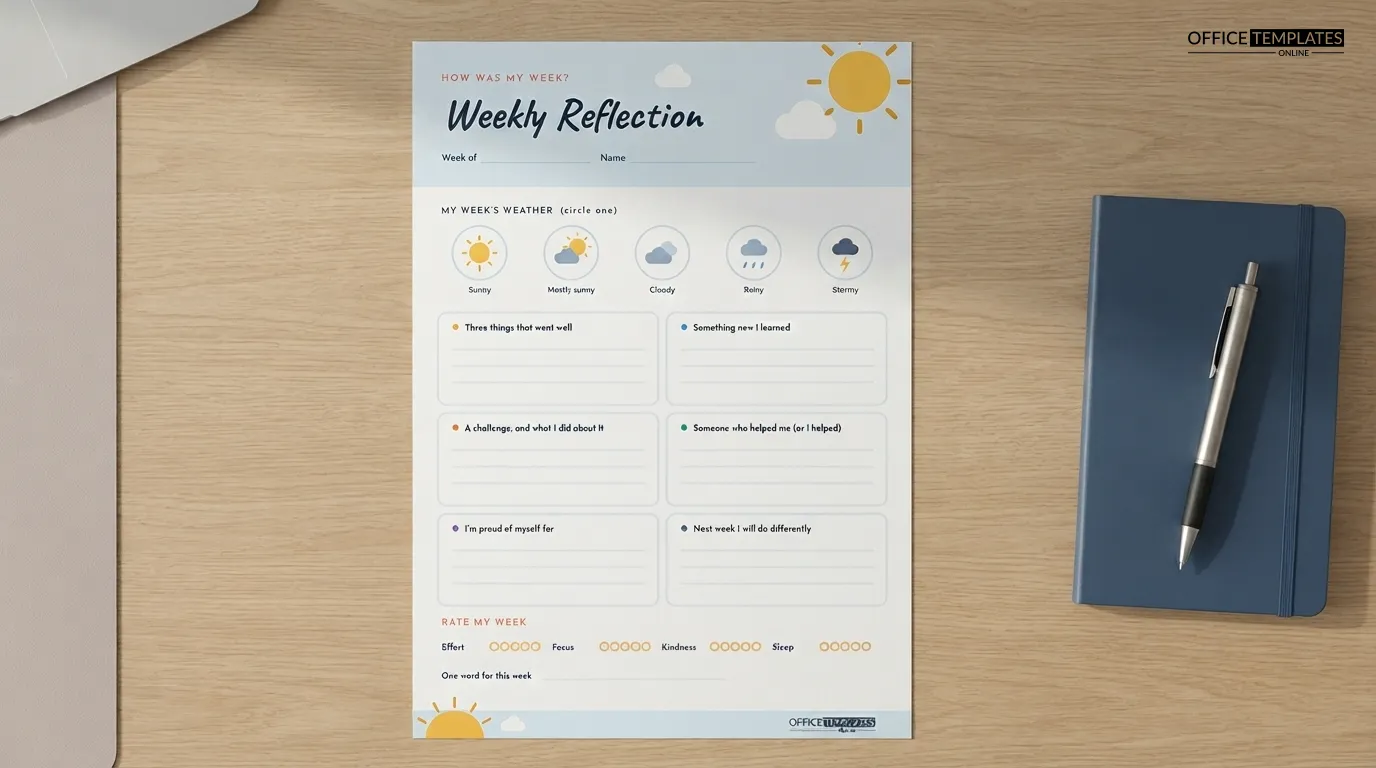
The page is A4 portrait (210 x 297 mm) with a pale sky-blue header. A big yellow sun with orange rays shines from the top right corner, half hidden behind a white cloud, and a smaller cloud drifts nearby. A coral How was my week? question sits above the title Weekly Reflection, written in the relaxed handwriting of the Caveat font, with lines for Week of and Name.
Just below the header is the heart of the design: My Week’s Weather (circle one). Five round badges show Sunny, Mostly sunny, Cloudy, Rainy, and Stormy, each drawn with simple suns, clouds, raindrops, and a lightning bolt. Students circle the one that best matches their week. At the bottom of the page, a sun rises from the corner of a sky-blue band, next to our logo.
Six Reflection Cards
The middle of the page holds six rounded cards in two columns, each with a coloured dot and three ruled lines:
- Three things that went well
- Something new I learned
- A challenge, and what I did about it
- Someone who helped me (or I helped)
- I’m proud of myself for
- Next week I will do differently
Beneath them, Rate My Week asks for a score out of five for Effort, Focus, Kindness, and Sleep by filling in small circles, and a final line asks for one word for this week.
Sentence Starters for Each Card
A blank card can freeze a writer. These starters help students who are not sure what to say. Teachers can read one aloud, or print them on the back of the sheet.
| Card | Try starting with… |
|---|---|
| Went well | I finally…, I was pleased when…, The best lesson was… |
| Learned | I didn’t know that…,Now I understand how…, A new word I learned is… |
| Challenge | I found it hard to…, At first I…, so I tried… |
| Helped | ___ helped me by…, I helped ___ when… |
| Proud | I kept going even though…, I was brave when… |
| Differently | Next week I will start… earlier, I’ll ask for help with… |
What the Weather Picture Tells a Teacher
The weather circle is quick for students and surprisingly informative for adults. A class where most pupils circle Sunny is probably in a good rhythm. A cluster of Rainy and Stormy weeks might point to a heavy assessment load, a friendship problem, or tiredness near the end of term. Because the icons need no words, the page also works well for younger pupils and for students still learning English, who can share how they feel before they can explain it.
For parents, the circle is a gentle conversation opener: I see you had a cloudy week. What happened on the cloudy days? is easier than How was school?
Rate My Week: Four Honest Scores
The four ratings are chosen deliberately. Effort and Focus are about learning. Kindness reminds students that school is also about how we treat each other. Sleep is included because it quietly affects all the others. Over several weeks, the scores reveal links: low sleep scores often sit next to low focus scores, which is a more convincing argument for an earlier bedtime than any lecture.
Closing the Loop on Monday
Reflection only pays off when it changes something. The last card, Next week I will do differently, is the bridge. On Monday morning, before the first lesson, reread that card and copy its sentence into your planner or onto a sticky note on your pencil case. On the following Friday, the first question to ask is simple: did I do it? Over a term, those small promises add up to real improvement, and students start to trust their own ability to change how a week goes.
Making the Page Your Own
- Click any card heading to change the question. A sports coach might use A skill I practised; a music teacher, A piece I improved.
- Rename the four ratings, for example Homework, Reading, Friendship and Fitness.
- Change One word for this week to My goal for next week if you prefer a forward-looking finish.
- Recolour the sky header to match a class theme; the weather badges stay clear on any pale colour.
Printing and Collecting
Print on A4 at Actual size. The pale sky and small icons are light on ink, so colour printing is inexpensive. Teachers can run off a class set each week and keep the returned sheets in each student’s folder; after a term, flicking through a pupil’s weeks gives a real sense of their journey. At home, a ring binder of reflections becomes a quiet diary of the school year.
Making Reflection a Weekly Ritual
Consistency matters more than depth. Choose a regular slot, such as the last ten minutes of Friday’s final lesson, Sunday afternoon at the kitchen table, or the car ride home. Keep the tone light and never grade the answers. Adults can model it by filling in a sheet about their own week, which shows children that everyone has cloudy days.
Weekly Reflection FAQs
What age is this suited to?
Roughly seven to fourteen. Younger children can draw instead of writing on the cards; older students can write more on the back.
How long should it take?
About ten minutes. The weather circle and ratings take seconds, and the cards need only a line or two each.
Should reflections be shared?
Let students choose. Many will happily share the weather and ratings but prefer to keep a card or two private.
Forecast: A Better Week Ahead
Print a sheet this Friday, circle the weather, and fill in the cards. Next week, check the do differently card on Monday morning, and see if the forecast improves.