I want to do better at school is a wish. I will raise my maths test average from 64 to 72 by the end of term by doing ten practice questions three evenings a week is a goal. The difference is detail, and the SMART framework is the simplest way to add it. This worksheet walks a student through each step on one page, with a mountain to climb along the way.
The Summit Design
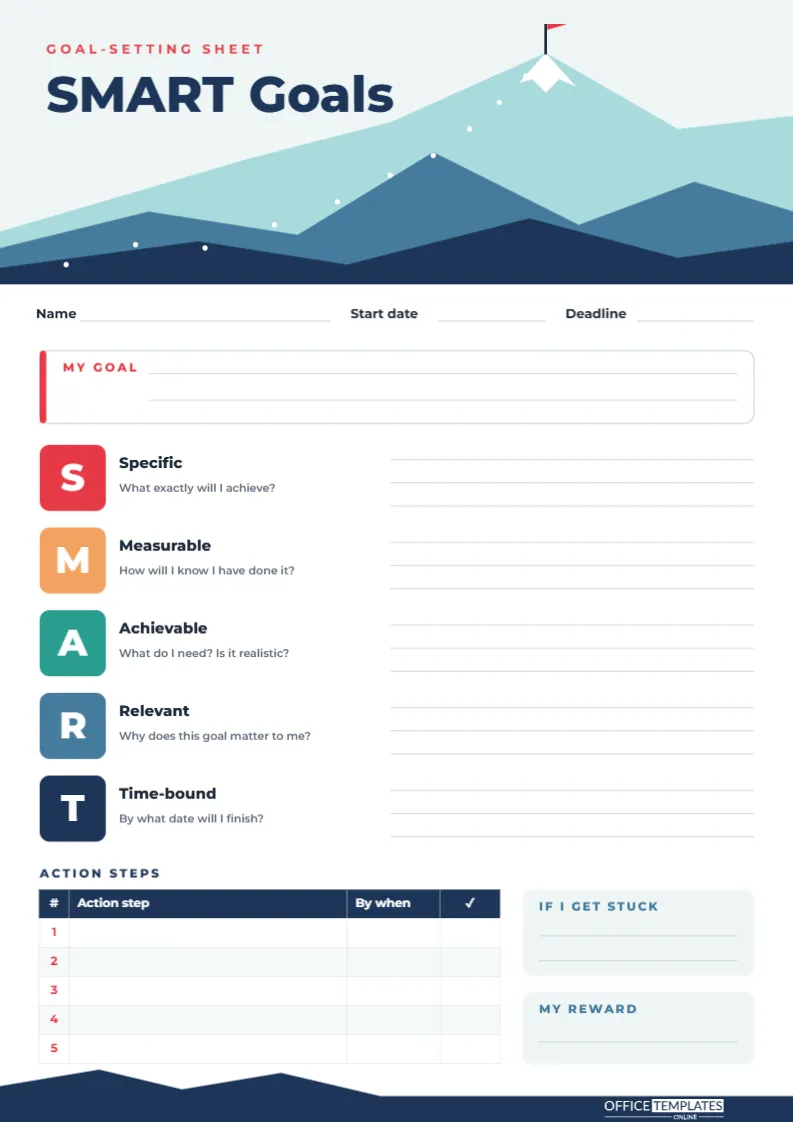
The page is A4 portrait (210 x 297 mm). Its header is a soft, pale sky with a mountain range rising across it in three layers: pale aqua peaks at the back, steel blue in the middle, and deep navy in front. The tallest peak wears a white snow cap, and a small red flag flies from a pole at the summit. A trail of white dots zigzags up the slopes from the lower left to the flag, the route from where you are to where you want to be.
Above the mountains, a red Goal-setting sheet label sits over the title SMART Goals in heavy Montserrat. The footer is a smaller navy ridge along the bottom edge carrying our logo in white, so the page starts and finishes in the mountains.
How the Page Is Organised
- Name, Start date, and Deadline lines under the header.
- My Goal: a white box with a red edge and two lines for the goal in your own words.
- The SMART rows: five coloured letter tiles down the left, each with a heading, a guiding question, and three ruled lines.
- Action Steps: a navy-headed table with five numbered steps, a By When column, and a tick column.
- If I Get Stuck and My Reward: two pale boxes on the right.
The Five Letters and Their Questions
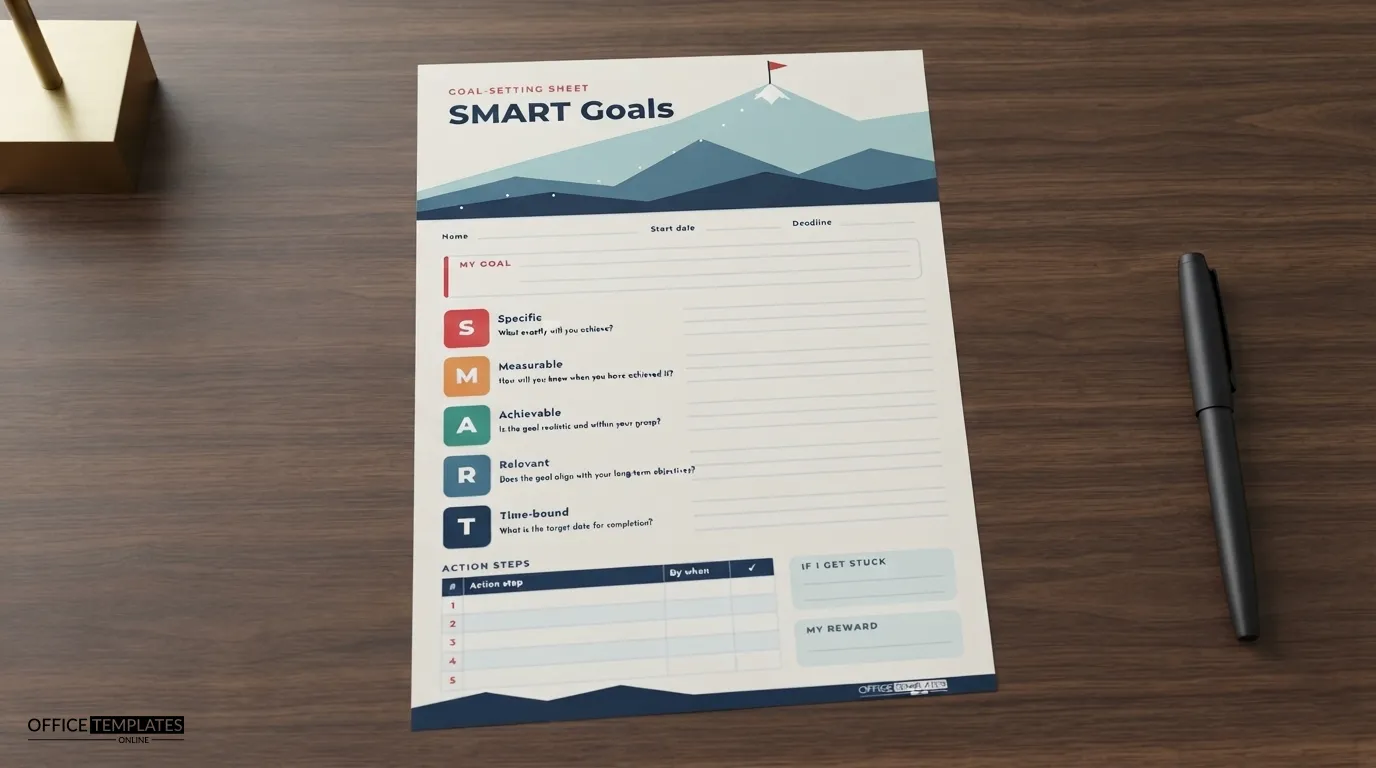
- S, Specific (red tile): What exactly will I achieve?
- M, Measurable (orange tile): How will I know I have done it?
- A, Achievable (teal tile): What do I need? Is it realistic?
- R, Relevant (blue tile): Why does this goal matter to me?
- T, Time-bound (navy tile): By what date will I finish?
Answering all five turns a hopeful sentence into a plan you can check, which is exactly what makes SMART goals more likely to succeed.
A Completed Example
Seeing a finished sheet makes it easier to write your own. Here is how a thirteen-year-old might fill in the page for a reading goal.
| Section | What they wrote |
|---|---|
| My Goal | Read more books and get better at English. |
| Specific | Finish six novels this term, at least two from genres I don’t usually read. |
| I need a library card and 20 minutes each night. | |
| Measurable | I will log each book in my reading log with the date I finish it. |
| Achievable | Six books in twelve weeks is one every two weeks. |
| Relevant | My teacher says wider reading will help my essays, and I want a higher English grade. |
| Time-bound | By 15 December. |
| Action step 1 | Join the town library (by Saturday). |
| If I get stuck | Ask the librarian for a shorter book, or switch to an audiobook for one title. |
| My reward | Choose a new book to buy with my own pocket money. |
Writing Good Action Steps
Goals are reached through steps, and the Action Steps table is where the plan becomes practical. Each step should be something you could start today, finish in a week or less, and tick off clearly. Study harder is not a step; making flashcards for chapter 3 is. Put a realistic date in the By When column for every step. If a step feels too big to start, it probably needs splitting into two rows.
Planning for Obstacles
The If I Get Stuck box is based on a simple idea: people who plan for problems handle them better. Before starting, think about what is most likely to go wrong, such as a busy week, losing motivation, or not understanding the work, and write what you will do. If I miss two sessions, I’ll do a double session on Sunday is the kind of sentence that rescues goals.
Customizing the Worksheet
- Click any text to retype it. Teachers sometimes change the guiding questions to suit younger pupils, for example, How will I show I did it?
- Double-click the Action Steps table to open Edit Table Data, add rows for longer goals, or rename By When to Deadline.
- The mountain range and flag are grouped into one object; select it to move or recolour the whole scene together.
- Use Add Page to make a second sheet for a different goal, so academic and personal goals sit in one file.
Printing and Revisiting
Print on A4 at Actual size. The pale sky and layered mountains use moderate ink; the rest of the page is white. Keep the sheet somewhere you will see it at least once a week, such as the inside cover of your planner. Set a reminder to review it halfway to the deadline: tick finished steps, adjust dates if needed, and note what is working.
Who Uses SMART Goal Sheets
Teachers use them at the start of a term or after report cards. School counsellors use them in one-to-one sessions. Parents use them to turn New Year’s resolutions into something children can actually achieve. And older students use them on their own for exam targets, sports improvements, saving money or learning a skill.
SMART Goal Sheet Questions
How big should a student’s goal be?
Big enough to matter, small enough to finish in a term or less. Longer ambitions can be broken into several SMART goals.
Can younger children use this?
Yes, with an adult helping to write the answers. Keep the goal very concrete, such as learning the six times table by Friday.
What if the goal turns out to be unrealistic?
Change it. Adjusting a goal is not failure; it is the Achievable question doing its job.
Plant Your Flag
Write one goal today and answer the five questions. By the deadline, you will have climbed to a summit of your own choosing.