Football on Tuesdays, piano on Wednesdays, drama club after school on Thursday, and a swimming gala on Saturday. After-school life can be as full as the school day, and it comes with its own kit, fees, contacts and changing times. An activities planner puts it all on one page, so students know what to pack, and parents know where to be.
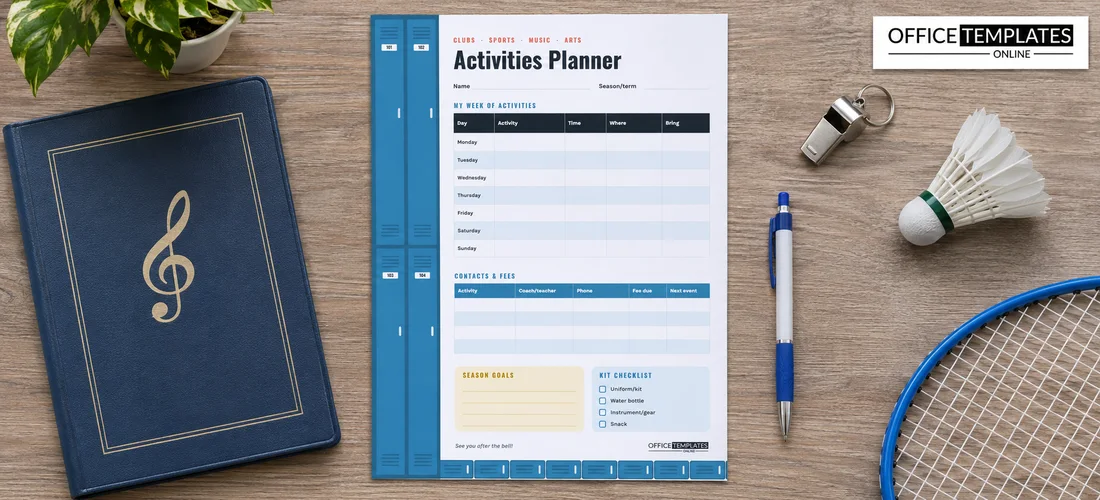
A Row of Lockers Down the Side
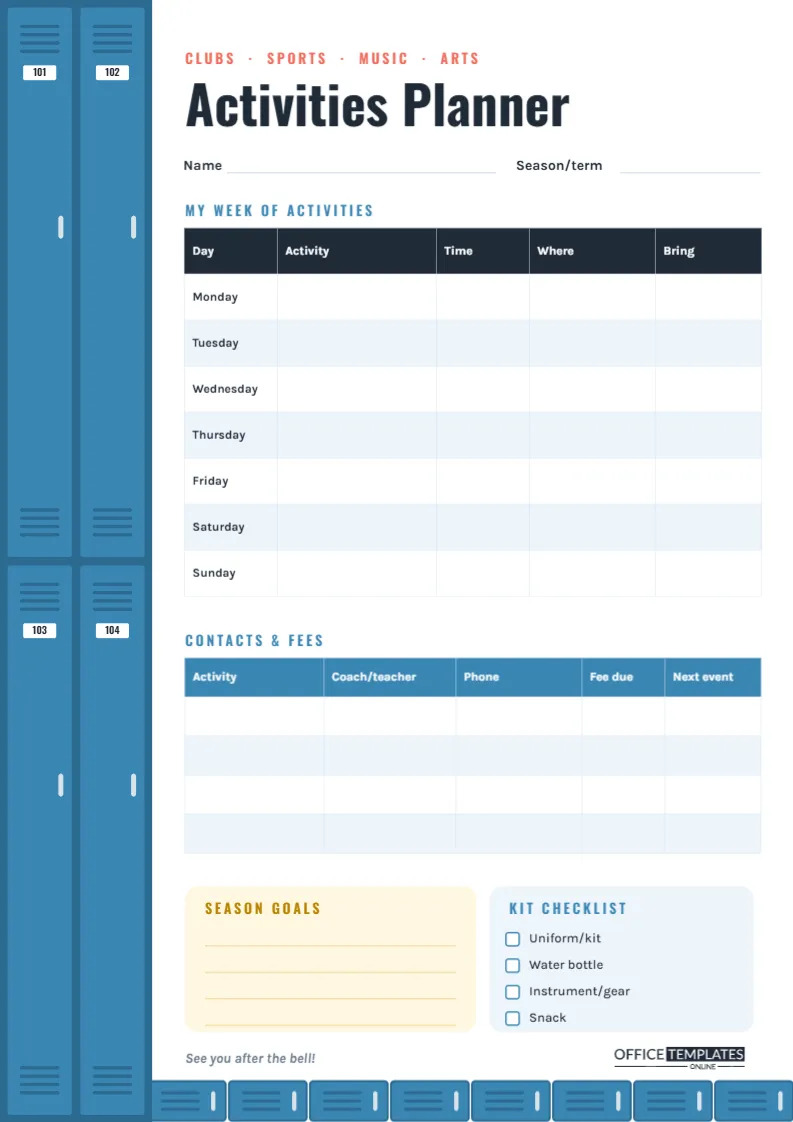
The design of this A4 portrait page (210 x 297 mm) is built around a school corridor. A bank of four tall blue lockers runs down the entire left edge, each with ventilation slots at the top and bottom, a silver handle, and a white number plate reading 101, 102, 103, and 104. Along the bottom of the page, a row of shorter lockers continues the corridor underneath the content, so the page feels framed by the place where the kit actually lives.
To the right of the lockers, a coral line reads Clubs · Sports · Music · Arts above the title Activities Planner in tall, condensed Oswald capitals. The line See you after the bell! and our logo sit just above the bottom lockers.
What the Planner Covers
My Week of Activities
A dark-headed table lists Monday to Sunday, each with columns for Activity, Time, Where, and Bring. It shows the rhythm of the week at a glance, including which evenings are free.
Contacts & Fees
A second, blue-headed table holds four activities with columns for Coach/teacher, Phone, Fee due, and Next event. This is the information parents usually hunt for in old emails.
Season Goals and Kit Checklist
A warm yellow card offers four lines for goals this season, and a pale blue card lists Uniform/kit, Water bottle, Instrument/gear, and Snack as tick boxes.
A Sample Busy Week
Here is how the weekly table might look for an eleven-year-old with a fairly full schedule.
| Day | Activity | Time | Where | Bring |
|---|---|---|---|---|
| Monday | Free | After school | Home | Nothing |
| Tuesday | Football training | 4:00-5:30 | School field | Boots, shin pads |
| Wednesday | Piano lesson | 5:00-5:30 | Mrs Ahmed’s | Music book |
| Thursday | Drama club | 3:30-4:30 | Hall | Script |
| Friday | Free | After school | Home | Nothing |
| Saturday | Swimming | 9:00-10:00 | Leisure centre | Towel, goggles |
| Sunday | Family day | All day | Grandparents’ house | Board games |
Writing “Free” in the empty days is deliberate. Rest days are part of the plan, not gaps in it.
Is the Week Too Full? A Quick Load Check
Activities are wonderful for confidence, fitness and friendships, but too many can crowd out homework, sleep and simple play. Once the weekly table is filled in, run through these questions together:
- Are there at least two evenings with nothing scheduled?
- Is homework still getting done before activities, not squeezed in after them?
- Is the student getting enough sleep on activity nights?
- Does every activity still feel fun, or has one become a chore?
- Can the family manage the driving and costs comfortably?
If two or more answers are no, it may be time to pause one activity for a term.
Setting Season Goals With a Coach or Teacher
The yellow Season Goals card is easy to skip, but it turns activities from something a student simply attends into something they are working towards. At the start of a season, ask the coach or teacher one question: what is the next step for this student? The answer might be learn to dive from the block, pass Grade 2 piano, learn all my lines by the dress rehearsal, or make the starting team. Write it on the card in the student’s own words, with a rough date. Halfway through the season, look at the card again together. Goals that come from the coach are usually realistic, and goals written by the student are the ones they care about.
At the end of the season, keep the page. A stack of old activity planners is a lovely record of everything a child tried, stuck with, and achieved.
Changing the Planner to Suit Your Week
- Double-click either table to open Edit Table Data. Add rows in Contacts & Fees if there are more than four activities, or rename Bring to Notes.
- Change the kit checklist items to suit your activities, such as Ballet shoes, Swim cap, or Sketchbook.
- Click the lockers and choose a different colour to match your school; the tall lockers are one group and the short lockers another.
- Retitle the page as Sports Planner, Music Schedule, or Club Calendar if you want one page per type of activity.
Printing the Planner
Print on A4 at Actual size. The blue lockers take up the left edge and the bottom, so colour printing uses a moderate amount of ink; if you print a new copy every term, that is perfectly manageable at home. Stick one copy on the fridge or family noticeboard and put another in the student’s bag or planner. When activities change mid-season, edit the saved design and print a fresh copy rather than crossing out.
Keeping the Contacts Section Useful
The Contacts & Fees table is most useful when it is complete. Fill in a phone number for every coach and teacher, because cancellations often come by text at short notice. Write fee due dates in full, including the month, and cross them off when paid. The Next event column is ideal for matches, concerts, exams, and gala dates, which families often need to plan around weeks ahead.
Activities Planner Questions
Is this for students or parents?
Both. Older students can manage it themselves; for younger children, it is the family’s shared reference.
Can it cover school clubs and outside clubs together?
Yes. The Where column makes it clear which are at school and which need a lift.
What about seasonal activities?
Print a new page each season. Season Goals then match what the student is working on at that time.
Pack the Right Bag Every Day
Fill in the week, add the contacts, and tick the kit list the night before each activity. With everything in one place, after-school life becomes something to enjoy rather than something to chase.