There is a particular satisfaction in looking back at a list of books you have finished. A Reading Log turns a term of quiet reading into something you can see, count, and be proud of. Teachers use reading logs to encourage regular reading at home; readers of every age use them to remember what they loved, what they abandoned, and what they want to try next.
A Shelf Full of Books Across the Top
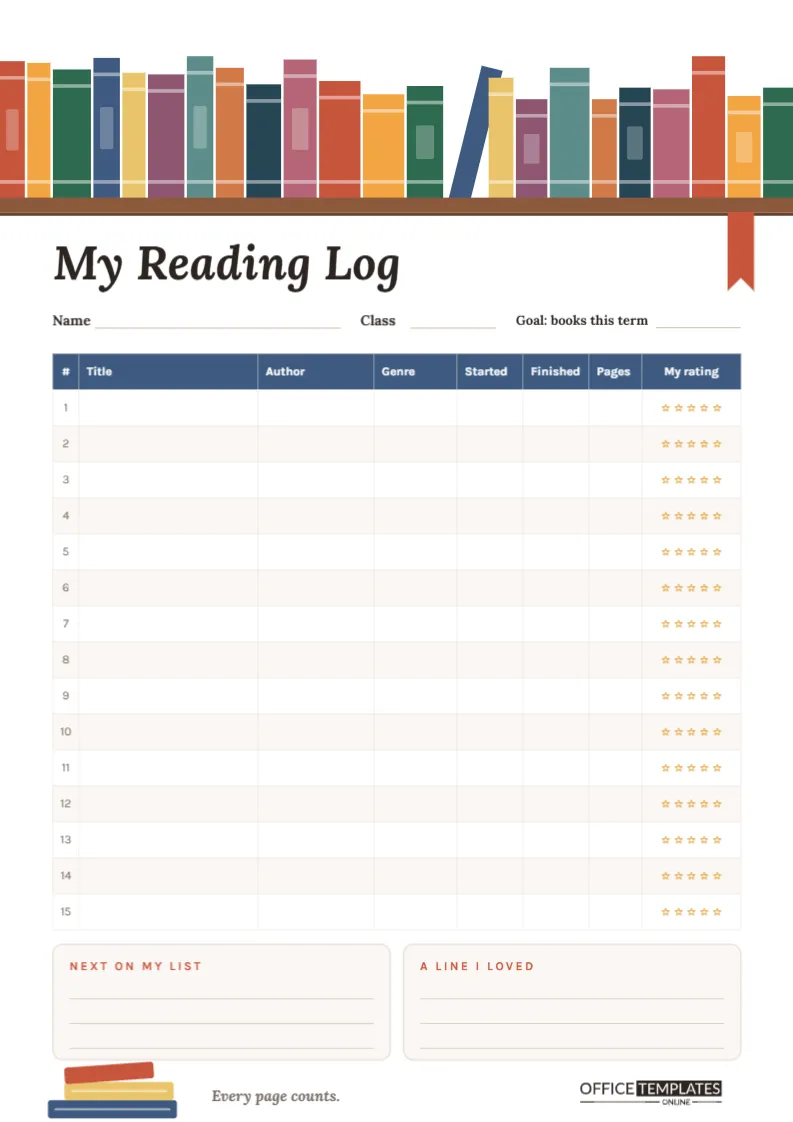
The header of this A4 portrait page (210 x 297 mm) is a wooden bookshelf packed edge to edge with book spines. They come in warm library colours, brick red, mustard, forest green, slate blue, plum and teal, in different heights and widths, with pale bands near the top and bottom like real cloth bindings. One book leans casually against its neighbour. Hanging from the shelf on the right is a red ribbon bookmark with a notched tail.
Below the shelf, the title My Reading Log is set in a bold italic Lora serif, the kind of type you find on a novel’s title page. A small stack of three books lies at the bottom left of the page beside the words Every page counts, echoing the shelf above.
What Goes in Each Column
Under lines for Name, Class, and a personal target (Goal: books this term) sits a fifteen-row table with a slate-blue header:
- # numbers each book, so your total is always visible.
- Title and Author.
- Genre: adventure, mystery, fantasy, biography, poetry, graphic novel, and so on.
- Started and Finished dates, which show how long each book took.
- Pages, useful for reading challenges that count pages rather than books.
- My rating, pre-printed with five empty stars to colour in.
Under the table are two cream cards: Next on my list for books you want to read, and A line I loved for a favourite sentence or quote.
What Each Star Means
Ratings are more useful when they mean the same thing every time. Agree on a scale with yourself, or as a class, and stick to it.
| Stars | Meaning | Would I recommend it? |
|---|---|---|
| 1 | Did not enjoy it or did not finish | No |
| 2 | Some good parts, but slow | Only to certain readers |
| 3 | A solid, enjoyable read | Yes, to friends who like the genre |
| 4 | Hard to put down | Yes, to most people |
| 5 | An all-time favourite | To everyone, immediately |
Genres Worth Adding to Your List
Reading logs have a hidden bonus: after a few weeks you can see your habits. If the Genre column says fantasy fifteen times, consider stretching a little. A few ideas for the Next on my list card:
- A biography of someone you admire
- A graphic novel or illustrated story
- A collection of poems or short stories
- A non-fiction book about animals, space, or inventions
- A classic your parents or grandparents read at your age
- A book set in a country you have never visited
Using the “A Line I Loved” Card
This small card does more work than it looks. Copying out a favourite sentence makes a reader slow down and notice how writers use words, which quietly improves their own writing. It also gives a reader something to share. When a friend asks whether a book is any good, a well-chosen line says more than it was fine. Try to choose one line from each book you finish and write the page number next to it. By the end of term you will have a small personal anthology of the moments that stayed with you, and a ready-made starting point for any book review or class presentation.
Younger readers can draw a tiny picture of their favourite scene instead of copying a line. Either way, the card turns the log from a list into a conversation about books.
For Teachers and Parents
Many schools ask pupils to read for twenty minutes each evening and record it. This log focuses on whole books rather than daily minutes, which suits independent readers from about age eight upward and keeps the record tidy. Teachers can set a class goal, check the log at the end of each half term, and use the A line I loved card as the start of a book talk. Parents can sign or initial the Finished column as each book is completed, a small ritual that younger readers enjoy.
Customizing the Log
- Double-click the table to open Edit Table Data. Add rows for a longer challenge, or rename columns, for example Minutes instead of Pages.
- Click the title to personalise it: Maya’s Reading Log or Class 5 Book Challenge.
- The bookshelf is a single grouped object, so you can move it or recolour its parts as one unit without disturbing the text below.
- Click the red ribbon to change its colour to match your school.
Printing the Log for Home and School
Print on A4 at Actual size. The bookshelf is the most colourful part of the page, but it is a narrow band, so the sheet is economical to print. If the log travels between school and home inside a reading folder, heavier 120 gsm paper survives better. Keep completed logs; stacked together at the end of the year, they make a lovely record of a reader growing up.
Reading Log FAQs
What counts as “finished”?
That is up to you or your teacher. Some readers log abandoned books with a one-star rating and a note, which is honest and still useful.
Can I log audiobooks?
Yes. Many readers add a small A after the title for audiobooks. They still build vocabulary and a love of stories.
How many rows does the log have?
Fifteen, which covers a term for most readers. Add a second page with Add Page when you fill it.
Fill the Shelf
Write your goal at the top, record the book you are reading right now, and let the list grow one line at a time. By the end of term, your own shelf will be as full as the one on the page.