Children feel big feelings every day, but they are not always given the words or the space to notice them. A few minutes with a gratitude and mood journal gives them both. Writing down three good things, naming a feeling, and letting go of one worry is a small ritual, yet teachers, counsellors, and parents often see real changes from it: calmer evenings, kinder words, and children who find it easier to talk about their day.
A Rainbow to Start the Day
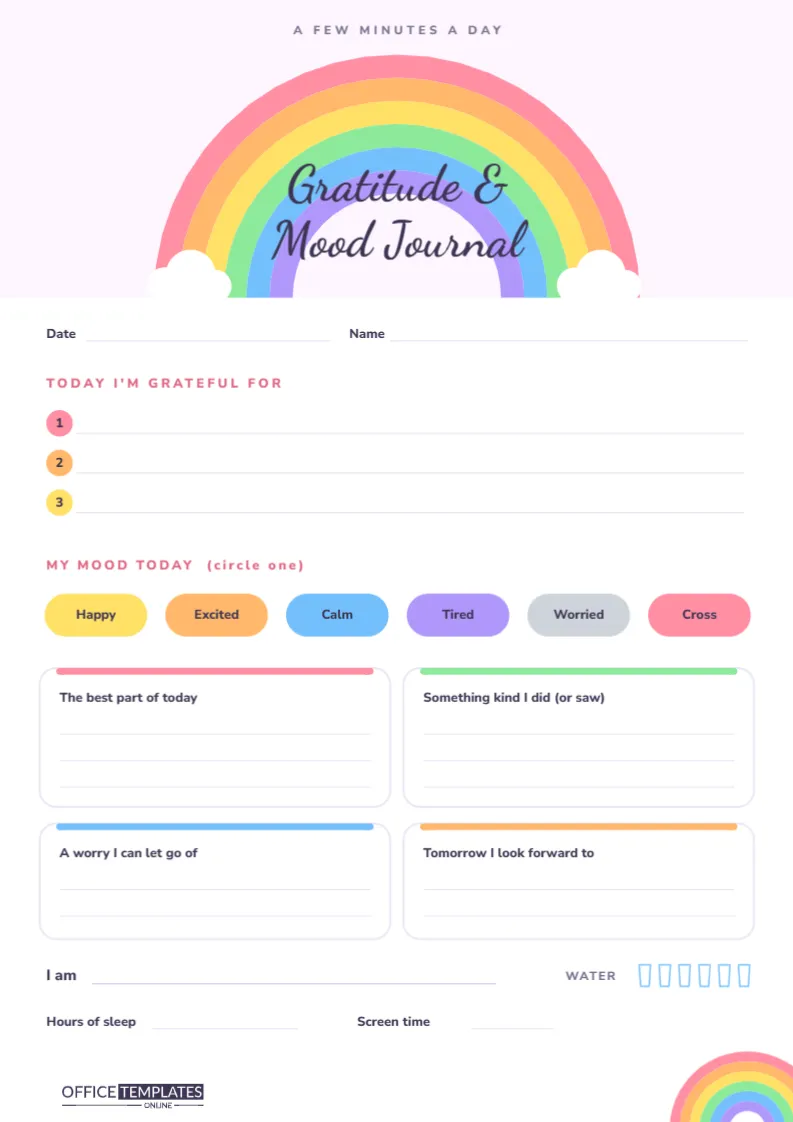
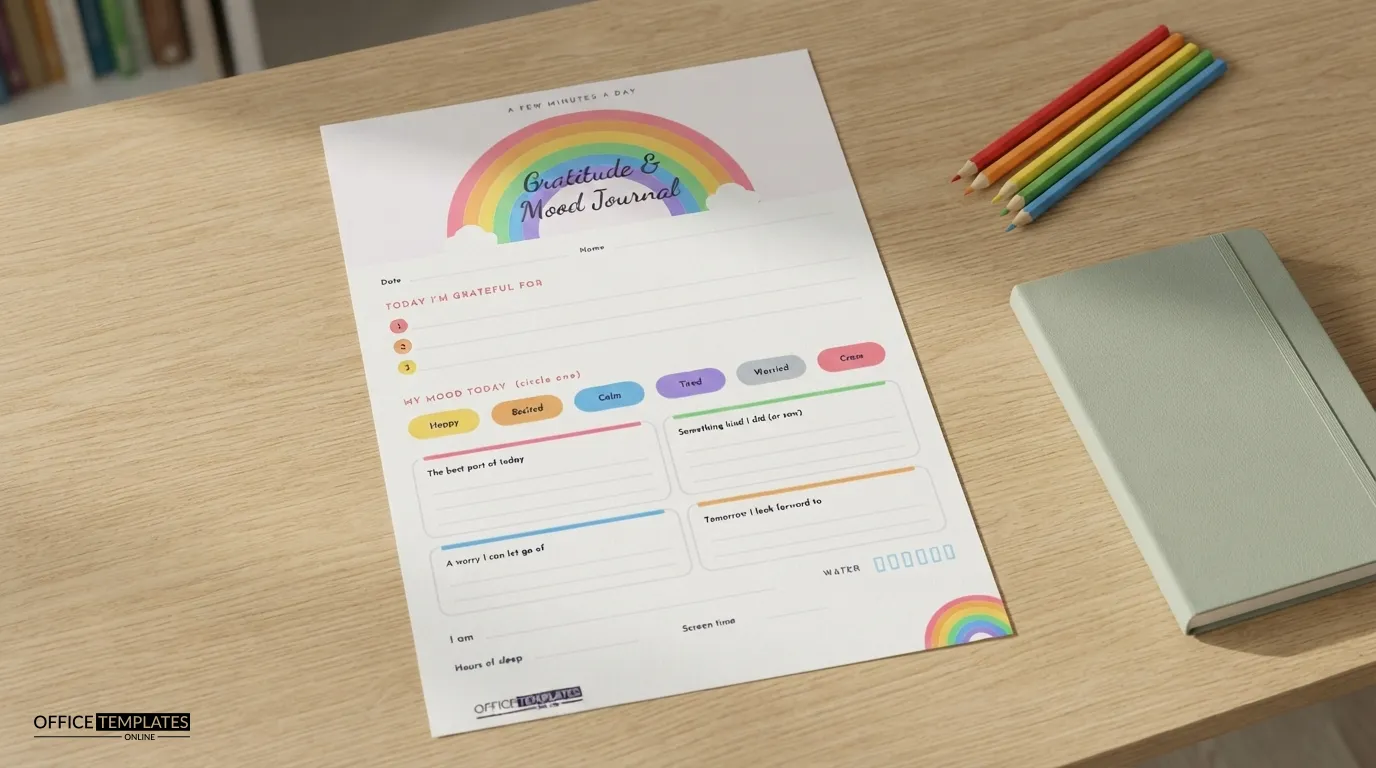
The top of this A4 portrait page (210 x 297 mm) is a soft lilac-white sky with a large pastel rainbow arching across it in six bands: rose pink, peach, butter yellow, mint, sky blue and lavender. A fluffy white cloud sits at each foot of the rainbow. Inside the arch, the title Gratitude & Mood Journal is written in flowing Dancing Script, and a small A few minutes a day line floats above the rainbow’s peak.
At the bottom right corner, a smaller rainbow peeks in from the edge of the page, so the day’s entry both begins and ends under a rainbow. Our logo sits quietly in the bottom left.
What the Page Asks
- Today I’m grateful for: three numbered lines, each marked with a rainbow-coloured circle.
- My mood today (circle one): six coloured pills labelled Happy, Excited, Calm, Tired, Worried and Cross.
- The best part of today and Something kind I did (or saw): two cards with ruled lines.
- A worry I can let go of, and Tomorrow I look forward to: two more cards.
- I am ___: a single line for a daily affirmation.
- Water: six small glasses to colour in, plus lines for Hours of sleep and Screen time.
Why Every Feeling Gets a Colour
The mood pills include comfortable feelings and uncomfortable ones on purpose. Worried and Cross sit right beside Happy and Excited, with no suggestion that some are good and others bad. For children, learning that all feelings are allowed, and that naming them helps, is one of the most valuable lessons a journal can teach. Many children find it easier to circle a colour than to say I felt anxious today out loud, so the pills open a door that a question sometimes cannot.
Fifteen Gratitude Prompts for Stuck Days
Some evenings the three lines feel hard to fill. Try one of these:
- A person who made me smile today
- Something delicious I ate
- A thing I can do now that I couldn’t do last year
- A place where I feel safe
- Something in nature I noticed
- A song, book, or game I enjoy
- A pet or animal I love
- Something funny that happened
- A teacher who helped me
- Something in my room I like
- A friend and why they are a good friend
- Something my body let me do today, such as running or dancing
- A problem that turned out all right
- Something I’m looking forward to
- A small comfort: a warm bed, a hug, a cup of cocoa
Ideas for the “I Am” Line
Affirmations work best when they are short and believable. Children can choose one each day or keep the same one for a week: I am brave. I am kind. I am learning. I am a good friend. I am allowed to make mistakes. I am getting better every day. Encourage children to pick the word they most need that day, not the one they think adults want to hear.
A Worry I Can Let Go Of
This card deserves a special mention. Writing a worry down moves it from the head to the page, which often makes it feel smaller. For younger children, a lovely addition is to fold the page corner over the worry card before bed, as if tucking it away for the night. Parents can read it (with permission) and gently follow up the next day if it seems important.
Making the Journal Your Family’s Own
- Click any card title to change the question. Something I learned or Someone I want to thank are popular swaps.
- Change the mood words to suit your child’s age, for example Silly, Proud or Lonely.
- Remove the screen-time line for younger children, or rename it to Outdoor time.
- The large rainbow and its clouds are one grouped object, so you can recolour the bands or move the whole rainbow together.
Printing and Keeping the Pages
Print on A4 at Actual size. The pastel rainbow is soft and uses little ink, so printing a month of pages at once is affordable. Keep them in a ring binder or bind them into a booklet, and let the child decorate a cover. A daily journal becomes a treasure over time; reading back through a term of entries is often a surprising reminder of how many good things happened. For older children who prefer screens, a PNG download works in any drawing or notes app.
Building the Habit
Attach the journal to something that already happens every day: after brushing teeth, before a bedtime story, or at the end of homework. Five minutes is plenty. Adults who fill in their own page alongside their child show that gratitude and feelings are for everyone, and it often leads to the best conversations of the day.
Gratitude Journal Questions
What age is this journal for?
It suits children from about six to twelve. Younger children can draw their gratitude items; older ones may write more than the lines allow.
Should parents read the journal?
Ask first. Many children love sharing, but respecting privacy keeps the journal honest.
What if my child circles Worried or Cross every day?
That is useful information, not failure. Talk gently about it, and if it continues, share it with a teacher or school counsellor.
Under the Rainbow, One Day at a Time
Print a page tonight, write three small good things, and circle how you feel. Tomorrow, do it again. The rainbow is waiting at the top of every page.