School mornings go wrong in the same ways in almost every home: a missing shoe, a forgotten lunch, a child still in pyjamas at ten to eight. Evenings have their own chaos: homework left late, a bag not packed, bedtime sliding later and later. A visual routine chart takes the nagging out of both. Children can see what comes next, tick it off themselves, and parents get to be encouragers instead of alarm clocks.
Day on One Side, Night on the Other
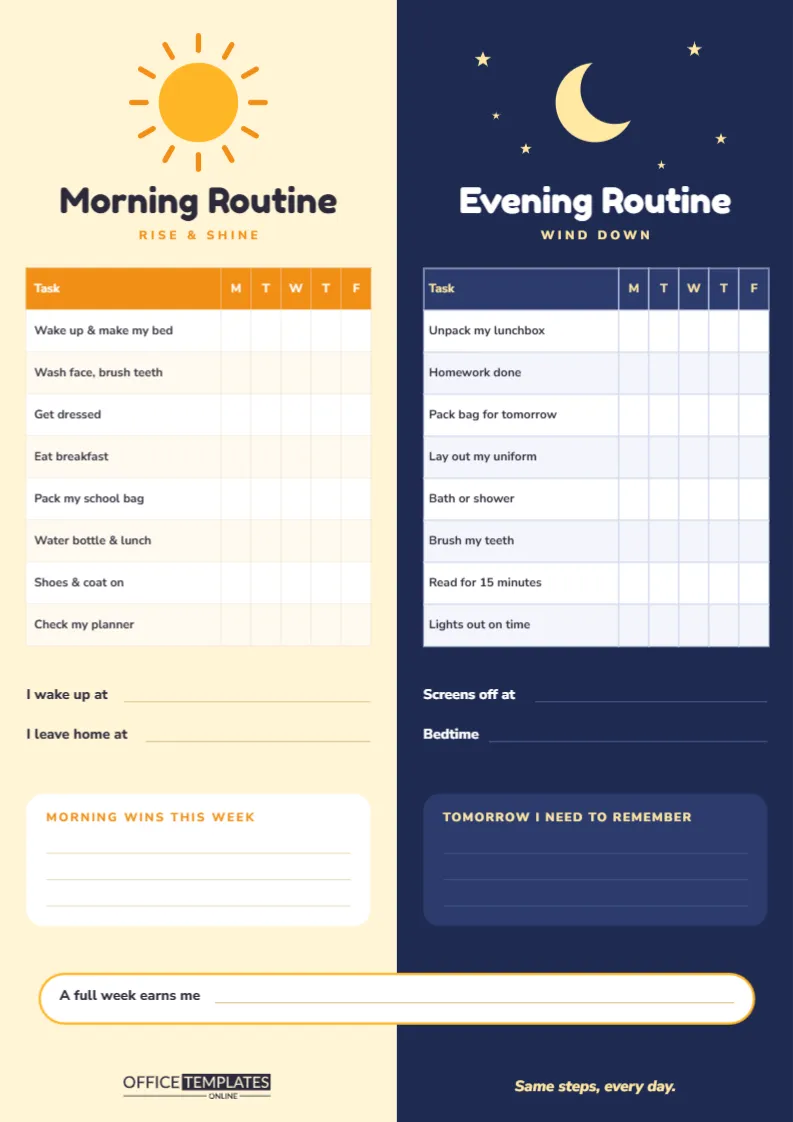
This A4 portrait page (210 x 297 mm) is split straight down the middle. The left half is a warm cream morning with a big golden sun and orange rays; the right half is a deep navy night sky with a pale crescent moon and a scattering of small stars. The titles match: Morning Routine in dark rounded Fredoka One with an orange Rise & Shine beneath it, and Evening Routine in white with a pale yellow Wind Down.
The split makes the idea of two routines instantly clear, even to children who cannot read yet. A rounded white banner stretches across both halves near the bottom, joining day and night together, with our logo on the morning side and the line Same steps, every day. on the evening side.
Sixteen Steps, Ticked Monday to Friday
Each half has its own table with a Task column and five narrow columns for M, T, W, T, and F.
Morning tasks: wake up and make my bed; wash face and brush teeth; get dressed; eat breakfast; pack my school bag; water bottle and lunch; shoes and coat on; check my planner.
Evening tasks: unpack my lunchbox; homework done; pack bag for tomorrow; lay out my uniform; bath or shower; brush my teeth; read for 15 minutes; lights out on time.
Under each table are two timelines. The morning side asks: I wake up at and I leave home at; the evening side asks: Screens off at and Bedtime. Writing the times down turns vague expectations into clear, agreed ones.
Notes, Wins and the Weekly Reward
A white card on the morning side collects Morning Wins This Week, such as being ready five minutes early on Wednesday. A navy card on the evening side holds Tomorrow I Need to Remember, for the permission slip or the non-uniform day. The banner across the bottom completes the sentence A full week earns me ___, so the child knows exactly what a week of ticks is working towards.
Adjusting the Routine by Age
The pre-filled tasks suit children of roughly six to ten, but routines should grow with the child. Use this table to adjust the steps in the editor.
| Age | Morning changes | Evening changes |
|---|---|---|
| 4 to 5 | Fewer steps; combine wash and brush; parent packs the bag | Replace homework with tidy toys; keep the story |
| 6 to 9 | Use the chart as it is | Use the chart as it is |
| 10 to 12 | Add check the weather, make my own breakfast | Add check tomorrow’s timetable, charge my device outside the bedroom |
| 13+ | Replace make my bed with 15 minutes of review | Add screens off one hour before bed |
Why Routines Help Children
Predictable routines reduce the number of decisions a child has to make when they are tired or rushed, which is exactly when decisions go badly. They also build independence: every tick is something the child did without being told. Teachers notice the difference too, because children who arrive with the right things and enough sleep are ready to learn. The evening routine matters just as much as the morning one; a calm, consistent wind-down is one of the most reliable ways to protect sleep.
When the Routine Wobbles
Holidays, illness, a new sibling, or a change of school can knock any routine off course. When that happens, go back to the chart rather than giving it up. Cut the list down to the four or five steps that matter most, write them in bold, and rebuild from there. Children often find comfort in the familiar sun and moon layout during a change, because it shows that some things stay the same.
Setting It Up Together
- Sit down with your child and read through the tasks. Change anything that does not fit your home.
- Agree on the times together and write them on the lines. Children follow rules they helped make.
- Choose the weekly reward together too. Small and meaningful works best: a later bedtime on Friday, choosing dinner, a trip to the park.
- Print the chart and put it where the routine happens, such as the bedroom door or the hallway.
- Praise the ticks, not just the finished week.
Editing the Chart Online
- Double-click either table to open Edit Table Data and retype the tasks. Add rows for extra steps like feed the cat or practise violin.
- Add Saturday and Sunday columns in the Table panel if you want weekend routines too.
- The sun and the moon-and-stars sky are separate grouped objects, so each can be moved or recoloured on its own.
- Change the reward sentence on the banner to suit your family.
Making the Chart Last All Term
Choose A4 and Actual size when you print. The navy half uses a fair amount of ink, so if you print a new chart every week, consider laminating one copy and using a dry-wipe marker for the ticks instead. Laminated charts also survive toothpaste splashes and breakfast spills much better. Fix it at child height so they can reach it easily.
Routine Chart FAQs
How long before the routine sticks?
Most families see a real difference within two or three weeks of using the chart consistently.
What if my child has two homes?
Print a copy for each home with the same tasks, so the routine stays the same wherever the child wakes up.
Should missed ticks be punished?
No. Simply try again tomorrow. The chart works through encouragement, not consequences.
Calmer Mornings Start the Night Before
Fill in the times, agree on the reward, and put the chart up tonight. Tomorrow morning, the sun side will show the way, and tomorrow night, the moon side will help everyone wind down.