Every strong reader and writer has something in common: a large, flexible vocabulary. It does not appear by magic. It grows word by word, each time a student meets an unfamiliar term, looks it up, and uses it until it belongs to them. A vocabulary log is where that growth is recorded, and this one is designed to make collecting words feel like a game.
Letter Tiles on a Rack
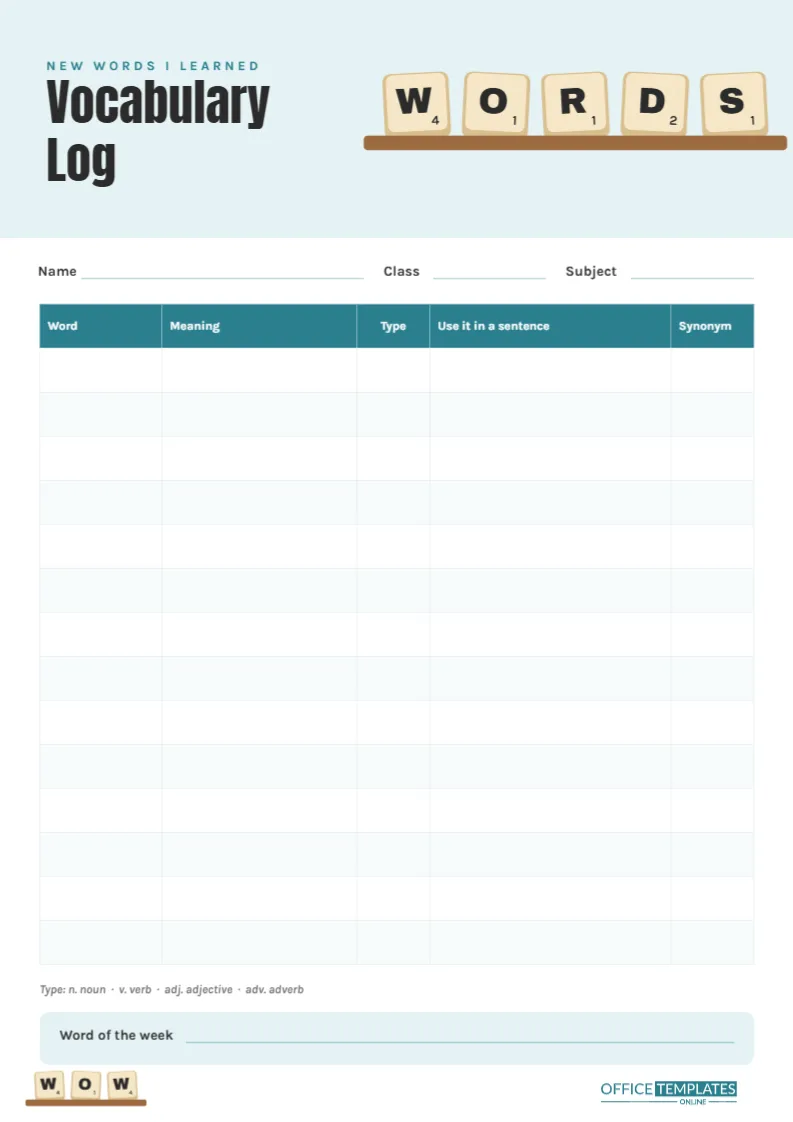
The header of this A4 portrait page (210 x 297 mm) is a soft teal band. On the right sits a wooden rack holding five cream letter tiles that spell WORDS, each tile tilted slightly and marked with a small point value in the corner, just like the pieces from a classic word board game. On the left, a teal New words I learned label sits above the title Vocabulary Log, stacked on two lines in the bold, friendly Righteous font.
At the bottom left, a smaller rack holds three tiles that spell WOW, the reaction every good new word deserves, beside our logo in teal.
Five Columns for Every Word
After lines for Name, Class, and Subject comes a teal-headed table with fourteen tall rows, generous enough for handwriting. Each row records one word in five parts:
- Word: spelled carefully.
- Meaning: a short definition in your own words, not copied from the dictionary.
- Type: the part of speech. A key under the table explains the short forms: n. noun, v. verb, adj. adjective, adv. adverb.
- Use it in a sentence: the widest column, because using a word is how you really learn it.
- Synonym: a word with a similar meaning, which builds links between words you already know.
Below the key, a teal box holds a single line: Word of the week.
An Example Row
Here is how one entry might look after a history lesson.
| Word | Meaning | Type | Use it in a sentence | Synonym |
|---|---|---|---|---|
| reluctant | not wanting to do something | adj. | The soldiers were reluctant to cross the frozen river at night. | unwilling |
| scarce | hard to find, not enough of it | adj. | Food was scarce during the long winter siege. | rare |
| negotiate | to discuss until you reach an agreement | v. | The two leaders met to negotiate a peace treaty. | bargain |
Notice that each example sentence relates to something the student actually studied. Personal sentences are much easier to remember than dictionary examples.
Where to Find Words Worth Logging
- The novel you are reading for English, especially words you had to guess from context.
- Subject vocabulary from science, maths and geography lessons: photosynthesis, perpendicular, erosion.
- News articles, documentaries and podcasts.
- Words a teacher writes on the board or uses in feedback on your work.
- Crossword puzzles and word games played with family.
Aim for quality over quantity: three or four words a week that you truly learn beat twenty you forget.
Turning the Log Into a Game
The letter tiles are a hint. Once the log has a dozen words, try these quick activities with a friend or parent:
- Cover and define: cover the Meaning column and explain each word aloud.
- Synonym swap: read your sentence aloud using the synonym instead. Does it still work? Why or why not?
- Word of the week challenge: use the week’s word in conversation three times before Friday without anyone noticing.
- Tile points: score your words using board-game letter values and see whose list is worth most.
Why the Word Type Column Matters
It is tempting to skip the Type column, but knowing whether a word is a noun, verb, adjective, or adverb is what lets you use it correctly. Many words change form: anxious is an adjective, anxiety a noun, and anxiously an adverb. Writing the type makes you notice this, and it prevents sentences like she was very anxiety. When you find a word with several useful forms, write the others in small letters under it. Over a term, the log quietly becomes a grammar lesson as well as a vocabulary list, and students often find their written work reads more fluently as a result.
For the Word of the Week box, pick the entry you most want to start using in your own writing, then try to fit it into at least one piece of homework.
Customize It for Any Subject or Language
- Double-click the table to open Edit Table Data and rename columns. Language learners often replace Synonym with Translation, and science teachers may prefer Diagram or Example.
- Add rows with + Add Row for longer lists, or make a second page with Add Page.
- The WORDS rack is a grouped object; the letters are part of the artwork, so to spell a different word, draw your own tiles or delete the rack and use the space for a class name.
- Change the teal header and table colour to match a subject folder.
Printing the Log
Print on A4 at Actual size; the tall rows are designed for real handwriting, so avoid scaling down. The teal band and tiles use moderate ink, and the rest of the page is white. Keep the log at the front of your English or language binder, or glue a folded copy into an exercise book. For younger students, printing on slightly heavier paper helps the page survive a term of daily use.
Vocabulary Log FAQs
What age is a vocabulary log for?
From about eight years old upward. Younger children can skip the Type and Synonym columns and draw a picture in the sentence space.
Should I copy the dictionary definition?
Read it, then close the dictionary and write the meaning in your own words. That small step is where learning happens.
How often should I review the log?
Once a week is ideal. Quiz yourself on older words as well as new ones so they do not fade.
Spell Out Your Progress
Start with the next unfamiliar word you meet today. Fourteen rows later, you will have a page full of words that are finally yours, and a lot more ways to say exactly what you mean.