Farming runs on the calendar. Seed has to be in the shed before planting, fertilizer applied at the right moment, feed delivered before the bins run low, and fencing mended before stock go out. Farmers, ranch managers, market gardeners and co-op members order supplies in a few big bursts through the year, often from the same co-op or dealer. A clear purchase order makes sure the right product, in the right unit, arrives at the right yard on the right day. This Farm & Agricultural Supplies Purchase Order Template brings that order onto a page that looks like the farm itself.
A Farm Scene Across the Top
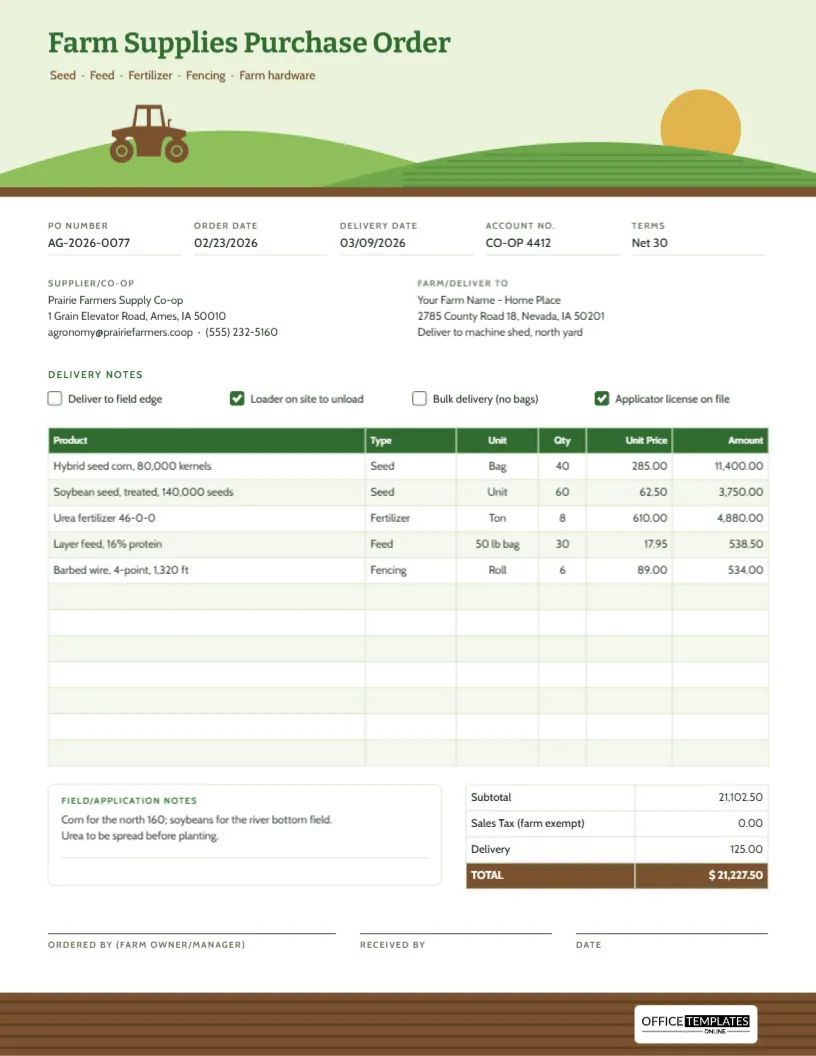
The template is US Letter portrait, 8.5 x 11 inches. The header is a small landscape: a pale green sky, a golden sun rising behind the hills, two rolling green hills with furrow rows ploughed across the right-hand one, and a brown tractor on the left hill. Farm & Agricultural Supplies Purchase Order is set in Bitter, a sturdy slab serif, with Seed · Feed · Fertilizer · Fencing · Farm hardware in brown beneath. A soil-brown line separates the scene from the form.
At the foot of the page, a band of dark soil with furrow lines echoes the header, and our logo sits on a white plate. The form, in Cabin, includes:
- PO Number, Order Date, Delivery Date, Account No. and Terms.
- Supplier/Co-op and Farm/Deliver To blocks, down to machine shed, north yard
- Four Delivery Notes checkboxes.
- A 12-row table with a green header: Product, Type, Unit, Qty, Unit Price and Amount.
- A Field/Application Notes box, totals with a brown TOTAL row, and signatures for the farm owner or manager and the person receiving.
A Year of Farm Ordering
Every farm is different, but many arable and mixed farms in temperate regions follow a similar rhythm. Use this as a starting point for planning your orders, and adjust it for your crops, climate, and livestock:
| Season | Typical orders |
|---|---|
| Winter | Seed for spring planting (early-order discounts are common), machinery parts, fencing materials |
| Early spring | Fertilizer, crop protection products, twine and net wrap |
| Late spring and summer | Top-up fertilizer, feed, fuel, spare parts for haymaking and harvest |
| Autumn | Cover crop and winter crop seed, feed for the winter, bedding |
| All year | Livestock feed, minerals, veterinary supplies, farm hardware |
Ordering seed early often secures the varieties you want before they sell out; ask your co-op or dealer about their early-order programme.
Units on Farm Orders
Agricultural products come in units that confuse newcomers, and mixing them up is expensive. The sample shows several:
- Seed corn is usually sold in bags of 80,000 kernels, so the Unit is Bag and the product name gives the kernel count.
- Soybean seed is often sold in units of 140,000 seeds.
- Fertilizer such as urea 46-0-0 is usually ordered by the ton for bulk delivery.
- Feed comes in 50 lb bags or in bulk by the ton.
- Barbed wire is sold in rolls, typically 1,320 ft.
Always write the unit in the Unit column and the size in the product name, so 40 can never be mistaken for 40 tons instead of 40 bags.
The Sample Spring Order
The sample is a spring order from a co-op: 40 bags of hybrid seed corn at 285.00 (11,400.00), 60 units of treated soybean seed at 62.50 (3,750.00), 8 tons of urea at 610.00 (4,880.00), 30 bags of layer feed at 17.95 (538.50) and 6 rolls of barbed wire at 89.00 (534.00). The subtotal is 21,102.50, delivery is 125.00, and the total is $21,227.50. Sales tax is shown as zero because many states exempt qualifying agricultural inputs; exemptions vary and often need a certificate, so check the rules where you farm. Work out your own amounts and type them in, since the table does not calculate.
Delivery Notes and Field Notes
The four delivery checkboxes answer the questions a driver will ask: deliver to the field edge or the yard, is there a loader on site to unload pallets, is this a bulk delivery with no bags, and is a pesticide applicator license on file for restricted products. The Field/Application Notes box records where products are going, for example, corn for the north 160 and soybeans for the river bottom field, and when fertilizer should be spread. That note is useful months later when you compare yields with inputs.
Setting Up the Form for Your Farm
- Enter your farm name, delivery point, and account number with your supplier.
- Type your regular products into the order table’s Edit Table Data window (double-click to open), then save the design as a master copy you can reuse each season.
- Tick the delivery notes that apply; ticked boxes are green.
- The tractor is an editable vector with its own colour swatch. The hills, sun and furrows are grouped, so the scene moves and recolours as one piece.
Checking the Delivery at the Yard
Farm deliveries often arrive when everyone is out in the fields, so agree in advance who will meet the truck or where the driver should leave the load. When you check it, compare product names, varieties, seed treatments, and quantities against the PO before the driver leaves, because a wrong seed variety or an untreated seed can be hard to swap once planting has started. Keep seed tags and bag labels with the order: they carry lot numbers and germination details you may need if a crop underperforms. Store fertilizer and crop protection products as their labels direct, away from feed and seed.
Printing in the Farm Office
Print on US Letter at actual size. The sky is pale, so the header prints lightly; the soil band at the foot is the darkest area. Keep a copy in the shed so whoever receives the delivery can check it off.
Farm Supply Questions
Can I use it for livestock supplies?
Yes. Change the product types to feed, minerals, bedding, or veterinary supplies.
Can ranches and orchards use it?
Certainly. Retitle the notes box to Pasture/Block Notes and list your own products.
Ready for Planting Day
Seed in the shed, fertilizer booked and fences ready: plan your season’s orders on this farm supplies purchase order and send them to your co-op in good time.