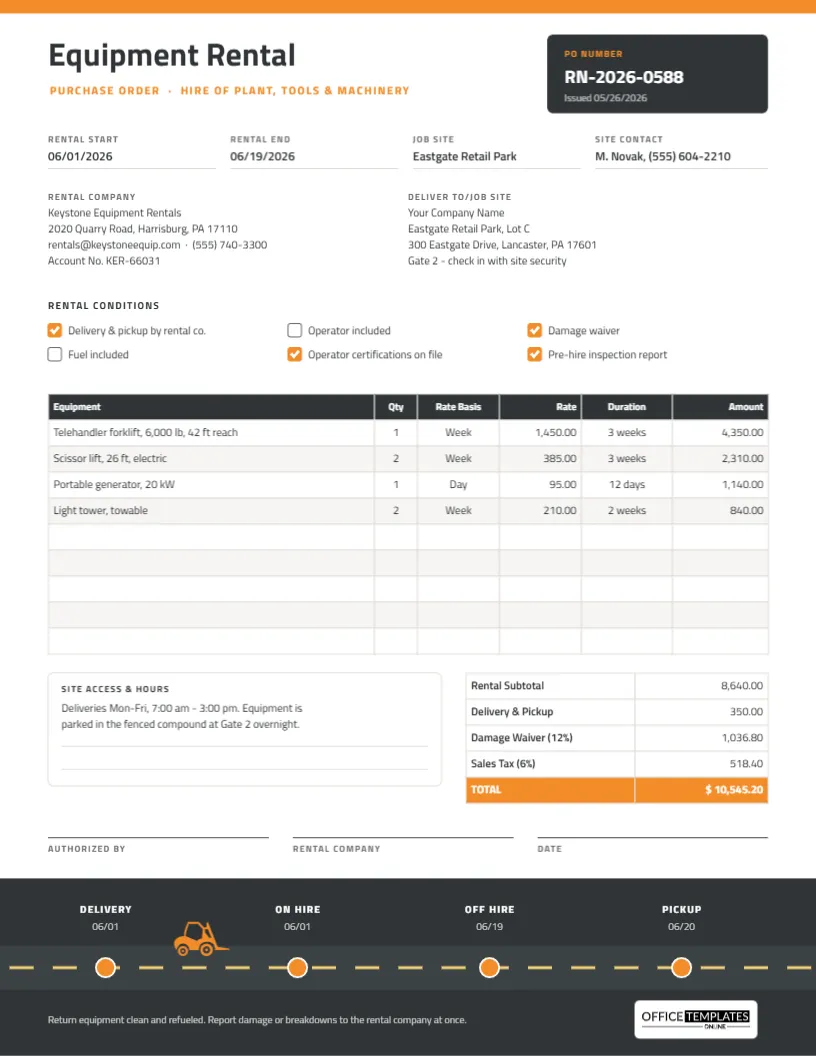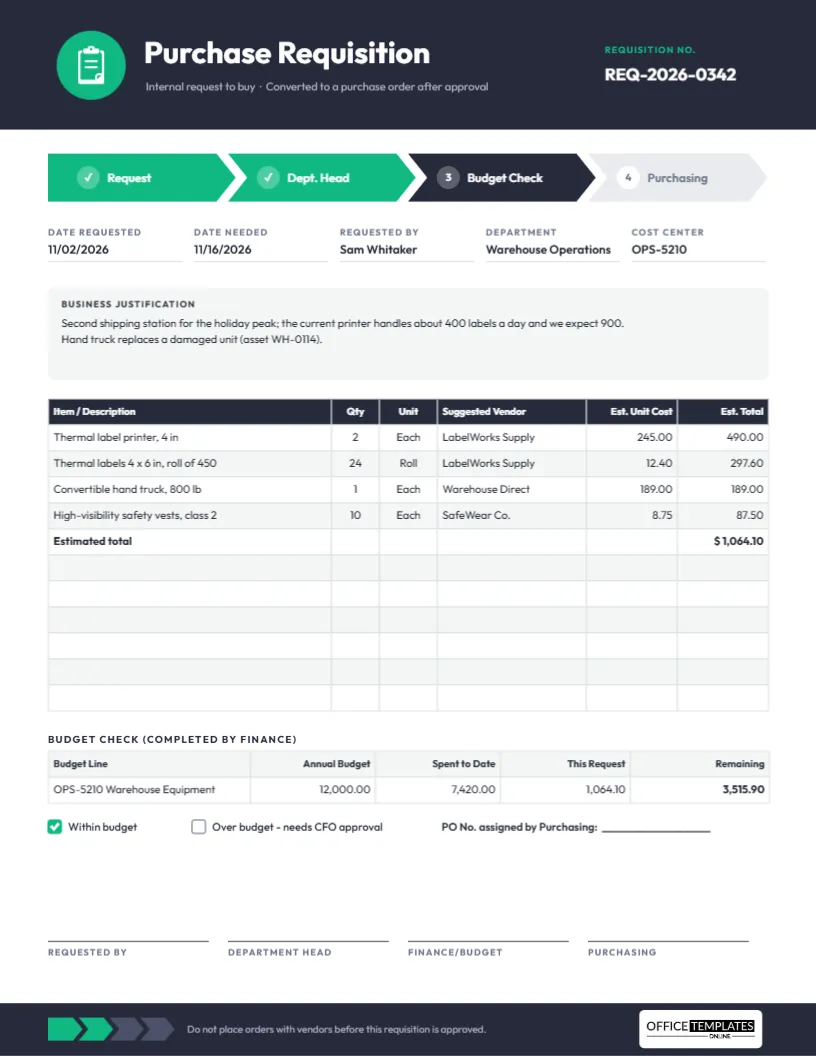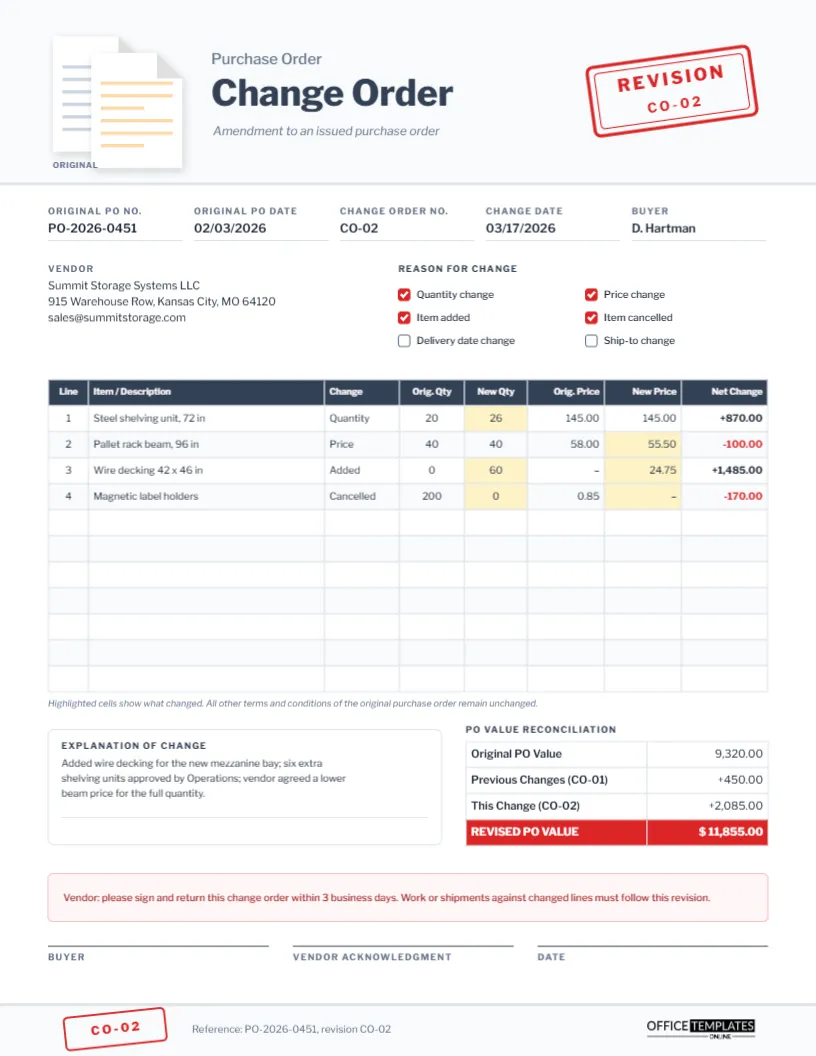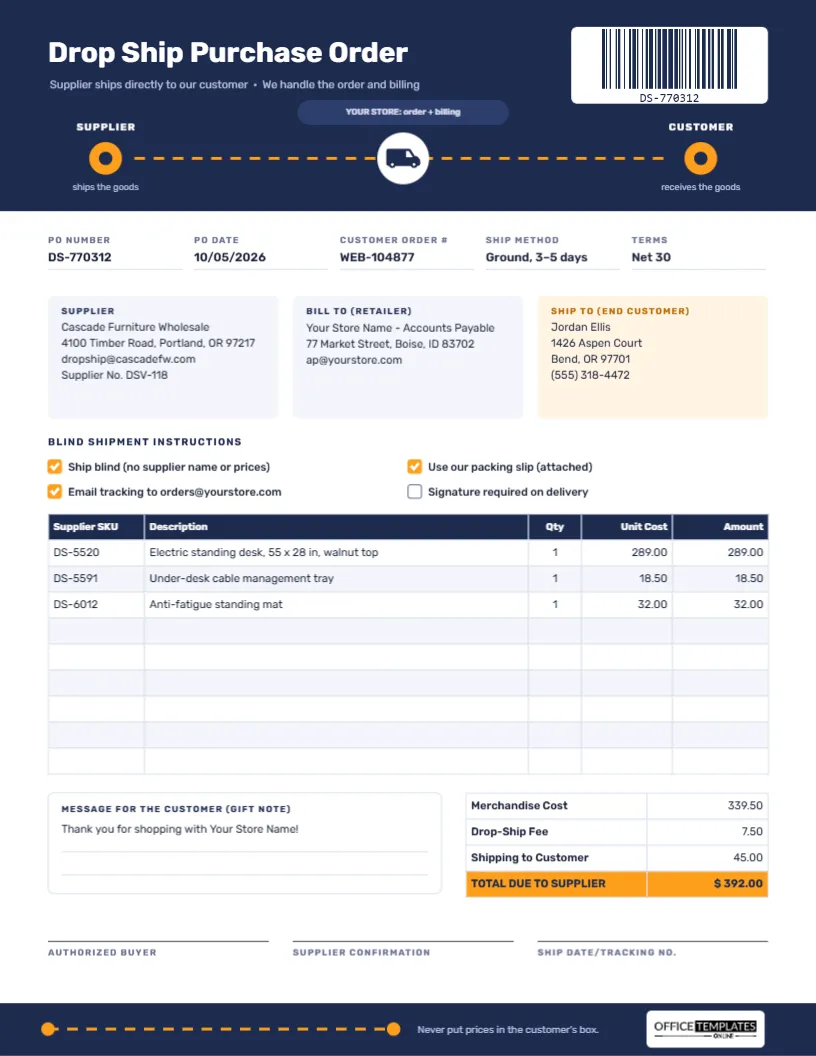
Some supplies are bought again and again: packaging, cleaning products, spare parts, office paper. Raising a brand-new purchase order every time wastes hours and makes prices drift from one order to the next. A Blanket Purchase Order Template solves both problems. You agree on prices and a maximum spend with one supplier for a set period, then call off deliveries (called releases) as you need them. This Blanket Purchase Order Template puts the whole agreement, and its running balance, on a single page
Blanket vs. Standard vs. Contract Orders
Purchasing teams use a few different kinds of orders. This comparison shows where the blanket PO fits:
| Standard PO | Blanket PO | Contract PO | |
|---|---|---|---|
| Items and quantities | Fixed and known | Items known; quantities estimated | Often not specified |
| Prices | Fixed for this order | Fixed for the agreement period | Terms agreed, prices set later |
| Delivery | One delivery (or a few) | Many releases over time | Each order issued separately |
| Spending control | Order total | Not-to-exceed amount | Usually none on the contract itself |
| Best for | One-off purchases | Repeat supplies from one supplier | Framework agreements |
If you order the same things from the same supplier more than a few times a year, a blanket order is usually worth setting up.
What the Landscape Page Shows
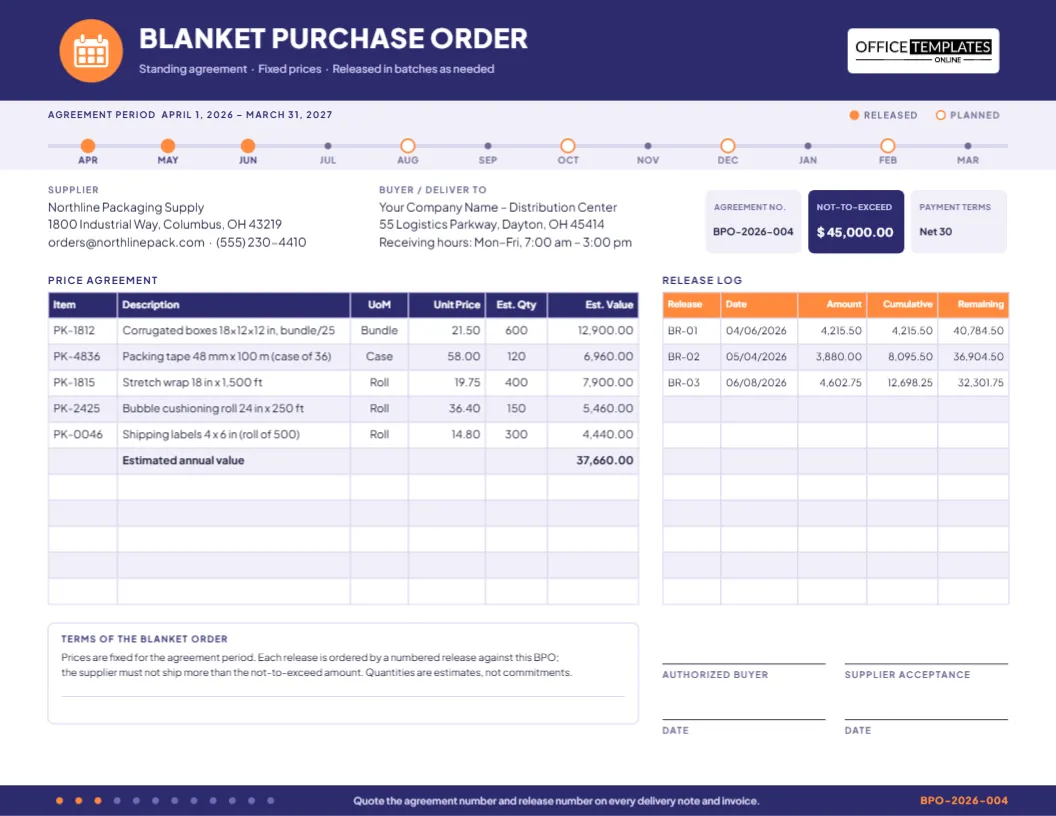
This template is US Letter landscape, 11 x 8.5 inches, which gives room for two tables side by side. A deep indigo header carries an orange calendar badge, the title BLANKET PURCHASE ORDER in heavy Plus Jakarta Sans, the line Standing agreement · Fixed prices · Released in batches as needed, and our logo on a small white plate.
Directly below is the design’s signature element: a lavender agreement timeline running from April to March. Solid orange dots mark months with a completed release (April, May, and June in the sample), outlined orange rings mark planned releases, and small grey dots mark quiet months. A legend at the top right explains the symbols. The rest of the page holds:
- Supplier and Buyer/Deliver To details.
- Three tiles for Agreement No., Not-to-Exceed (in a solid indigo tile, because it is the number that matters most), and Payment Terms.
- A Price Agreement table: Item, Description, UoM, Unit Price, Est. Qty and Est. Value, with a bold estimated annual value.
- A Release Log with an orange header: Release, Date, Amount, Cumulative, and Remaining.
- A terms box, signature and date lines for the buyer and supplier, and an indigo footer with twelve small dots echoing the timeline and the agreement number.
Keeping the Release Log: A Worked Example
The release log is where a blanket order earns its keep. Each time you call off a delivery, add a line and update two running figures. Here is the sample, step by step, against a not-to-exceed amount of 45,000.00:
- BR-01, 04/06/2026, 4,215.50. Cumulative = 4,215.50. Remaining = 45,000.00 ? 4,215.50 = 40,784.50.
- BR-02, 05/04/2026, 3,880.00. Cumulative = 4,215.50 + 3,880.00 = 8,095.50. Remaining = 36,904.50.
- BR-03, 06/08/2026, 4,602.75. Cumulative = 12,698.25. Remaining = 32,301.75.
When the remaining balance approaches zero, you either stop releasing or formally raise the limit. The log makes that moment obvious, long before an invoice arrives that pushes you over budget. After each release, also turn that month’s timeline dot from an outlined ring into a solid dot, so anyone glancing at the page sees progress at once.
Setting Up the Price Agreement
The sample agreement covers warehouse packaging: corrugated boxes, packing tape, stretch wrap, bubble cushioning, and shipping labels. For each item, write the supplier’s code, a precise description, the unit of measure, the agreed price, and your estimated annual quantity. Estimated value is simply price times quantity; in the sample, the five lines add up to 37,660.00, comfortably under the 45,000.00 limit, leaving headroom for busier months.
Remember that the quantities are estimates, not promises. The terms box says so explicitly, which protects you if demand falls. The prices, on the other hand, are fixed for the agreement period, which protects you if the supplier’s costs rise.
Setting Up a New Blanket Agreement
- Replace the supplier and buyer details, and set the agreement number, not-to-exceed amount, and payment terms in the three tiles.
- Edit the agreement period text above the timeline. If your period starts in a different month, click each month label and retype it.
- Double-click the Price Agreement table to open Edit Table Data and enter your items. You can paste a list from a spreadsheet using Import CSV.
- Leave the Release Log empty for a new agreement, or enter releases as they happen.
- Recolour dots on the timeline as releases are made: select a dot and change its fill.
- Both parties sign and date the agreement before the first release.
The table does not calculate running totals, so work out Cumulative and Remaining with a calculator each time. It takes seconds and keeps the log trustworthy.
How Releases Are Ordered in Practice
Most buyers place releases by email or phone, quoting the blanket number and a release number: Please deliver release BR-04 against BPO-2026-004: 50 bundles of PK-1812 and 10 cases of PK-4836. The supplier ships and invoices each release separately, quoting both numbers, as the footer reminds them. Your accounts team matches the invoice to the release and the agreed prices on this page.
Keeping the Signed Agreement Current
Print on US Letter in landscape orientation at actual size, or fit to page on A4. Keep the signed original with your supplier contracts, and a working copy where the person placing releases can update the log. Many teams re-download the page as a PDF after each release, so there is always a current version to share with finance.
Blanket Order FAQs
How long should a blanket order last?
Twelve months is typical, as shown on the timeline, but three or six months works for new suppliers or volatile prices.
Can I add more items during the year?
Yes, with the supplier’s agreement. Add a line to the price agreement and have both parties initial the change.
What happens to unused budget?
Normally nothing; the agreement simply ends. The not-to-exceed amount is a ceiling, not a commitment to spend.
Order Once, Release All Year
A blanket purchase order locks in prices, cuts paperwork, and keeps spending visible month by month. Set up your agreement, track each release on the log and timeline, and let routine buying run itself.