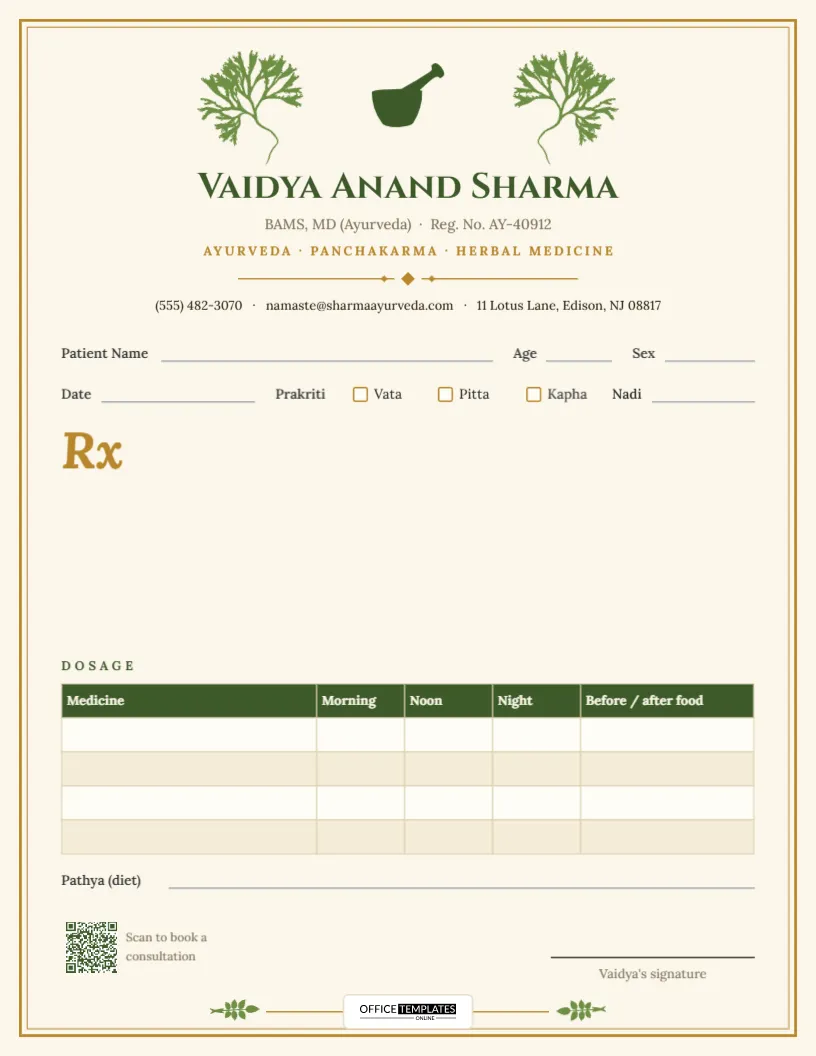
Ayurvedic practice has its own vocabulary, its own rhythm of dosing and its own visual tradition: herbs, the mortar and pestle, warm earthy colors and a sense of calm. A generic medical form never quite fits. This Ayurvedic doctor prescription pad is designed for the Vaidya, with an ornamental parchment layout, fields for Prakriti and Nadi, a dosage table set out by time of day, and a line for Pathya, the diet advice that is central to Ayurvedic treatment.
The Look of a Traditional Apothecary
The page has a warm parchment background framed by a double border in ochre: a firm outer line and a delicate inner one. At the top center, a deep green mortar and pestle is flanked by two herbal branches in leaf green, angled outward like a crest. Beneath them, the practitioner’s name is set in Cinzel, a classical inscriptional typeface with Roman capitals, followed by degrees and registration number in a soft brown Lora and Ayurveda · Panchakarma · Herbal Medicine in spaced ochre capitals.
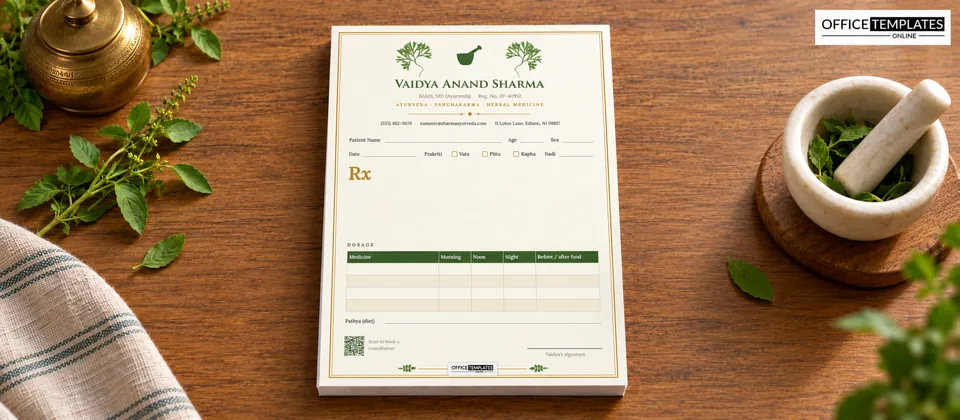
A small ornamental divider follows, two fine ochre lines meeting a central diamond with smaller diamonds on each side, and then a single line of contact details. At the foot of the page, the Office Templates Online logo sits on a white plate between two short ochre rules, each ending in a tiny mint sprig.
Ayurvedic Terms on the Pad
Several fields use traditional terms. For patients and staff who are new to them, here is what each one means:
| Term | Meaning | Where it appears |
|---|---|---|
| Vaidya | A practitioner of Ayurvedic medicine | Name line and signature |
| Prakriti | A person’s natural constitution | Tick boxes after the date |
| Vata, Pitta, Kapha | The three doshas, or functional principles | The three Prakriti boxes |
| Nadi | Pulse, as assessed in Ayurvedic examination | Short line on the second row |
| Pathya | Wholesome diet and routine recommended with treatment | Full-width line below the table |
| Panchakarma | A set of cleansing therapies | Specialty line |
Every label is editable, so a practice that prefers plain English can change Prakriti to Constitution and Pathya to Diet advice.
The Dosage Table
Below the Rx space, a dosage table titled Dosage lists up to four medicines, with columns for Medicine, Morning, Noon, Night, and Before/after food. The header is deep green with parchment-colored text, and the rows alternate between cream and a slightly deeper sand. It suits the way Ayurvedic medicines are usually given: churnas, vatis, kashayams and ghritas taken at set times of day, often with a specific relationship to meals or with an anupana such as warm water, honey or milk.
The table is editable. Double-click it to type in the cells, use + Add Row for longer prescriptions, or rename Before/after food to Anupana if you prefer to note the vehicle.
How a Consultation Flows Onto the Page
- Record the patient’s name, age, sex, and the date.
- Tick the predominant dosha or doshas in the Prakriti boxes, and note the Nadi findings.
- Write the treatment plan in the Rx area: medicines, therapies, and duration.
- List each medicine in the dosage table with the times it should be taken.
- Add diet and lifestyle guidance on the Pathya line.
- Sign above Vaidya’s signature.
Pathya: Making Diet Advice Specific
In Ayurveda, what the patient eats and how they live is treated as part of the medicine, which is why Pathya has its own full-width line rather than being squeezed into the margin. Advice is most useful when it is concrete. Instead of avoid heavy food, a Pathya note might read warm, freshly cooked meals; mung dal khichdi for dinner; avoid curd at night; sip warm water through the day. For a Pitta imbalance, it might favour cooling foods, and for Kapha, lighter, drier meals with more movement. If one line is not enough, write the essentials there and continue in the Rx space, or add a second line by copying the first.
Timing matters as much as content. Many Vaidyas note when to eat the main meal, when to sleep and wake, and which seasonal adjustments to make, all of which fit naturally alongside the Pathya advice.
Personalizing Your Pad
- Replace the name, degrees, and registration number.
- Edit the specialty line, for example, Ayurveda & Yoga Therapy, Kerala Ayurveda Treatments, or Homeopathy & Herbal Medicine.
- Update the phone, email, and address.
- Click the QR code captioned Scan to book a consultation and add your own booking link.
- Download the finished pad as a PDF.
The same layout suits homeopaths, naturopaths and Unani practitioners: change the specialty line, rename the Prakriti row to something relevant or delete it, and adjust the table headings.
Paper That Matches the Design
The template is US Letter, 8.5 x 11 inches, portrait. The parchment tone is part of the design, so plain white paper reproduces it. If you would rather print on real ivory, cream, or laid paper, set the large parchment-colored background rectangle to white in the editor first, and let the paper’s own color show through. The double border sits inside the page edge, so it prints completely on desktop printers. For busy clinics, a local printer can produce glued pads with a card backing.
Questions From Ayurvedic Clinics
Can I add my clinic logo?
Yes. Replace the mortar and pestle with your logo, or place the logo beside it.
Can I write in Hindi or another language?
You can type in any language supported by the chosen font; for Devanagari text, choose a Google Font that includes it.
Can I record Panchakarma therapies on this pad?
Yes. Write the therapy plan in the Rx area, such as Abhyanga, Swedana, or Basti, with the number of sittings, and use the dosage table for the internal medicines given alongside.
Are the herbal branches editable?
Yes. They are editable vector illustrations, so you can resize, rotate, move, or delete them, and change their green from the colour swatch when you select one.
Ayurveda treats the whole person, and your stationery can reflect that care. Add your details, print a pad, and give every patient a prescription that feels as considered as the consultation.