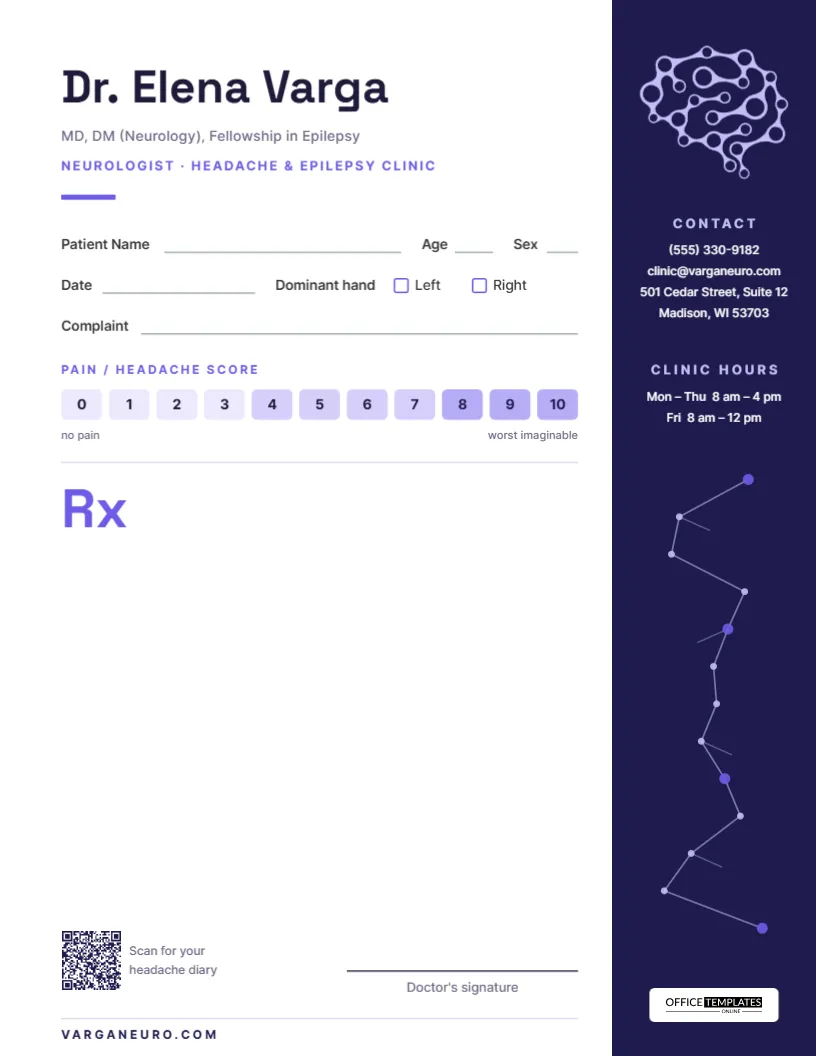
Headache, migraine, epilepsy, neuropathy, stroke follow-up: neurology clinics see conditions that are often measured by what the patient feels rather than what a scan shows. That makes a quick, consistent way of recording symptoms valuable. This neurologist prescription pad template includes a printed 0 to 10 pain and headache score right above the prescription, alongside a dominant-hand record and the usual patient details, all framed by a striking indigo sidebar that is unmistakably neurological.
What You See on the Page
A deep indigo sidebar runs down the full height of the right side of the page. At the top, a network-style brain illustration in soft lilac is drawn as connected nodes rather than folds, a nod to the brain’s wiring. Below it sit the clinic’s contact details and hours in white. Further down, a nerve pathway made of fine lilac lines and small glowing nodes zig-zags towards the bottom, where the Office Templates Online mark sits on a white plate. The pathway is one grouped object, so it can be moved or deleted in a single click.
The white area on the left holds the doctor’s name in Space Grotesk, a contemporary sans-serif with a slightly technical feel, the qualifications in grey, and Neurologist · Headache & Epilepsy Clinic in violet capitals, underlined by a short violet bar.
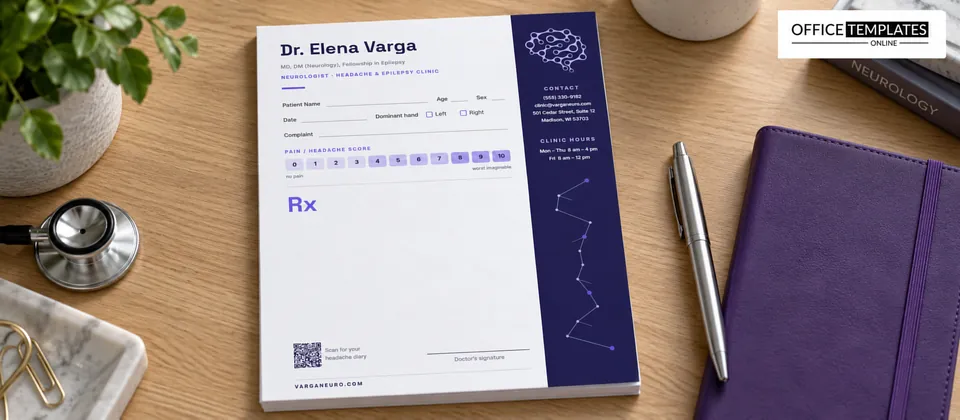
Using the 0 to 10 Pain Score
Under the patient fields is a row of eleven numbered boxes from 0 to 10, shaded from pale lilac to deeper violet, with no pain under the 0 and worst imaginable under the 10. Circle the number the patient reports. Because it is on every prescription, the score builds a simple record of how symptoms change between visits. Clinicians commonly read the numeric rating scale in bands like these:
| Score | Common interpretation | Example note |
|---|---|---|
| 0 | No pain | Headache-free since last visit |
| 1-3 | Mild | Noticeable, does not interfere with work |
| 4-6 | Moderate | Interferes with concentration or sleep |
| 7-10 | Severe | Stops normal activity, may need rescue treatment |
The scale is a grouped object. To relabel it, for example, as a seizure frequency or dizziness score, ungroup it and edit the numbers or the heading above it.
Patient Fields With a Neurology Focus
- Patient Name, Age, Sex and Date across two rows.
- Dominant hand, with Left and Right boxes. Handedness is part of many neurological assessments and is quicker to tick than to write.
- Complaint, a full-width line for the presenting problem.
A light rule then separates the patient block from the violet Rx and a wide, blank prescription area that runs down to the signature line.
Symptoms Worth Scoring at Every Visit
A number is not a diagnosis, but a consistent number over time is useful evidence. Neurologists often ask for a score in situations like these:
- Migraine and tension-type headache: the usual severity of attacks, to judge whether a preventive medicine is working.
- Neuropathic pain: burning or tingling in the feet or hands, which often changes slowly over weeks.
- Radiating back or neck pain: before and after a nerve-focused treatment plan.
- Post-herpetic neuralgia and trigeminal neuralgia: where dose changes are guided largely by how the patient feels.
Because the scale sits directly above the Rx area, the score and the medication change are recorded side by side, which makes the reasoning behind a dose adjustment clear to anyone who reads the prescription later.
Why Handedness Is on the Form
Knowing whether a patient is left- or right-handed helps interpret weakness, tremor, writing difficulties and some speech problems, and it matters when planning certain investigations and procedures. It is a small detail that is often asked and rarely written down, so the pad gives it two tick boxes of its own.
The Headache Diary QR Code
At the bottom left, a QR code carries the caption Scan for your headache diary. Many neurologists ask migraine patients to log attacks, triggers, and medication use between appointments, and a code on the prescription makes the diary easy to find. Click the code in the editor to open its settings and paste in your own link: a printable diary on your website, an app recommendation, or a booking page.
Tailoring the Pad for Your Clinic
- Change the name, degrees, and specialty line. The specialty can be broadened to Neurology & Neurophysiology or narrowed to Movement Disorders Clinic.
- Update the contact block and the clinic hours in the sidebar.
- Replace the website at the foot of the page.
- Edit or relabel the score scale if you track something other than pain.
- Point the QR code to your own resource.
- Download the finished file as a PDF, PNG, or JPG.
Getting a Clean Print
The template is US Letter, 8.5 x 11 inches, portrait. The indigo sidebar is a large block of dark color, so it will look richest from a color laser printer or a print shop; inkjet printers may need a heavier 28 lb paper to avoid curling. Keep the scale at 100% so the score boxes and writing lines keep their size. If you print in black and white, the sidebar turns dark grey and the lilac elements light grey, and the page still reads clearly.
Neurology Pad Questions
Can I move the sidebar to the left?
You can. Select the sidebar and its contents, move them to the left edge, and shift the main column to the right.
Is the brain illustration editable?
Yes. It is an editable vector illustration: recolour it from its colour swatch, resize it, move it, or replace it with your own logo.
Is this suitable for a pediatric neurologist?
Yes. Update the specialty line and consider replacing the pain scale label with Symptom score.
Can nurses use the pain scale at triage?
Yes. Many clinics have a nurse circle the score before the consultation, so the doctor sees it immediately.
Can I add fields for EEG or MRI results?
Yes. Copy one of the existing writing lines, paste it below the Complaint line, and change its label to EEG, MRI brain, or Nerve conduction.
Neurology is a specialty of patterns. Give your patients a prescription that captures the pattern every time, and a design they will recognize at once.