Elementary Teacher Resume Template with Chalkboard Header
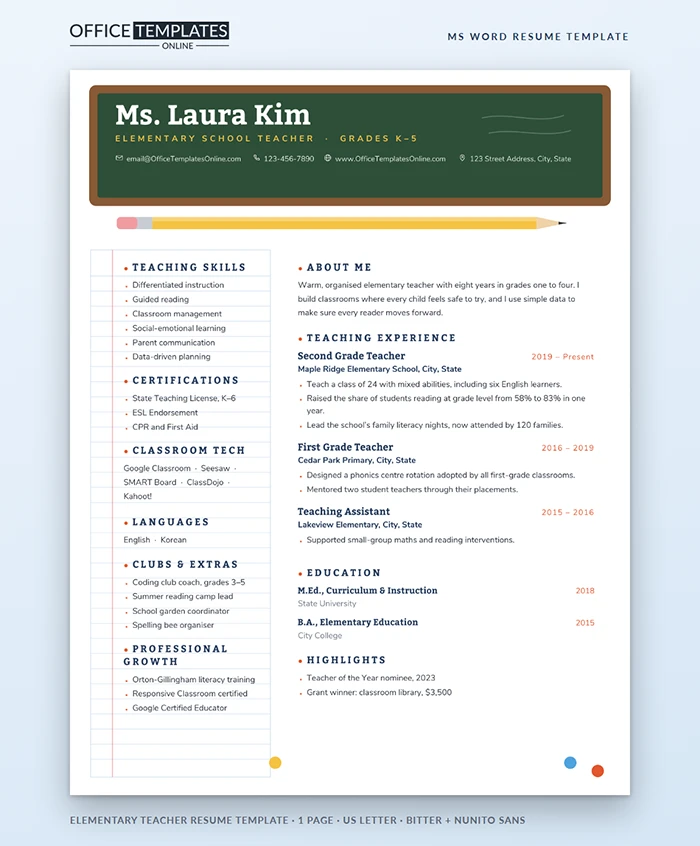
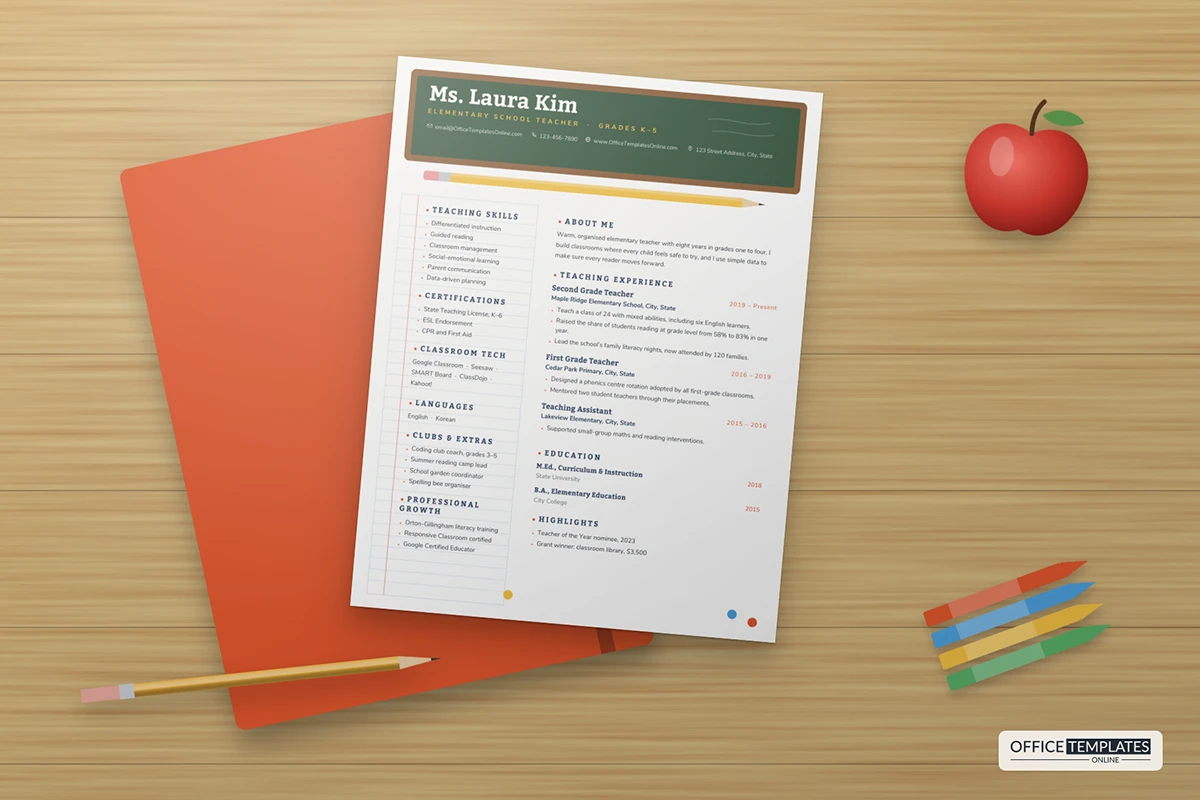
Principals hiring for elementary classrooms want someone warm, organized, and ready on day one. This resume says all three at a glance. It opens with a classroom chalkboard, a sharpened yellow pencil, and a column of ruled notebook paper, yet the content underneath is as tidy and professional as a well-planned lesson.
A Classroom on Paper
The header is a dark green chalkboard inside a warm wooden frame. Your name is written across it in white Chalk, with your role and grade range in spaced yellow letters and your contact details in pale chalk-colored text with small white icons. A couple of faint chalk strokes sit in the corner. Under the board lies a long yellow pencil with a pink eraser, a silver band, and a sharpened tip.
On the left, a sheet of notebook paper with blue ruled lines and a red margin holds your teaching skills, certifications, classroom technology, languages, clubs, and professional growth. The right side holds your introduction, teaching experience, education, and highlights. Three small colored dots in yellow, blue, and red finish the bottom of the page like scattered classroom stickers.
Lesson Plan: Filling In Your Resume
| Lesson step | Resume section | What to include |
| Objective | About me | Grades you teach and the kind of classroom you build |
| Direct instruction | Teaching experience | School, grade, class size, and two measurable results |
| Guided practice | Teaching skills | Six methods you use every week |
| Independent practice | Clubs and extras | What you run beyond the timetable |
| Assessment | Highlights | Awards, grants and recognition |
Showing Student Growth
Schools want evidence that children learn in your room. Reading levels, math benchmarks, attendance, and family involvement are all fair game. Raising the share of students reading at grade level from 58% to 83% in one year tells a principal far more than planned engaging lessons. If your school does not share data, describe growth in your own words, for example, every student moved up at least two reading levels.
First-Year and Career-Changing Teachers
If you are new to teaching, list student teaching placements as experience, with the grade and your mentor teacher's role. Use the clubs section for tutoring, camps, or coaching. Career changers can show how earlier work, such as training adults or youth leadership, translates into classroom skills, and should put their teaching license or alternative certification near the top of the left column.
Questions Principals Often Ask
How do you manage a classroom?
Point to a specific routine on your resume, such as morning meetings or a calm-down corner, and explain why it works.
How do you support students who are behind?
Use your reading or math results as the story: what you noticed, what small groups you ran, and what changed.
How do you work with families?
Mention literacy nights, newsletters, or apps such as Seesaw, and give one example of a parent partnership that helped a child.
Customizing the Board and Pencil in Word
- The chalkboard, wooden frame, chalk marks, pencil, notebook paper, ruled lines, and colored dots are shapes in the page header. Double-click near the top of the page to select them; recolor the board blue for a whiteboard feel, or delete the pencil for a quieter look.
- Your name and contact details on the board are normal text; just click and type.
- The notebook column is a table cell, so its bullets wrap neatly over the ruled lines.
Fonts, Size and Printing
Bitter and Nunito Sans are free from Google Fonts. The page is one US Letter sheet. Bring a few printed copies to school job fairs, and email a PDF for district applications so the colors look the same on every screen.