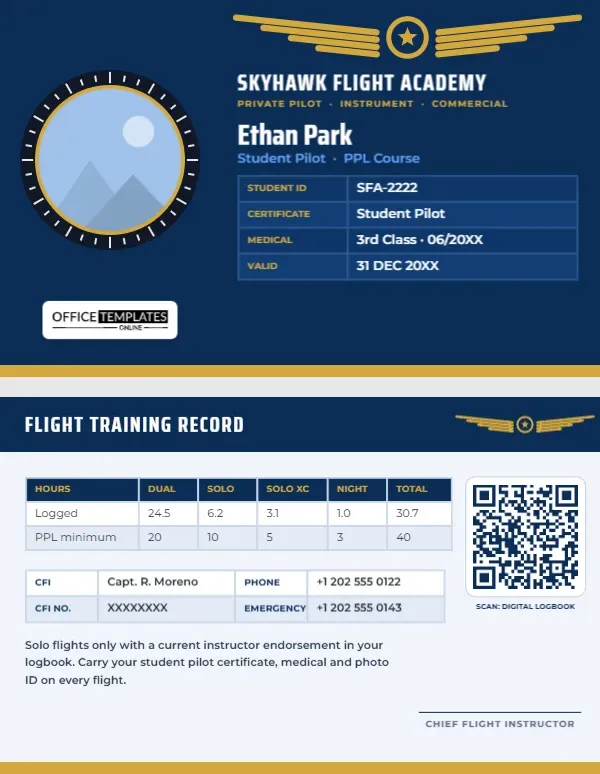
Learning to fly is one of the most exciting things a student can do, and every flight school knows the pride of a student who earns their first solo. Flight schools also need to know exactly who is on the airfield, which aircraft they are cleared to fly, and how far they are through their training. This Student Pilot ID Card handles both the pride and the paperwork. Gold pilot wings sit across the top, the student’s photo appears inside an aircraft instrument bezel, and the back is a flight training record showing hours logged against private pilot minimums.
Wings and an Instrument Bezel
The card is horizontal, 3.375 inches wide and 2.125 inches high, on a deep navy background. On the left, the student’s photo fills a round instrument face: a black bezel with white tick marks around the edge, like an altimeter or attitude indicator, and a gold inner ring. At the top of the right side, a pair of gold pilot wings spreads out from a small navy roundel with a gold star.
SKYHAWK FLIGHT ACADEMY is set below the wings in Saira Condensed, a crisp aviation-style typeface, with Private Pilot · Instrument · Commercial in gold. The student’s name follows, Ethan Park in the sample, with Student Pilot · PPL Course in sky blue. A navy table lists the student ID, certificate, medical class and date, and the validity date. Our logo sits on a white plate beneath the instrument, and a gold band runs along the bottom edge.
The Flight Training Record
The back is light, with a navy header reading FLIGHT TRAINING RECORD and a small pair of wings. The main table compares hours logged with private pilot minimums across dual, solo, solo cross-country, night, and total time. A QR code labelled SCAN: DIGITAL LOGBOOK can link to the student’s electronic logbook or the school’s training records. A contact grid lists the certificated flight instructor (CFI), their certificate number, the student’s phone, and an emergency contact. A note reminds students that solo flights require a current instructor endorsement and that they must carry their student pilot certificate, medical, and photo ID. A chief flight instructor signature line completes the card.
Private Pilot Minimums at a Glance
| Requirement (US Part 61 PPL) | Minimum |
|---|---|
| Total flight time | 40 hours |
| Dual instruction | 20 hours, including cross-country, night, instrument, and test preparation |
| Solo flight | 10 hours |
| Solo cross-country | 5 hours, including one long flight with full-stop landings at three airports |
| Night training | 3 hours, with a night cross-country and ten night takeoffs and landings |
Most students need more than the minimum before the checkride, and Part 141 schools follow a different approved syllabus. Other countries have their own requirements; edit the table to match the licence you are training for.
Filling In the Skyhawk Card
- Instrument photo: the round portrait inside the bezel changes with Replace Image once it is selected.
- Academy name and courses: retype the school name and the course line.
- Certificate and medical: update the rows once the student pilot certificate and medical certificate are issued.
- Hours: the training record is a real Table; press Edit Data after each lesson or stage check and update the logged hours.
- QR code: link it to a digital logbook or training portal using the Barcodes & QR panel.
- Wings: the wings and roundel are one group; recolour them silver for a different look.
Security on the Airfield
Airports and flight schools control who can walk onto the ramp. Students are usually expected to sign in, show ID, and walk directly to their aircraft or instructor. A clear, school-branded card makes this simple for front desk staff and line crew. It does not replace the documents a pilot must carry when flying: the student pilot certificate, medical certificate and government photo ID. The back note says exactly that, so there is no confusion.
From First Lesson to First Solo
Most students begin with discovery flights and basic manoeuvres, then practise takeoffs and landings in the traffic pattern until their instructor signs a solo endorsement. The first solo is a milestone traditionally celebrated in many schools by cutting off the back of the student’s shirt. After solo come cross-country flights, night training, and preparation for the knowledge test and checkride. The training record on this card lets students watch their hours grow toward each milestone.
Flight Schools, Aviation Colleges and Clubs
Part 61 and Part 141 flight schools, university aviation programmes, flying clubs, glider and helicopter schools, drone pilot courses and aviation-themed high school programmes can all use this card. Change the course line and the training record columns for helicopter, instrument or commercial training.
Printing Navy and Gold
Navy prints richly on PVC and matte cardstock, and gold looks warm and bright when the printer is calibrated. Check that the white tick marks around the instrument bezel are visible. A horizontal badge holder clipped to a flight bag strap keeps the card handy for the ramp gate without dangling in the cockpit.
Preparing for the Knowledge Test and Checkride
Alongside flight hours, student pilots must pass a written knowledge test and a practical test with an examiner. Study ground school material steadily rather than cramming, use practice tests to find weak areas, and ask your instructor to review airspace, weather, and regulations with you. Before the checkride, fly mock checkrides with a different instructor if your school offers them, and make sure every endorsement and logbook entry is complete. The training record on the back of this card is a handy summary to bring to those final review sessions.
Student Pilot Questions
Does this card let me fly solo?
No. Solo privileges come from your instructor’s endorsements and your student pilot certificate; the card identifies you at the school.
Can I track instrument hours too?
Yes. Add a column or row to the training record table using Edit Data.
Can instructors use the design?
Duplicate it and change the role line to CERTIFICATED FLIGHT INSTRUCTOR.
Open the template, place the student in the instrument bezel, log the hours, and get ready for the day they fly solo.