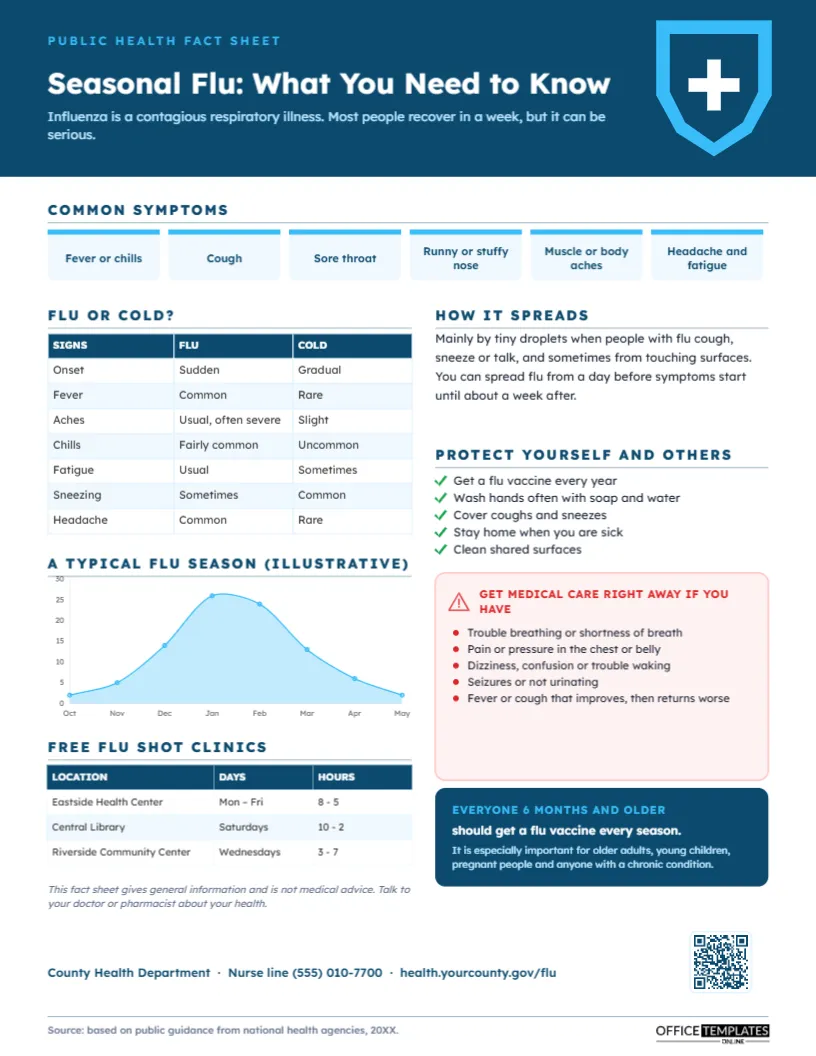
Every autumn, health departments, clinics, schools, pharmacies and employers hand out the same kind of page: a clear explanation of the flu, how to tell it from a cold, how to avoid it and when to get help. The best of these pages are short, calm and easy to read for people of all ages and reading levels. This Seasonal Flu Fact Sheet Template gives public health teams a ready-made layout with a shield motif, colour-coded warning signs and a local clinic table, so they can spend their time on the local details rather than on design.
What a Good Health Handout Does
A public health fact sheet has to work for a very wide audience: parents in a waiting room, older adults at a senior centre, employees in a break room and people reading in their second language. It succeeds when it answers a few practical questions in plain words. What is it? How do I know if I have it? How does it spread? How do I protect my family? When is it an emergency? Where can I get vaccinated? This template has a clearly labelled place for each answer.
A Blue Shield and Sky-Blue Tiles
A deep blue header carries a sky-blue PUBLIC HEALTH FACT SHEET label, the title Seasonal Flu: What You Need to Know in white Lexend, a one-line description, and, on the right, a shield with a white cross, a familiar symbol of protection and health. Lexend was chosen for this page because it was designed to improve reading fluency.
Six pale blue tiles with sky-blue top edges list the common symptoms. Below them, a Flu or cold? table compares onset, fever, aches, chills, fatigue, sneezing, and headache for each illness. Beside it, How it spreads explains transmission in two sentences, and Protect yourself, and others lists five green-checkmarked habits. An area chart shows a typical flu season rising from October to a peak in January and February, clearly labelled as illustrative. A red-bordered pink panel with a warning icon lists the signs that mean you should get medical care right away. A Free flu shot clinics table gives locations, days, and hours, and a blue panel states that everyone six months and older should get a flu vaccine each season. A disclaimer, the health department’s nurse line and website, a QR code, and a source line complete the page. It is designed as a portrait US Letter page (8.5 x 11 in).
Flu Versus Cold, Explained
People often call any bad cold the flu, which matters because the flu can be serious and some people benefit from antiviral treatment if they start it early. The table on the template follows the comparison used by national health agencies. Flu usually comes on suddenly, with fever, body aches, chills, and exhaustion. A cold comes on gradually, with sneezing, a stuffy nose and a sore throat, and rarely causes a high fever. Only a test can confirm flu, so the page encourages people to call a doctor if they are at higher risk or very unwell.
Localising the Handout for Your Community
- Your organisation: replace County Health Department in the contact line and the source footer.
- Clinic table: select the table and choose Edit Data to enter your locations, days and hours; add more with + Row.
- Season chart: the curve is an editor chart. Select it, click Chart Options, and then Edit Chart Data if you want to show last season’s local surveillance numbers instead of the illustrative curve; change the title to match.
- Warning signs: keep these aligned with your national health agency’s current list; each line is editable text.
- QR code: link it to your vaccine finder or appointment page in the Barcodes & QR panel.
- Language: duplicate the page and translate it for the main languages in your community.
Checklist Before You Publish
| Check | Why |
|---|---|
| Vaccine recommendation matches current national guidance | Recommendations can change from season to season |
| Clinic dates and hours are confirmed | Outdated clinic information frustrates the people most motivated to act |
| Emergency warning signs are complete | This is the section that can save a life |
| Phone numbers work and are staffed | Call the nurse line yourself before printing |
| Reading level is around grade 6-8 | Makes the page usable for most adults |
| Medical reviewer has approved the text | Standard practice for health communications |
Plain Language Tips From Health Communicators
Use short sentences and everyday words: throwing up rather than emesis, belly as well as abdomen. Put the action first (Get a flu vaccine every year), not the reason. Use numbers people can picture, like 6 months and older. Avoid all capitals for body text, which is harder to read. Use icons and colour to support meaning, but never rely on colour alone; the warning section uses both red and a warning symbol for that reason.
Waiting Rooms, School Folders and Break Rooms
Post it in clinic waiting rooms, pharmacies, school offices, libraries, community centres, places of worship, workplaces and senior housing. Send it home in school folders during the first weeks of flu season. Share the PDF on social media, school newsletters and employer intranets. Employers running workplace vaccination days can replace the clinic table with their own on-site schedule.
Reusing the Layout for Other Illnesses
The same structure works for COVID-19, RSV, measles, whooping cough, norovirus, strep throat, or seasonal allergies. Swap the symptom tiles, replace the comparison table (for example, allergies versus a cold), change the warning signs, and update the clinic table. Keep a consistent visual identity across your health department’s fact sheets so residents recognise official information.
A Note on Medical Accuracy
This template contains general information adapted from public guidance for illustration. It is not medical advice. Health organisations should have a clinician review the final text and check it against current guidance from their national public health agency each season, and individuals should always talk to their own doctor or pharmacist.
Print and Laminate
For waiting rooms and hallways, print in colour so the red warning panel stands out, and laminate copies that will be handled. The blue palette also works well photocopied in black and white for bulk handouts, because each section has a clear heading and rule.
Health Educator FAQs
Can I add a section for children?
Yes. Replace the season chart with warning signs specific to children, such as fast breathing or bluish lips, in line with current guidance.
Can I print it double-sided?
Add a second page with the same header for a translated version, vaccine myths and facts, or a symptom diary.
Is the chart real data?
It is labelled as illustrative. Replace it with local surveillance data if you have it.
Open the template, add your clinics and contact details, and help your community get through flu season healthier.