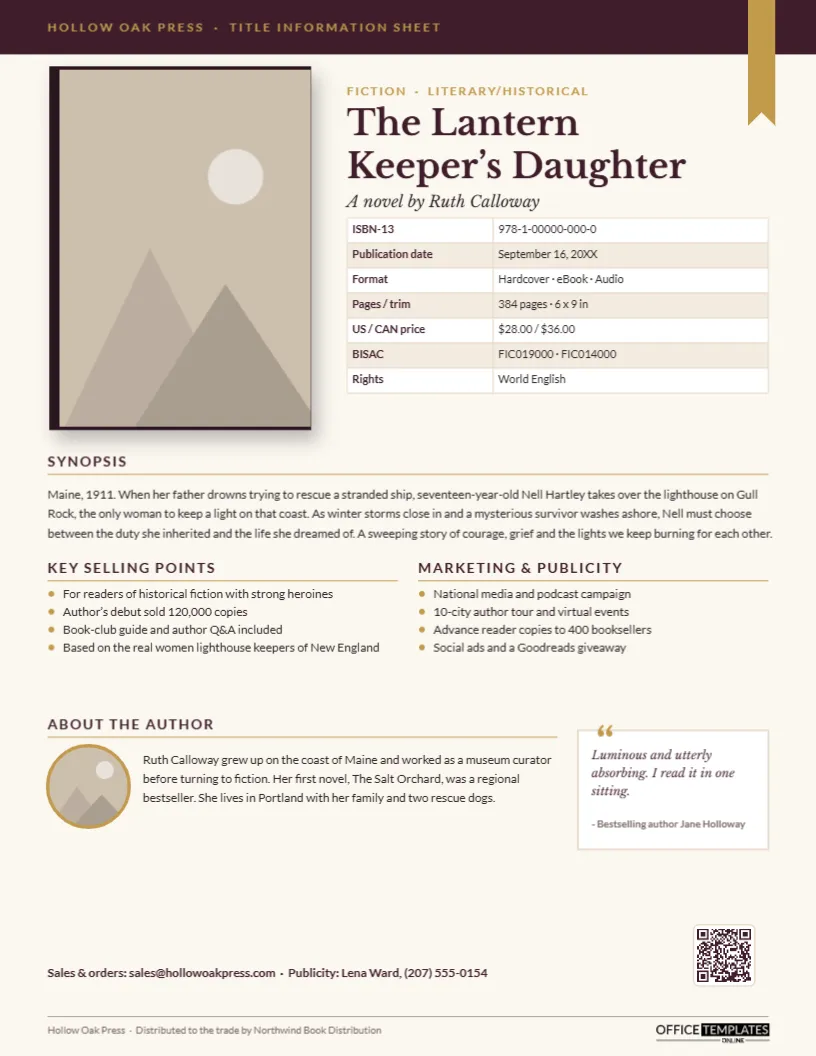
Every book that reaches a bookshop shelf passes through a buyer’s hands first, usually as a title information sheet (TI sheet), also called a sell sheet or tip sheet. Booksellers, librarians, distributors, sales reps, and wholesalers use it to decide whether to stock a book and how many copies to order. Publishers of every size, and self-published authors approaching local shops and libraries, need one for every title. This Book Title Information Sheet Template presents a novel with the elegance of a literary imprint, while keeping every piece of trade metadata exactly where buyers look for it.
What Buyers Need Before They Order
A bookseller reading a TI sheet asks: what is it, who is it for, what format and price, when does it publish, how will the publisher sell it, and why will customers want it? They also need the metadata required to order it: ISBN, publication date, BISAC categories, and distributor. Missing metadata is the most common reason a small press or indie author struggles to get books into shops, even when the book is good.
Plum, Gold and a Bookmark Ribbon
A deep plum bar runs across the top with HOLLOW OAK PRESS · TITLE INFORMATION SHEET in spaced gold capitals, and a gold bookmark ribbon hangs down from the top right as the page’s signature motif. On the left, a large cover slot with a soft drop shadow, as if the book were resting on the page, holds the front cover. Beside it, a gold genre label, the title The Lantern Keeper’s Daughter in large plum Libre Baskerville, and A novel by Ruth Calloway in italics introduce the book. A metadata table follows with ISBN-13, publication date, formats, pages and trim size, US and Canadian prices, BISAC codes and rights.
A full-width Synopsis sits below with gold rules. Two columns follow: Key selling points and Marketing & publicity, each with four gold-bulleted lines. At the bottom, About the author pairs a round gold-ringed headshot with a short biography, next to a white card holding an endorsement quote from another author. Sales and publicity contacts, a QR code, and a footer naming the distributor complete the sheet. The sheet is formatted for a US Letter page, 8.5 x 11 inches, portrait, the standard in North American trade publishing.
Metadata Glossary for New Publishers
| Field | What it is | Tip |
|---|---|---|
| ISBN-13 | The unique number for each format of the book | Each format (hardcover, eBook, audio) needs its own ISBN |
| Publication date | The official on-sale date | Buyers need it months ahead to plan orders |
| Trim size | The finished page dimensions | 6 x 9 in is common for hardcover fiction |
| BISAC codes | Standard subject codes used by the trade | Choose up to three; they decide where the book is shelved |
| Rights | Territories where you can sell the edition | Important for distributors and export |
| Distributor | Who ships the book to stores | Buyers order through them, not from the author |
Replacing the Sample Book
Click the cover slot and choose Replace Image, using a high-resolution front cover image in the book’s real proportions. Retype the genre line, title, and author. The metadata grid is an information table: select it and choose Edit Data to enter your ISBN, dates, prices, and codes, and use + Row for extra fields such as audience age or series number. Write your synopsis, selling points, and marketing plan, replace the author photo with Replace Image, and update the endorsement quote. Point the QR code (in the Barcodes & QR panel) at your catalogue page, an excerpt, or a request form for advance reader copies.
Writing a Synopsis That Sells, Not Summarises
A TI sheet synopsis is closer to jacket copy than a plot summary. In about eighty to one hundred words, establish the setting, the main character and her situation, the central conflict, and what is at stake, then close with a line that tells the reader what kind of experience the book offers. The sample follows that shape: time and place, character and catalyst, rising tension, the choice she faces, and a final line naming the book’s emotional promise. Do not reveal the ending.
Selling Points Buyers Actually Use
Booksellers use the selling points to hand-sell the book to customers, so make them easy to repeat. Good selling points include comparable titles (for readers of…), the author’s sales track record, awards or book-club potential, a hook such as a true story behind the novel, and timeliness, such as an anniversary or a film adaptation. The marketing column tells the buyer the publisher will drive customers into the shop: tours, media, advertising, and advance copies.
Advice for Self-Published Authors
If you publish independently, a professional TI sheet signals that you understand the trade. Include your distributor (for example, the wholesaler your print-on-demand service uses), the returnable status if applicable, and the wholesale discount. Bring printed sheets when you visit local bookshops and libraries, and leave one with the buyer rather than the book alone. Many independent shops consider local authors, but they need a sheet to process the order.
Timing: When to Send TI Sheets
Traditional publishers send TI sheets to sales reps and key accounts four to nine months before publication, when buyers are placing advance orders. Libraries order closer to publication, often based on reviews. Update the sheet as endorsements, reviews, and marketing plans are confirmed, and send an updated version before the on-sale date.
Other Uses of the Layout
The same design works for non-fiction, children’s books (add age range and grade level), poetry collections, cookbooks, and audiobook releases. Literary agents can adapt it into a pitch sheet for foreign rights and film scouts. Book festivals can use it to introduce featured titles.
Print Quality for Book Fairs
The cream background and plum and gold palette look best on a smooth matte paper. For book fairs and sales conferences, print on 80 lb or 100 lb stock. The PDF is ideal for catalogue submissions and email to buyers.
Publisher and Author FAQs
Should I include the retail price for every format?
Yes. Add a row per format to the metadata table if prices differ between hardcover, paperback, and eBook.
Can I show the back cover too?
Add a second page with the back cover and interior spread images.
Is an endorsement required?
No, but a strong one helps. Use a review quote from a trade publication if you have one.
Open the template, add your cover, metadata, and synopsis, and give booksellers every reason to stock your title.