Biography projects ask students to do something powerful: understand a real person’s life, what shaped them, what they achieved, and why it still matters. Whether the assignment is for Women’s History Month, a science unit, a famous people presentation, or a wax museum day, a Biography Fact Sheet helps students organise their research. This template, completed for Marie Curie, has the look of an archival document, with a framed oval portrait and a vertical timeline, and it doubles as a model for any historical figure.
Parts of a Strong Biography Page
A biography fact sheet answers five kinds of questions: the basic facts (who, when, where), the story of the life in order, the person’s own words, their lasting impact, and what readers should think about afterwards. The template has a section for each. Students learn that a biography is more than a list of dates; it connects events to reasons and to consequences.
Parchment, Gold Frames and a Portrait
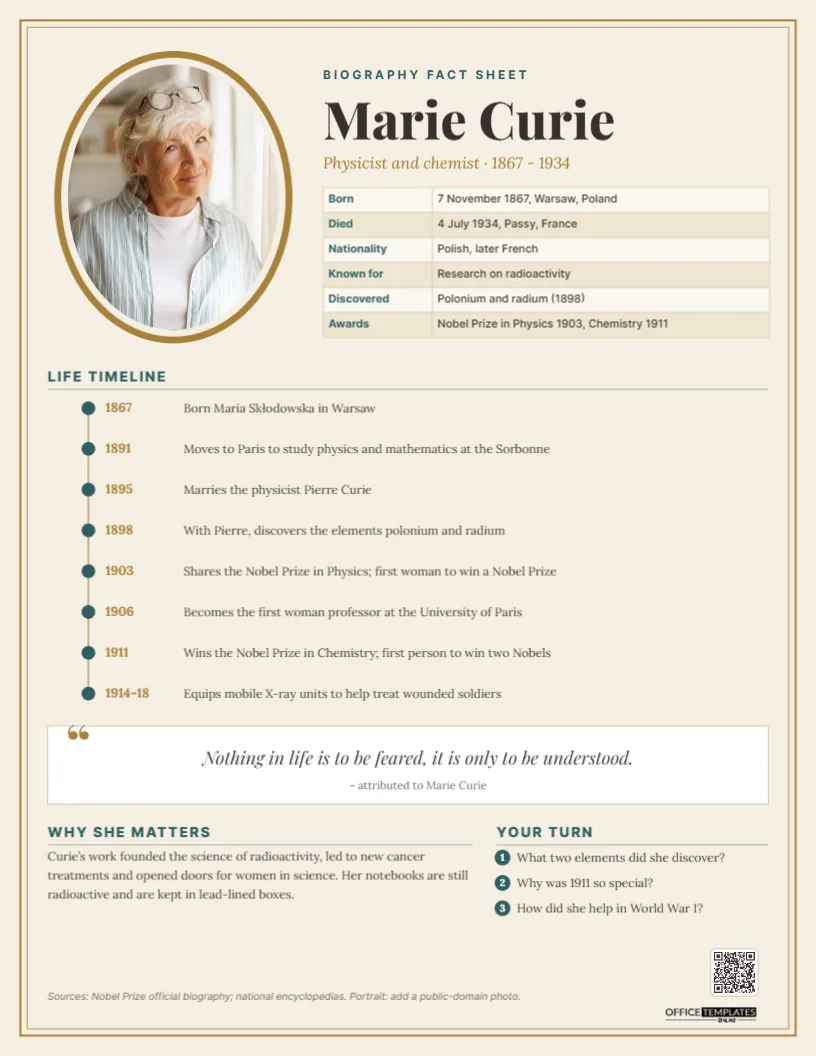
The page has a warm parchment background with a double gold border inset around the edges, like a museum display card. In the top left, an oval portrait slot sits inside a gold oval frame, ready for a historical photograph. Beside it, a teal BIOGRAPHY FACT SHEET label, the name Marie Curie in large Playfair Display, and Physicist and chemist · 1867 – 1934 in gold italic introduce her. A quick facts table lists birth, death, nationality, what she is known for, her discoveries, and her awards.
A Life timeline runs down the middle of the page: a thin gold vertical line with teal dots marking eight moments, from her birth as Maria Sk?odowska in Warsaw to her work equipping mobile X-ray units during the First World War, each with a gold year and a one-line description. A white quote card with a large gold quotation mark holds the line Nothing in life is to be feared, it is only to be understood, marked as attributed to her. At the bottom, Why she matters explains her legacy in three sentences, and Your turn asks three numbered questions. A sources line, a QR code, and our logo complete the page. The sheet is printed on standard US Letter (8.5 x 11 in), portrait.
Marie Curie in Eight Moments
The timeline on the template highlights the moments most useful for students:
- 1867: born Maria Sk?odowska in Warsaw, then part of the Russian Empire.
- 1891: moves to Paris to study at the Sorbonne.
- 1895: marries the physicist Pierre Curie.
- 1898: discovers polonium, named after her homeland, and radium.
- 1903: shares the Nobel Prize in Physics, the first woman to win a Nobel Prize.
- 1906: becomes the first woman professor at the University of Paris.
- 1911: wins the Nobel Prize in Chemistry, the first person to win two Nobel Prizes.
- 1914-18: develops mobile X-ray units to help treat wounded soldiers.
Answer Key for the “Your Turn” Questions
| Question | Answer |
|---|---|
| What two elements did she discover? | Polonium and radium (1898, with Pierre Curie) |
| Why was 1911 so special? | She won her second Nobel Prize in Chemistry, becoming the first person to win two. |
| How did she help in World War I? | She equipped mobile X-ray units that helped doctors treat wounded soldiers near the front. |
Creating a Biography of Someone Else
Duplicate the page and change the name, dates, and role. Click the oval portrait and use Replace Image to add a photograph or portrait; for historical figures, choose public-domain images from museums, national libraries, or archives. Select the quick facts table and use Edit Data to enter the new person’s details. Each timeline entry is a year and a line of text, so retype them; to add a moment, duplicate a dot, year, and line and move them down, extending the gold line. Replace the quote (checking that it is genuinely attributed to the person), rewrite Why they matter and the three questions, and link the QR code (in the Barcodes & QR panel) to a trusted video or article.
Checking Quotes and Facts
Many famous quotations are misattributed. The template marks its quote as attributed to Marie Curie because, like many popular quotes, its exact wording varies between sources. Teach students to check quotes in reputable collections or biographies, and to use attributed to when the source is uncertain. For dates and facts, official sources such as the Nobel Prize organisation’s biographies, national encyclopedias and museum websites are reliable starting points, as the sources line suggests.
Figures Who Work Well With This Layout
Any person with a clear life story and a lasting impact suits the page: scientists such as Isaac Newton, Katherine Johnson or Rosalind Franklin; leaders such as Nelson Mandela or Abraham Lincoln; writers, artists, inventors, explorers, athletes and activists. For contemporary figures, change the timeline to a career timeline and use a recent photo with permission.
Ideas for Presenting Biographies
Students can use their completed page as notes for a short presentation, a wax museum performance in costume, or a meet the scientist interview role-play. Display finished sheets along a classroom timeline to show which figures lived at the same time. Pair biographies with a creative writing task: a diary entry from a key day in the person’s life.
Supporting Different Learners
Younger students can complete a simplified version with four timeline events and one question. Advanced students can add a section on challenges the person faced (Curie faced discrimination as a woman and a foreigner) and on how their work was later built upon. English language learners benefit from the clear structure, and the quick facts table works as a vocabulary scaffold.
Display-Quality Printing
The parchment colour and gold frames look best in colour on slightly heavier paper, especially for display boards and wax museum projects. In black and white, the border and timeline remain clear.
Classroom Questions
Are Marie Curie’s notebooks really radioactive?
Yes. Her papers are still radioactive and are stored in lead-lined boxes; visitors to the archive wear protective clothing.
Can I remove the answer questions for a test?
Yes. Delete the Your turn section or replace it with blank lines for students’ own questions.
Is the portrait slot a fixed size?
The oval frame stays the same size when you replace the image, so any portrait fits neatly.
Open the template to share Marie Curie’s story, or create a biography fact sheet for any person who inspires your students.