Every year, college admissions officers read thousands of transcripts from schools they have never visited. To interpret a 3.6 GPA or a list of AP courses, they rely on the school profile, a one-page document that school counselors send with every application. It explains the school’s size, grading scale, curriculum, test score ranges, and where graduates go. A clear, accurate profile helps admissions readers put each student’s record in context, which is why counseling offices update it every autumn. This High School Profile Template gives counselors a polished, admissions-ready layout.
What Admissions Readers Look For
Admissions officers use the profile to answer specific questions. How rigorous is the curriculum, and did this student take the most demanding courses available? How does the school weight grades? How competitive is the class? Does the school rank? What are typical test scores? What do most graduates do next? The template gives each of these questions a labelled section, arranged in the order admissions readers tend to look.
Navy, Gold and a School Crest
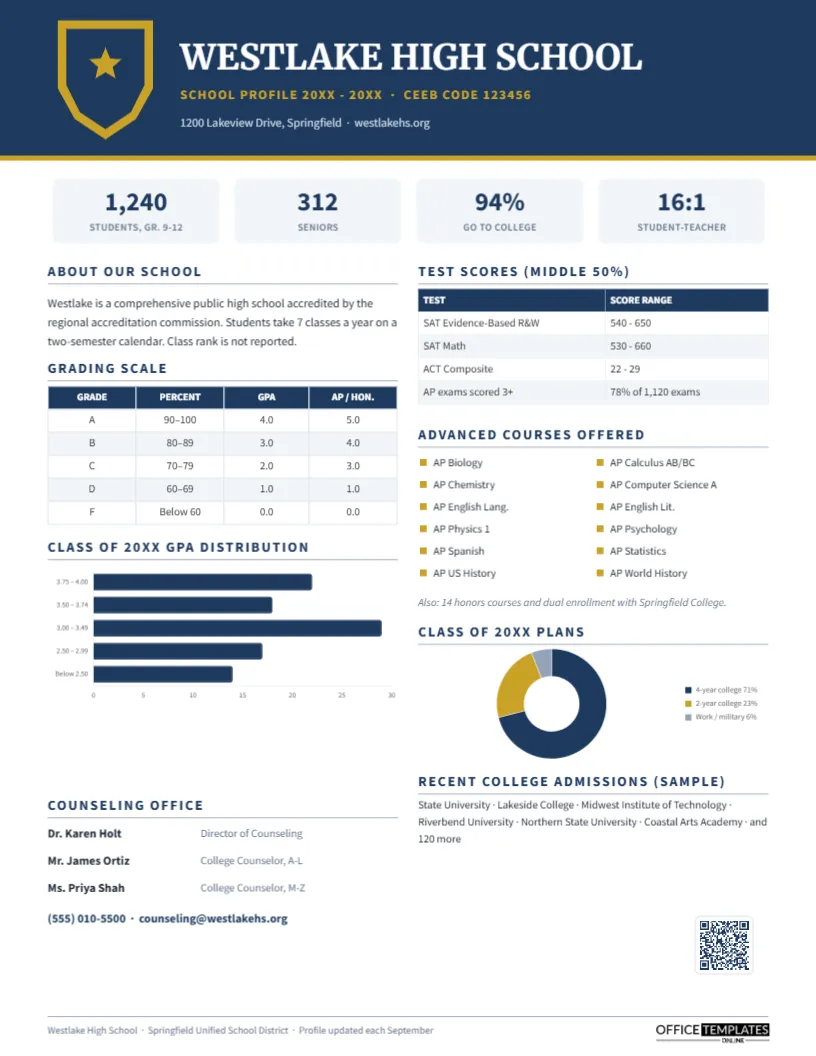
A navy header with a thin gold rule carries a shield-shaped gold crest with a star, the school name, WESTLAKE HIGH SCHOOL, in Merriweather, the profile year and CEEB code in gold, and the address and website. Four pale stat tiles below give total enrolment, the size of the senior class, the college-going rate, and the student-teacher ratio.
The left column holds About our school, a short paragraph covering accreditation, schedule, and class rank policy; a Grading scale table with letter grades, percentages, and unweighted and weighted GPA values; and a Class GPA distribution horizontal bar chart. The right column holds Test scores as middle-50% ranges, Advanced courses offered as a two-column list of twelve AP courses with gold square bullets and a note on honors and dual enrollment, a Class plans doughnut chart of four-year college, two-year college, and work or military, and Recent college admissions. The Counseling office section lists the director and two college counselors with the office phone and email, beside a QR code. It is set on a single US Letter page (8.5 x 11 inches, portrait), the format most admissions offices expect.
Annual Update Checklist for Counselors
| Item | When | Source |
|---|---|---|
| School year and enrolment | September | District enrolment report |
| Senior class GPA distribution | After junior-year grades are final | Student information system |
| Test score ranges | Summer | Testing agency school reports |
| AP, IB and honors course list | Before course selection | Master schedule |
| Graduate plans and admissions list | After graduation | Senior exit survey, college data |
| Grading or ranking policy changes | Whenever policy changes | School board policy |
| Counselor names and caseloads | September | Counseling office |
Editing the Westlake Profile
Replace the crest shapes with your school logo by adding it over the crest area with the editor’s upload tool, or recolour the crest to match school colours. Retype the school name, year, CEEB code, and address. The stat tiles are text boxes. The grading scale and test scores are editor Tables; select each and use Edit Data, adding rows for plus and minus grades if your school uses them. Both charts are editor charts: select one, click Chart Options, then Edit Chart Data to enter your GPA bands or graduation plans. Rewrite the course list, admissions list, and counselor details, and link the QR code (in the Barcodes & QR panel) to your counseling website or course catalogue.
Explaining Grading and Weighting Clearly
Grading practices vary widely, and admissions officers recalculate GPAs in their own ways, so clarity matters. State whether the school reports weighted GPAs and how weighting works (the template shows AP and honors courses weighted by one point for A through C). Explain any course caps on AP enrollment, prerequisites for advanced courses, and whether grades are reported by semester or year. If class rank is not reported, say so plainly, as the template does.
Presenting Rigor Fairly
Admissions readers judge rigor relative to what a school offers. A student who took five AP courses at a school with twelve available has a different record from one at a school with thirty. List every advanced course, including dual enrollment and IB courses, and note any limits on how many students can take them. Schools with few AP courses should explain alternatives, such as online courses or college partnerships.
Presenting Data With Integrity
Profiles are only useful if they are accurate. Present GPA distributions and test ranges for the whole class, not just high achievers, and use middle-50% ranges rather than averages if your testing population is small or self-selected. If only some students take the SAT or ACT, note the percentage tested. Honest profiles build trust with admissions offices over many years.
A Short Note on Context
Admissions readers value context that helps them understand students’ opportunities: the share of students eligible for free or reduced-price lunch, the number of languages spoken at home, a block schedule that limits course load, or recent events such as a building closure. Add a sentence or two to About our school if it helps readers interpret transcripts fairly.
Other Schools and Programs
Private and independent schools, charter schools, international schools, online academies, and home-school cooperatives can all use the layout. International schools might replace AP courses with the IB Diploma subjects and show IB score distributions. Middle schools applying to selective high schools can adapt it for their own admissions audience.
Digital First, Print Second
Most profiles are uploaded to application platforms as PDFs, so export a crisp PDF and check that every number is legible at normal zoom. Print copies for college visits and counselor conferences on bright white paper; the navy and gold design prints cleanly.
School Counselor FAQs
Should the profile include specific colleges?
Yes, a representative sample of recent acceptances or matriculations helps readers understand your graduates’ paths.
Can we include demographic information?
Many schools include a short context line; follow your district’s policies on reporting student data.
How long should the profile be?
One page is ideal, two at most. Admissions readers spend only a few minutes on each profile.
Open the template, add your school’s data, courses, and results, and give admissions officers the context they need to read every transcript fairly.