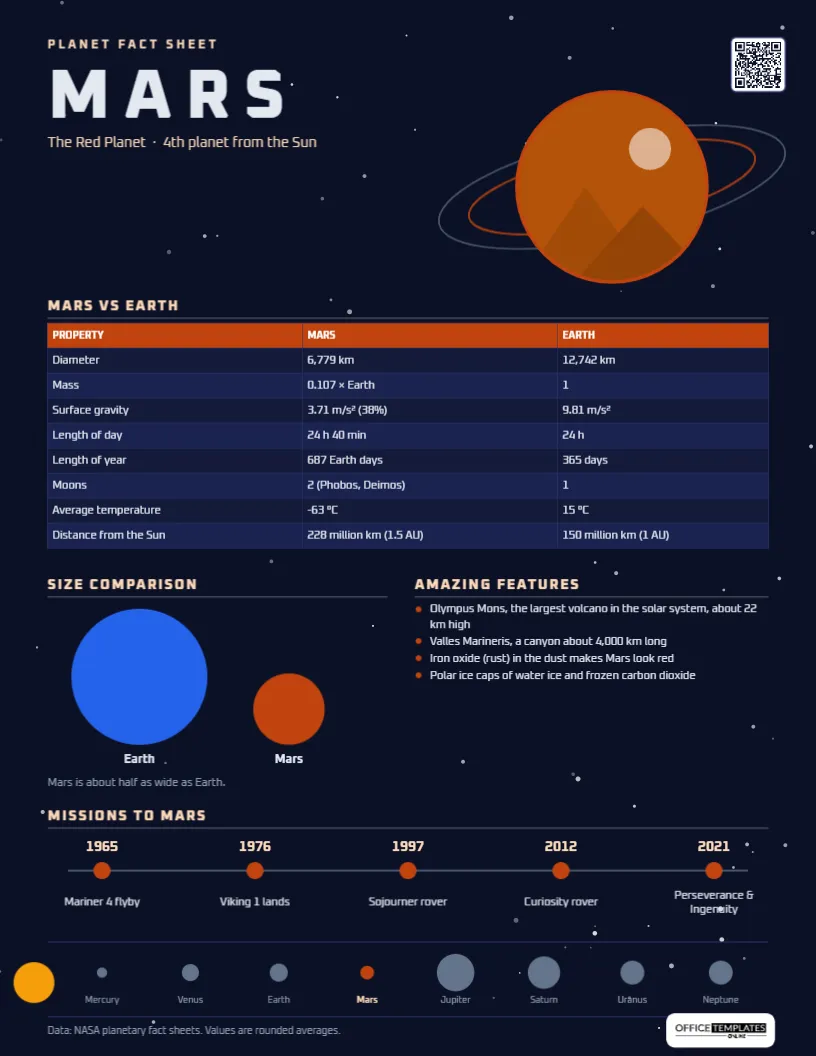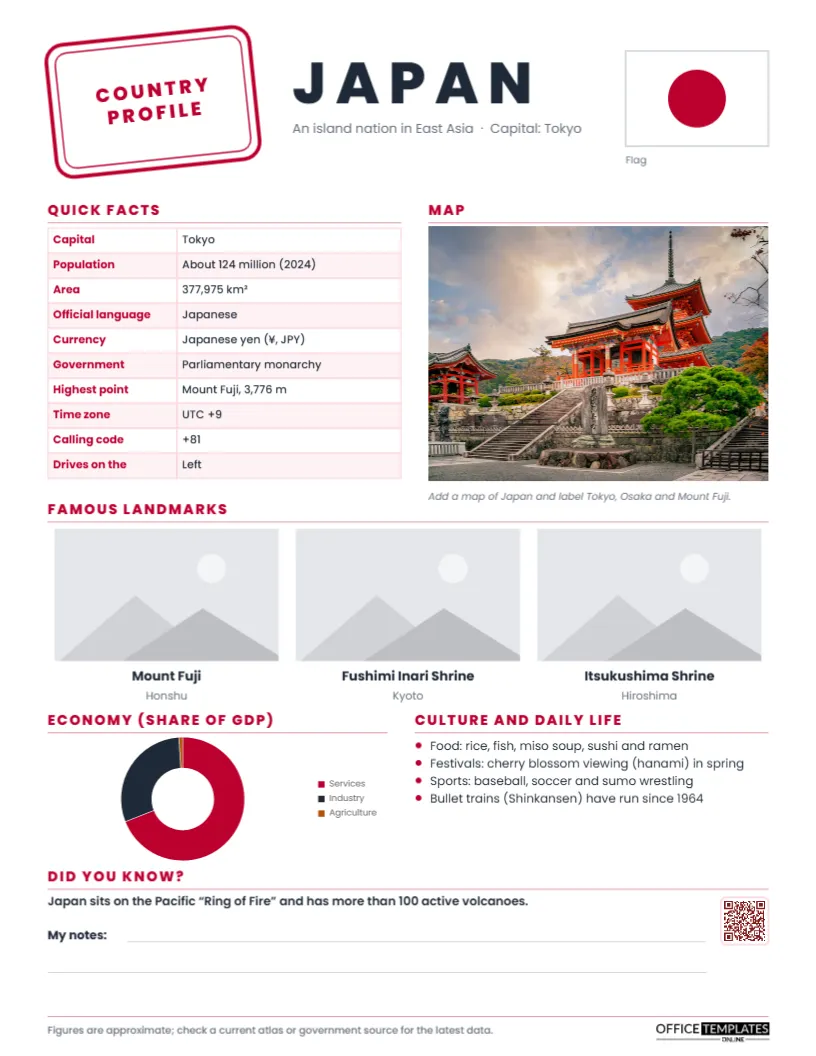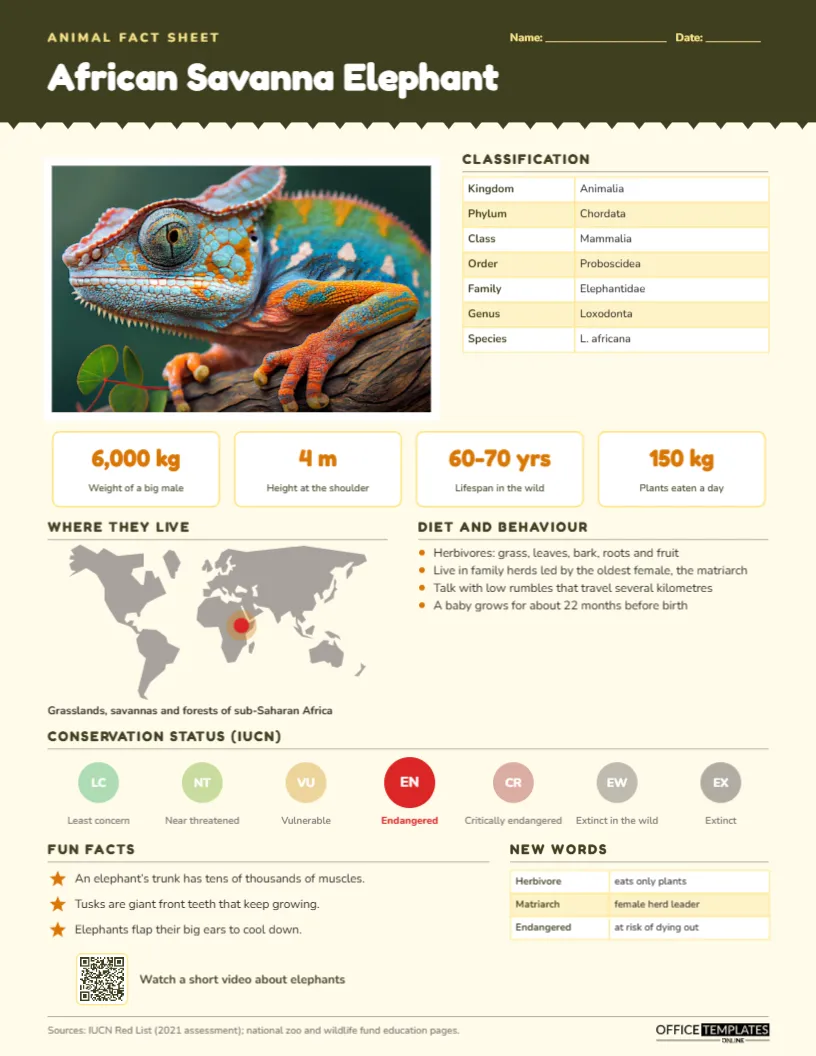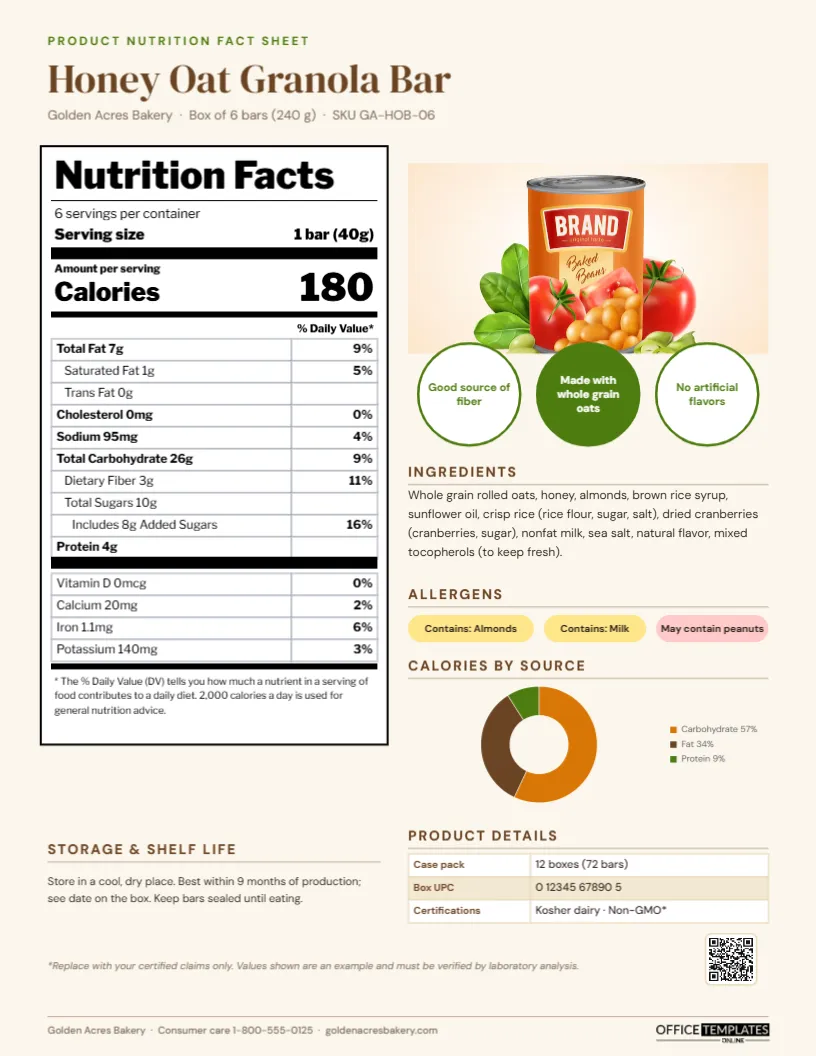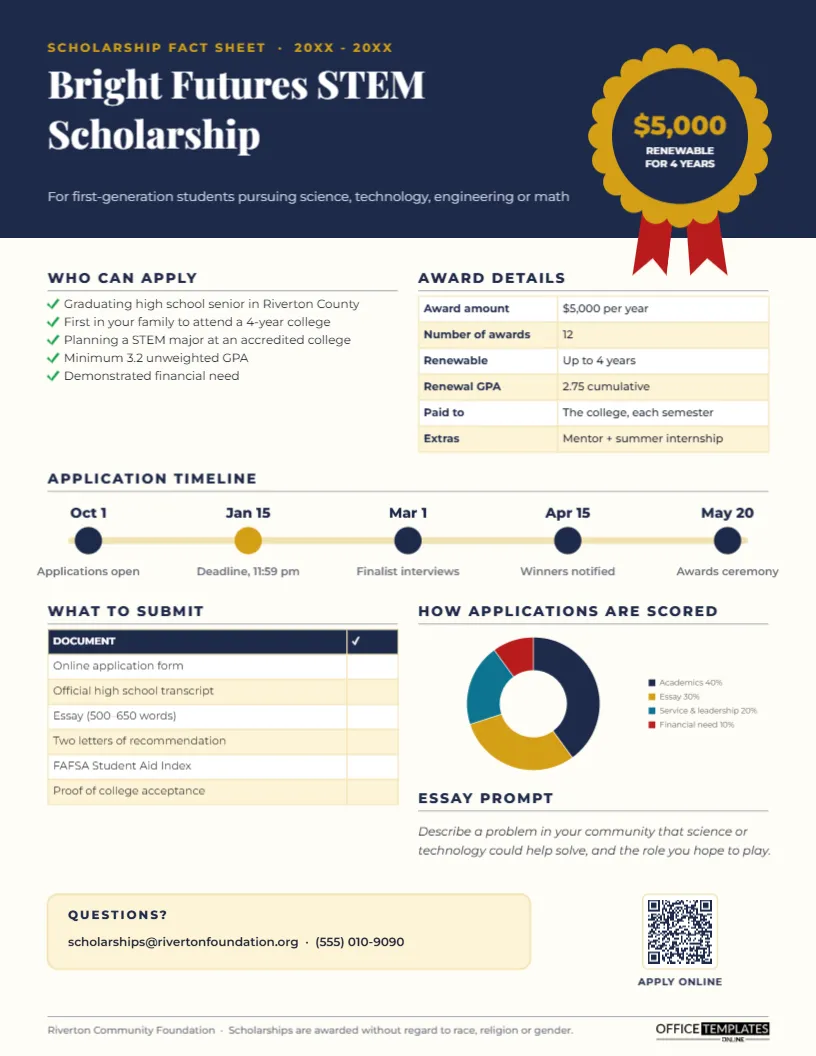
Scholarship providers want the right students to apply, and students want to know quickly whether they qualify and what they need to do. A Scholarship Fact Sheet serves both. It states who can apply, how much the award is worth, when the deadlines are, what to submit, and how applications are judged. Community foundations, companies, alumni associations, clubs, schools, and colleges send these sheets to school counselors, post them on bulletin boards, and share them online every application season. This template, shown for a STEM scholarship for first-generation students, makes a scholarship look as valuable as it is.
A Gold Medal on Navy
The design borrows from awards and ribbons. A navy header holds a gold SCHOLARSHIP FACT SHEET label with the academic year, the scholarship’s name, Bright Futures STEM Scholarship, in large white Playfair Display, and a line describing who it is for. On the right, a gold rosette with a scalloped edge and two red ribbon tails announces $5,000 in gold, Renewable for 4 years beneath, like a medal hanging from the page. The body sits on a warm ivory background.
Who can apply lists five eligibility criteria with green checkmarks. Award details are a table of amount, number of awards, renewal terms, renewal GPA, how funds are paid, and extras such as mentoring. An Application timeline runs across the page as five dots on a track, with dates above and milestones below, and the deadline dot highlighted in gold. What to submit is a document checklist table, and how applications are scored is a doughnut chart weighting academics, essay, service and leadership, and financial need. The Essay prompt appears in italics, and a cream contact box and a QR code labelled APPLY ONLINE complete the page above a non-discrimination statement. The page prints on standard US Letter, 8.5 x 11 inches, in portrait.
For Students: How to Read This Sheet
- Check every line under Who can apply. If you meet all of them, you are eligible.
- Note the deadline, including the time, and put it in your calendar with a reminder two weeks earlier.
- Use the document checklist to gather transcripts and letters early; recommenders need at least three weeks.
- Look at the scoring chart: if the essay is worth 30%, give it that much of your effort.
- Read the essay prompt carefully and answer the exact question.
- Scan the QR code to find the online application.
For Providers: Setting Up Your Scholarship
Retype the name, year, and description in the header. The award amount and renewal text in the gold rosette are separate text boxes; the rosette itself is a group you can recolour. Rewrite the eligibility bullets. The award details and document checklist are editor Tables: select each and use Edit Data, with + Row for additional documents such as a portfolio or résumé. Change the five timeline dates and labels. The scoring doughnut is an editor chart; select it, click Chart Options, and use Edit Chart Data to enter your criteria and weights. Update the essay prompt, contact details, and QR code in the Barcodes & QR panel.
Why Publishing the Scoring Weights Helps
Many scholarships keep their scoring criteria private, but publishing them improves applications. Students put effort where it counts, reviewers get stronger essays, and the process looks fair and transparent. If your committee uses a rubric, the chart can mirror its sections. Consider also publishing what a strong essay looks like, or holding an information session.
Writing Clear, Fair Eligibility Rules
Ambiguous eligibility wastes everyone’s time. Define terms precisely: first-generation usually means neither parent has completed a four-year degree, but say so. State whether the GPA is weighted or unweighted, which majors count, and whether part-time students qualify. Make sure criteria comply with applicable law and your organisation’s policies, and include a non-discrimination statement, as the footer does.
Sample Planning Calendar for Providers
| Month | Task |
|---|---|
| August | Confirm funding, update criteria and the fact sheet |
| September | Send the fact sheet to school counselors and community partners |
| October | Open applications; hold an online information session |
| January | Application deadline; begin reviewer scoring |
| March | Finalist interviews |
| April–May | Notify winners, hold the awards ceremony, pay the first installment |
Reaching Students Who Need It Most
Scholarships aimed at first-generation or low-income students only work if those students hear about them. Send fact sheets directly to school counselors and college access programs, post them in libraries and community centres, share them with youth organisations and faith communities, and translate them for families who speak other languages. The QR code lets students apply straight from a bulletin board.
Writing an Essay Prompt That Reveals the Student
A good prompt invites a personal answer that only that student could write. The sample asks applicants to describe a community problem that science or technology could help solve and the role they hope to play, which connects the scholarship’s mission with the student’s own experience. Avoid prompts that reward polished writing over substance, such as Why do you deserve this scholarship? Keep the word limit reasonable; 500 to 650 words is common, and state it on the sheet so students do not over- or under-write.
Beyond STEM
The layout suits any award: arts, athletics, community service, trade and vocational scholarships, graduate fellowships, employee children’s scholarships and memorial funds. Change the name, colours, eligibility, and scoring criteria. Companies can use it for tuition assistance programs, and schools for internal awards.
Printing for Counselors’ Offices
Print in colour on bright white or ivory paper; the gold rosette and navy header make the page stand out on crowded counselor boards. Send the PDF to counselors by email too, since many forward it to eligible students directly.
Scholarship Committee FAQs
Can I list several award levels?
Add rows to the award details table for each level, and change the rosette to show Up to $5,000.
Should I include past winners?
A short line or a second page with past winners’ photos and colleges inspires applicants.
Can the timeline have more steps?
Ungroup the timeline, duplicate a dot, and spread the dots evenly along the track.
Open the template, add your scholarship’s details, dates, and criteria, and help the right students find the support they deserve.