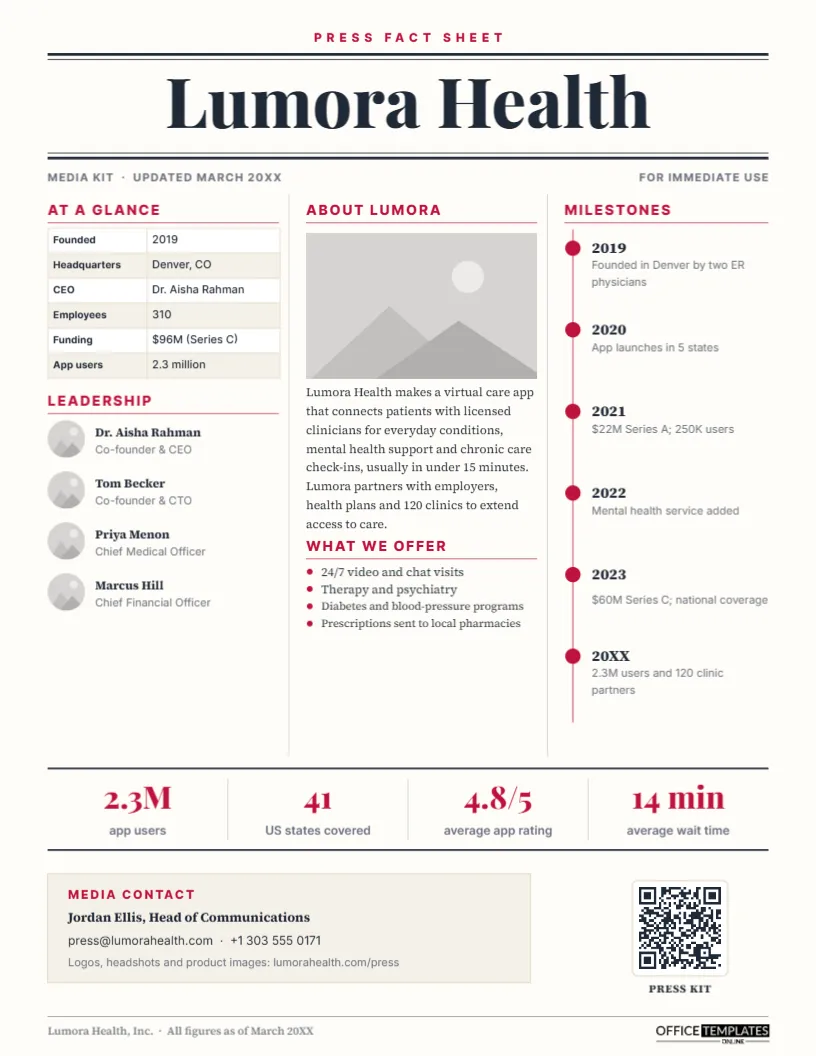
Journalists on a deadline need facts fast: when the company was founded, who runs it, how many people it serves, what it has achieved, and who to call for a quote. A press fact sheet puts all of that on one page, so reporters do not have to dig through your website or wait for an email reply. It is the most used document in any media kit. This Press Fact Sheet Template presents those facts with the confidence of a newspaper front page, complete with masthead, ruled columns, and a strip of big numbers.
Why Reporters Love a Good Fact Sheet
A press release tells one story. A fact sheet supports every story. Reporters use it to check spellings of executives’ names, confirm founding dates, pull statistics for a sentence of context, and find the right contact. Because it is designed to be scanned, not read top to bottom, every fact needs its own clearly labelled place. Getting this right means fewer errors in coverage and fewer follow-up calls to your team.
Masthead, Columns and a Stat Strip
The top of the page imitates a newspaper masthead: a small red PRESS FACT SHEET label, thick and thin rules, the company name, Lumora Health on the sample, in large Playfair Display, and a line with Media kit · Updated March 20XX and For immediate use. Below, three columns are separated by fine vertical rules:
- Left column: an At a Glance table (founded, headquarters, CEO, employees, funding, users) and a Leadership list with small round headshots, names, and titles.
- Middle column:About Lumora with a product photo and the company boilerplate, followed by What We Offer in four bullets.
- Right column: a vertical Milestones timeline with red dots, years, and short descriptions.
A stat strip between heavy rules shows four headline numbers in large red serif type. A Media Contact box gives the communications lead’s name, email, and phone, plus where to find logos and headshots, next to a QR code labelled PRESS KIT. It is designed as a single 8.5 x 11 inch US Letter page, portrait.
Checklist: Facts Every Media Kit Should Include
| Fact | Where it goes | Why reporters need it |
|---|---|---|
| Official company name and spelling | Masthead | Avoids errors in print |
| Founding year and location | At a glance | Context for the story |
| Leadership names and titles | Leadership | Accurate attribution of quotes |
| Boilerplate | About | Often quoted word for word |
| Key metrics | Stat strip | Adds scale to a story |
| Milestones | Timeline | Background and how we got here |
| Media contact | Contact box | Someone who answers on deadline |
Writing a Boilerplate That Gets Quoted
The About paragraph is often copied directly into articles, so write it carefully. In two to four sentences, say what the company does, for whom, and one proof point of scale or impact. Use plain language and avoid superlatives such as leading unless you can prove them. Keep the same boilerplate on your press releases so it stays consistent everywhere.
Updating the Lumora Template
- Company name: double-click the masthead name and type your own; long names fit if you reduce the size slightly.
- Update line: change the date each time you revise the facts.
- At a Glance table: choose Edit Data after selecting it to type your facts; add rows with + Row.
- Photos: click the product image or any leadership circle and use Replace Image.
- Milestones: each year and description is its own text box; keep descriptions to one or two short lines.
- Stat strip: retype the four numbers and labels.
- QR code: link it to your online press room in the Barcodes & QR panel.
Choosing Numbers That Hold Up
Every figure on a fact sheet may appear in print, so use numbers you can defend and date them. Prefer precise, verifiable metrics (users, locations, employees, funding raised) over vague claims. If a number changes often, round it and note the date. Reporters appreciate a source or date on figures that come from surveys or third parties.
Sample Boilerplate You Can Adapt
Lumora Health builds a virtual care platform that connects patients with licensed clinicians by video, chat and phone in under ten minutes. Founded in 2016 in Austin, Texas, Lumora serves more than 2.4 million members through 900 employer and health plan partners. The company is backed by leading healthcare investors and employs 480 people across the United States.
Notice the structure: what the company does and for whom in the first sentence, when and where it was founded in the second, and proof of scale in the third. Swap in your own facts and keep the length under eighty words. Journalists rarely use more than that, and a short boilerplate is less likely to be edited in ways you would not choose.
Preparing Spokespeople Alongside the Sheet
The fact sheet works best when the people named on it are ready to talk. Before a launch or announcement, confirm which leader will speak to which topic, make sure they know the figures on the page by heart, and agree on how to answer questions about numbers you do not publish. Consistency between what the sheet says and what a spokesperson says in an interview protects your credibility.
Other Ways to Use the Layout
Beyond companies, the newspaper layout suits nonprofits, universities, hospitals, events, festivals, government agencies, and public figures. A politician’s campaign can use it for a candidate fact sheet; a product launch can use it with the milestones column turned into a list of features; an event can use it for dates, venues and speakers.
Distributing Your Fact Sheet
Post the PDF in the press room of your website, attach it to press releases and pitches, include it in USB or printed media kits at events, and send it to reporters before interviews. Update it at least every quarter, and immediately after major news, such as funding, leadership changes, or acquisitions.
Print and Screen Tips
The cream background and serif typography give the page an editorial feel both on screen and on paper. Download the PDF for email, and print on bright white or natural white paper for events. The fine column rules print cleanly on laser printers.
PR Team Questions
How long should a press fact sheet be?
One page. If you need more, create separate fact sheets for products or executives.
Can I add executive bios?
Keep one-line titles on the fact sheet and put full bios in a separate document linked from the QR code.
Should I include funding amounts?
If they are public, yes; investors and funding rounds are common background facts in business coverage.
Open the template, add your facts, people, and milestones, and give every journalist a fact sheet that makes your story easy to get right.