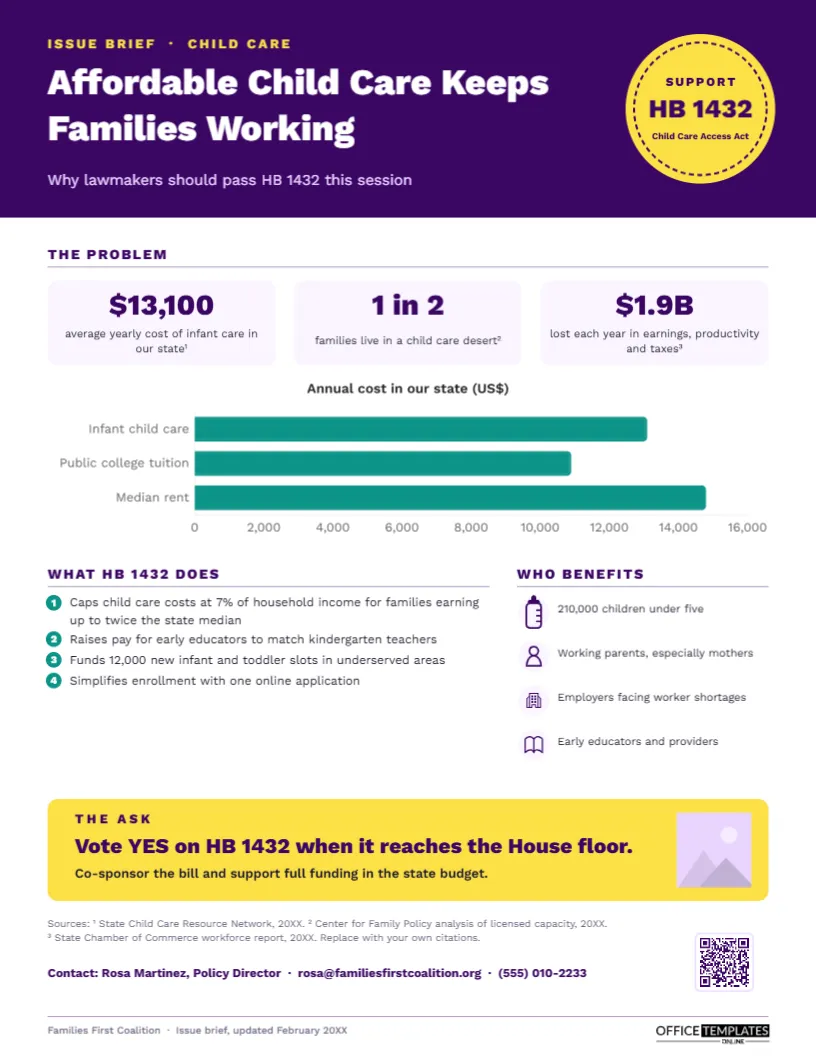
Legislators and their staff are flooded with information. During a session, a staffer may meet a dozen advocacy groups in a day, each leaving behind papers. The groups that succeed leave one page that makes the case in two minutes: the problem, the evidence, the solution, who benefits, and exactly what they want the legislator to do. That page is the Policy Fact Sheet, also called an issue brief or leave-behind. This Policy Fact SheetTemplate, designed for a child care bill, is built to be read, remembered, and acted on.
Built for a Two-Minute Read
A legislative staffer typically decides in the first few seconds whether a document is worth reading. This design is organised for that. The headline states the position, the badge names the bill, three numbers establish the problem, a chart gives context, and a bright yellow box states the ask. Everything else, the bill’s provisions and the list of who benefits, supports those points for readers who have more time.
Deep Purple, Teal and a Campaign Badge
A deep purple header holds a yellow ISSUE BRIEF · CHILD CARE label, the headline Affordable Child Care Keeps Families Working in bold white Work Sans, and a subtitle naming the bill. On the right, a round yellow badge with a dashed purple inner ring reads SUPPORT, HB 1432, and the bill’s short title, like a campaign button.
The problem section shows three lavender stat panels: the average yearly cost of infant care, the share of families in child care deserts, and the annual economic loss, each with a superscript footnote number. A teal horizontal bar chart then compares infant care costs with public college tuition and median rent. What HB 1432 does lists four provisions with numbered teal circles, and Who benefits pairs four small icons (children, parents, employers, and educators) with short labels. A yellow The ask box states the request in large purple type: Vote YES on HB 1432 when it reaches the House floor, with a secondary ask below it and a logo slot for your coalition on the right. Numbered source citations, a contact line with the policy director’s name, a QR code, and a footer finish the page. Page size: US Letter, 8.5 x 11 inches, portrait.
A Fill-In Framework for Any Issue
Customising the Brief
Retype the label, headline and subtitle, and change the badge text to your bill number and short title; if you oppose a bill, change SUPPORT to OPPOSE and consider a different badge colour. The three stat panels are text boxes. The chart is an editor chart: select it, click Chart Options, and then Edit Chart Data to enter your own comparison figures and chart title. Rewrite the provisions and beneficiaries; the small icons are editable vectors that you can swap from the icon library. Replace the logo slot in the ask box using Replace Image, update the sources, contact, and QR code (in the Barcodes & QR panel), and put the date in the footer.
Making the Numbers Local
National statistics are easy to find but easy to ignore. Legislators respond to numbers from their own state and, better still, their own district: how many families in this district, how many providers closed here, how much this costs local employers. If district data is not available, use state data and add a personal story from a constituent in person during the meeting. Every figure should have a footnote with a credible, recent source, as the template shows.
Writing a Clear Ask
The most common failure in advocacy materials is a vague ask. Support families is not an action; Vote YES on HB 1432 when it reaches the House floor is. Make the primary ask specific and time-bound, and add a secondary ask for legislators who are not ready to commit, such as co-sponsoring, supporting funding in committee, or meeting with constituents. Put the ask in the most visible place on the page, which is why it sits in a bright yellow box.
Nonpartisan Tone Wins Staff Trust
Staff from both parties read your brief. Avoid partisan language, attacks on opponents, and exaggeration. Frame the issue in terms most people share: working families, jobs, children, economic growth, fiscal responsibility. A calm, evidence-based page that respects the reader’s intelligence earns a second meeting far more often than an emotional one.
Preparing for the Meeting
Bring enough copies for the legislator and each staffer present. Practise summarising the page in ninety seconds, open with a constituent’s story, and close by restating the ask. Leave the sheet behind and send the PDF by email the same day with a thank-you note. Follow up closer to the vote. Keep a log of which offices received the brief and their response.
Beyond State Legislatures
The same design works for city council ordinances, county budget requests, school board proposals, congressional visits, ballot measures, and regulatory comment campaigns. Nonprofits, trade associations, unions, chambers of commerce and professional societies can all use it for their advocacy days.
Legal and Lobbying Rules
Advocacy is regulated. In the US, nonprofits organised under 501(c)(3) can lobby within limits but cannot endorse candidates, and many states require lobbyist registration and reporting. Check with counsel before your advocacy day, and make sure the brief identifies who produced it, as the footer does.
Printing for Lobby Day
Print on bright white paper; the purple header and yellow ask box need colour printing. Bring copies in a folder so they arrive unwrinkled, and keep a few spare for unexpected meetings in the hallway.
Advocate FAQs
Should the brief be longer for complex bills?
No. Keep one page and offer a longer analysis as a separate document or through the QR code.
Can I oppose a bill with this template?
Yes. Change the badge and headline, and frame the problem around the bill’s harms.
Can I add a constituent quote?
Replace one stat panel with a short quote and the constituent’s town.
Open the template, add your issue, evidence, and ask, and give lawmakers a policy brief that is easy to read and hard to forget.