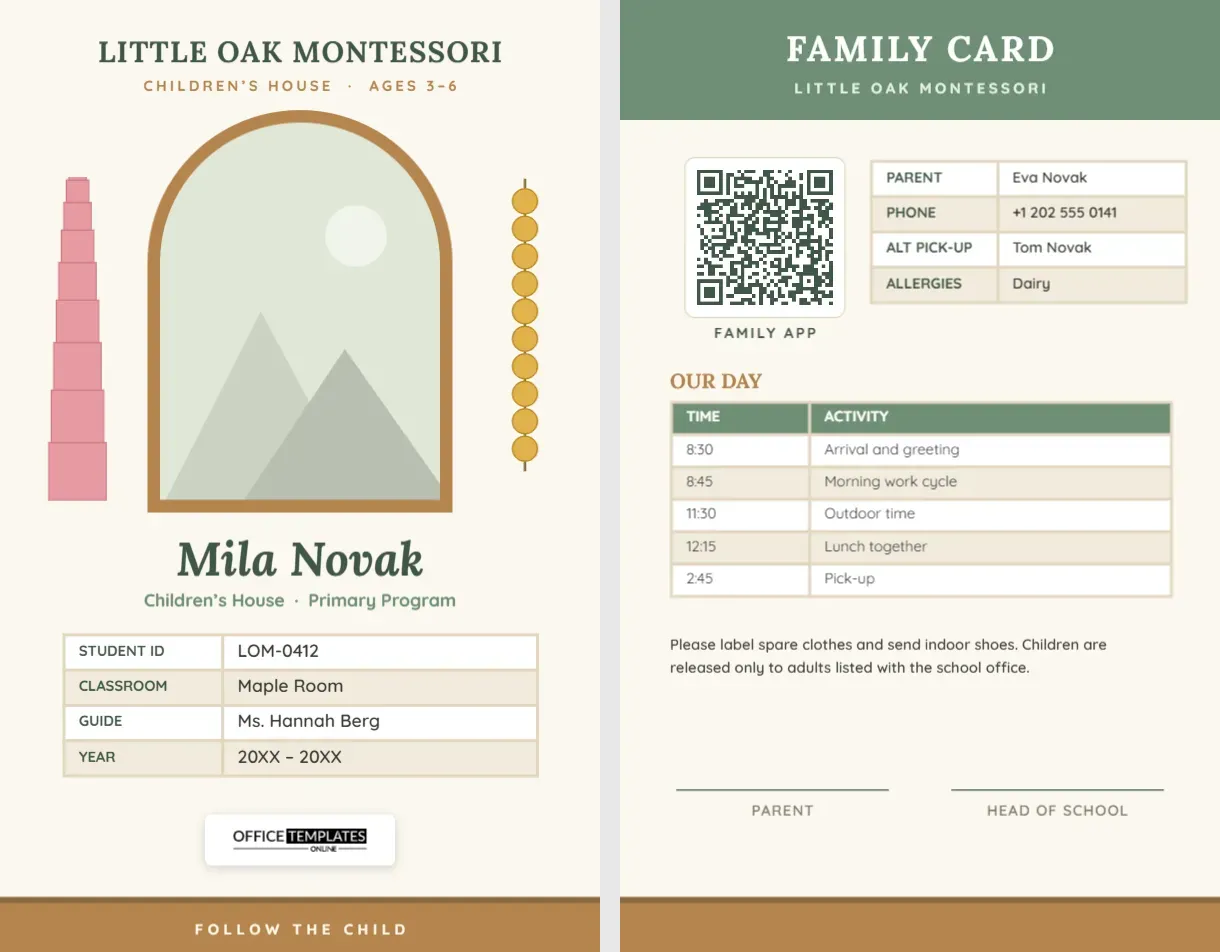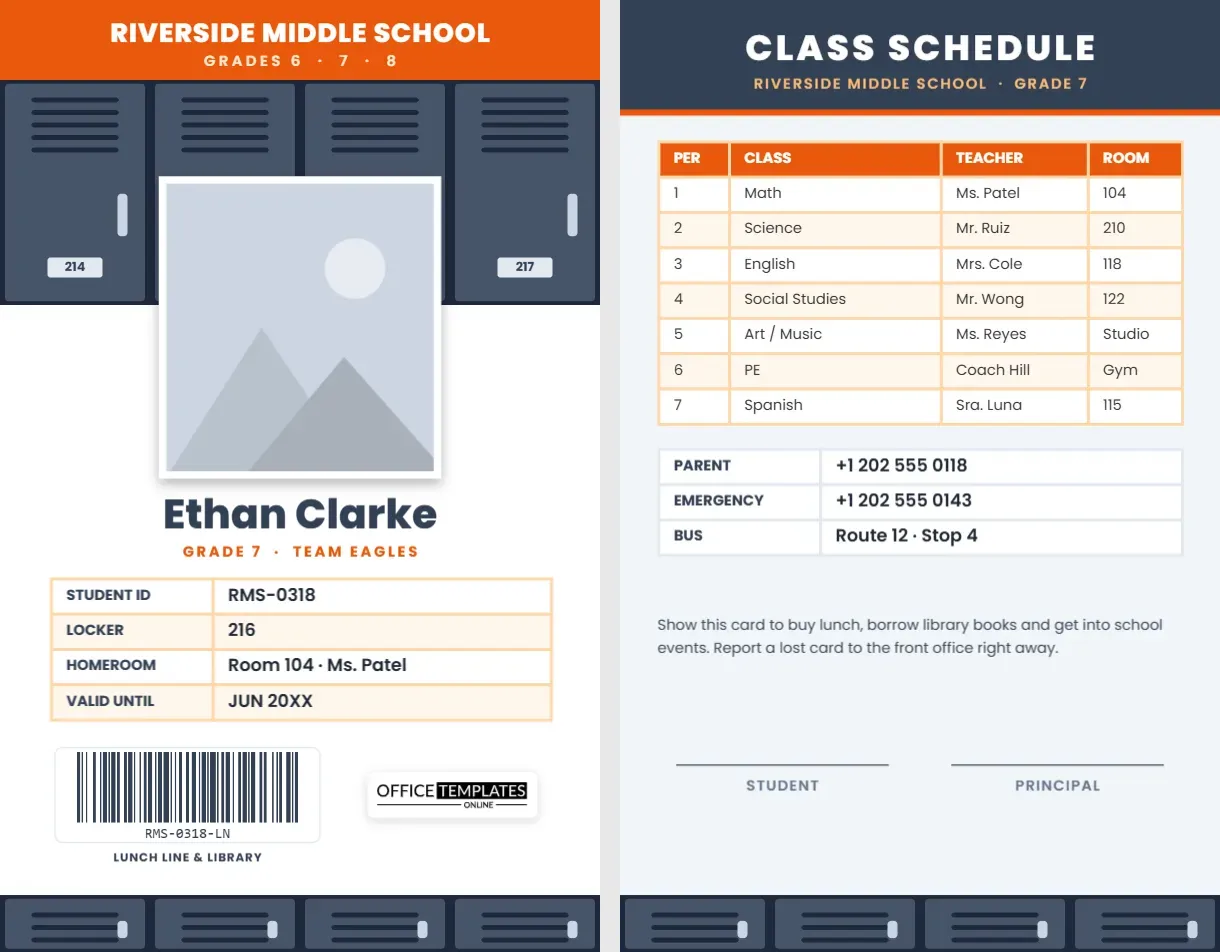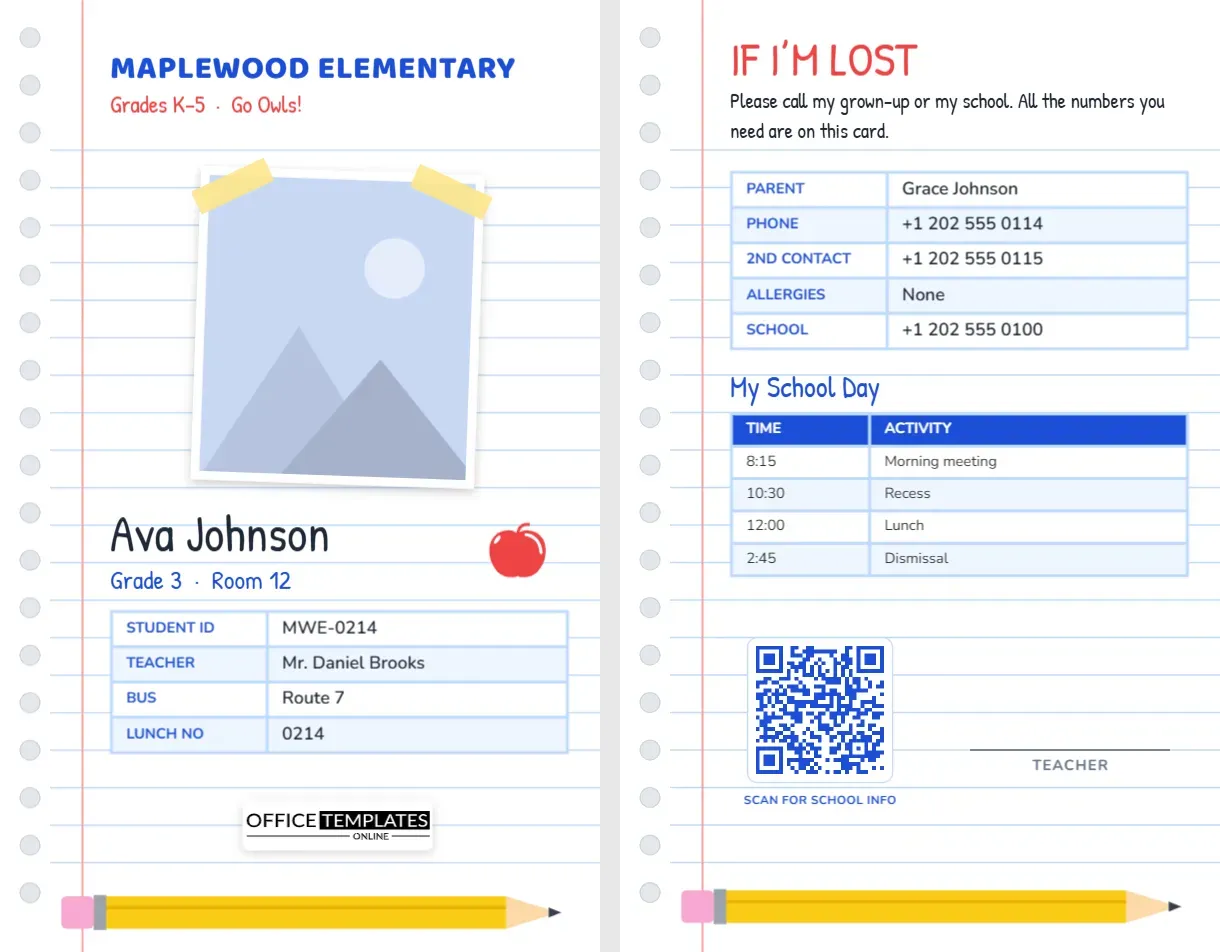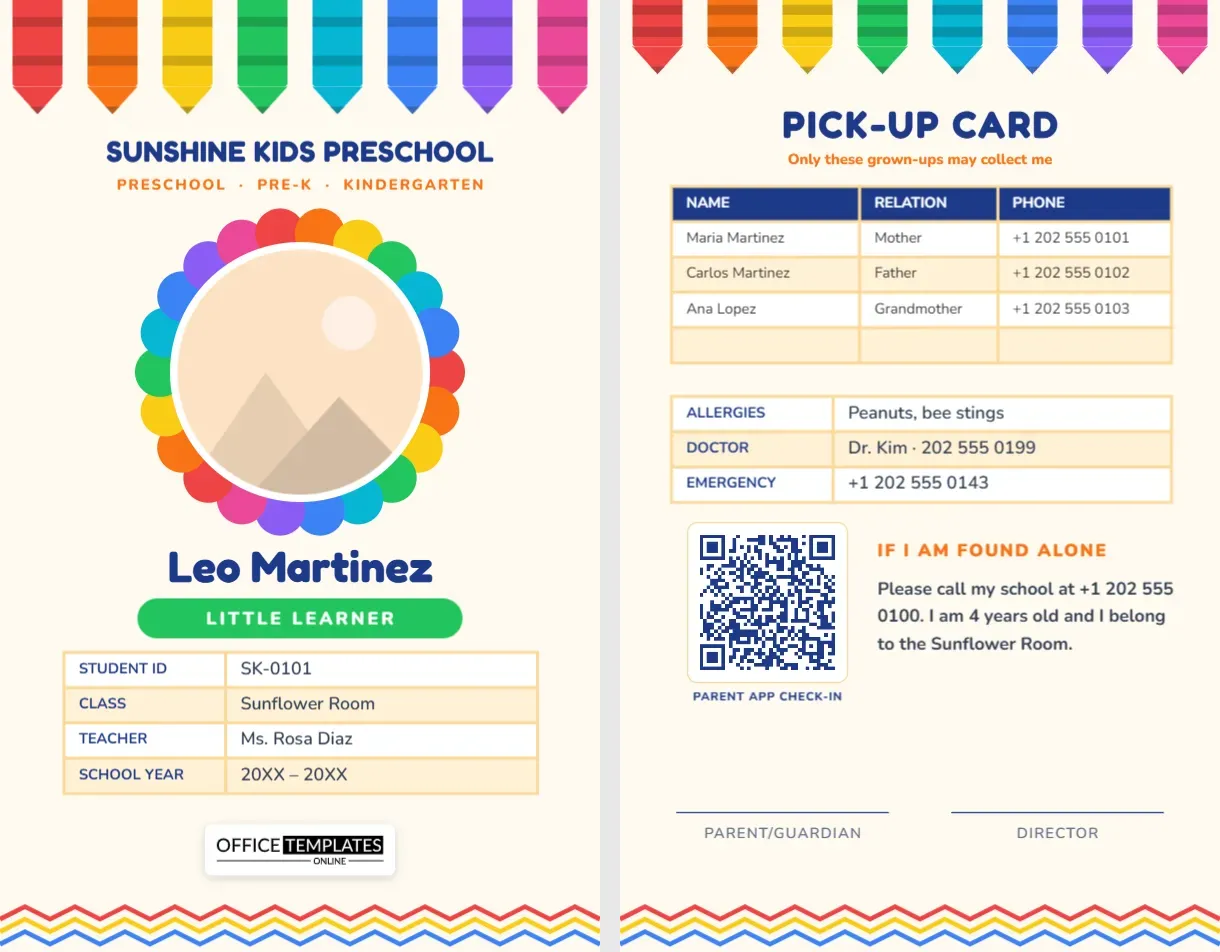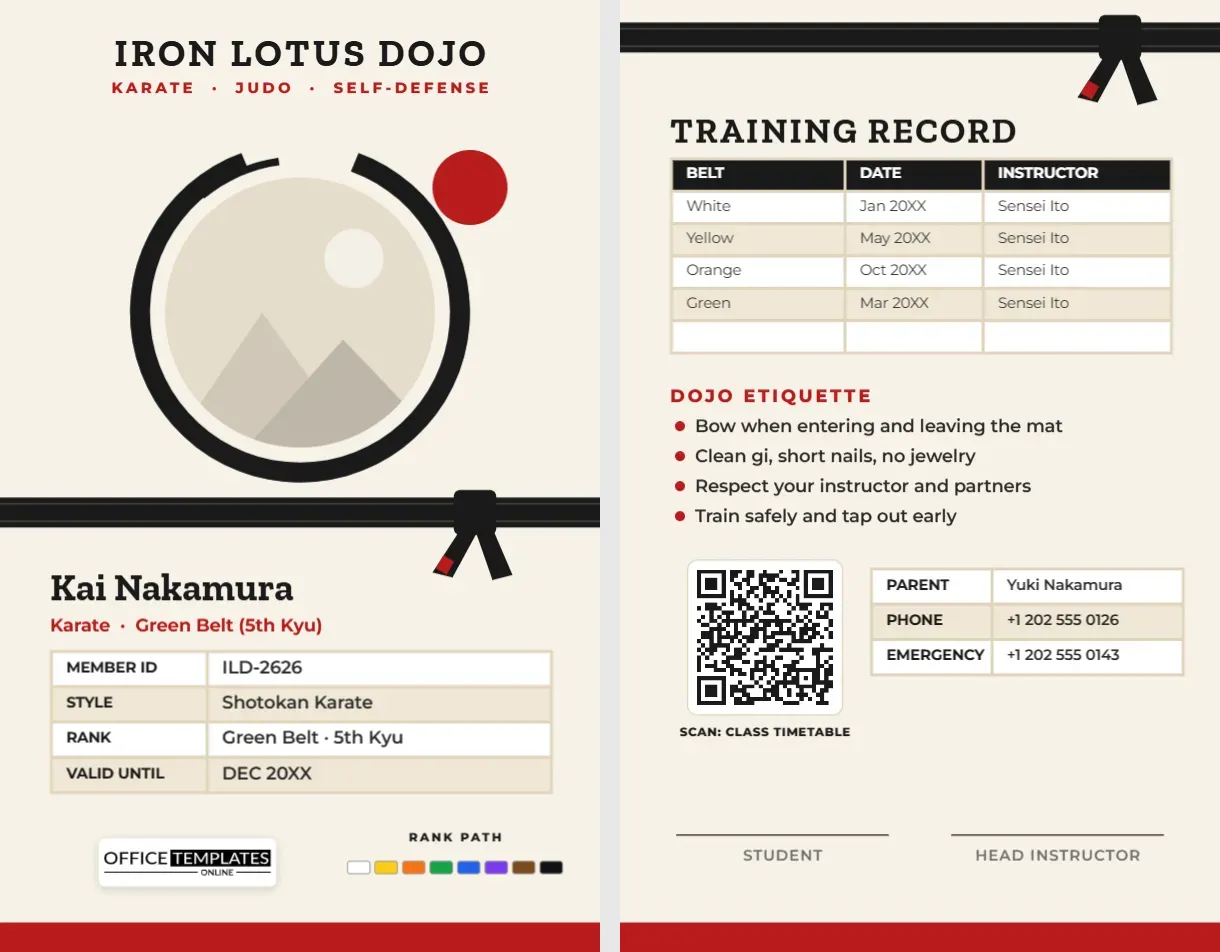
In a dojo, progress is visible: every new belt is earned through months of practice and a grading in front of an instructor. Students of all ages love to see that journey recorded, and dojos need a simple way to confirm membership, rank, and emergency contacts. This Martial Arts Student ID Card captures both. The student’s photo sits inside an ens?, the hand-brushed Zen circle, a tied belt crosses the card like one worn around a gi, and a small rank path shows every belt colour from white to black.
Ens?, Belt and Rising Sun
The card has a warm rice-paper cream background. At the top, IRON LOTUS DOJO is set in Zilla Slab, a strong slab serif, with Karate · Judo · Self-Defense in red. The student’s photo is round and surrounded by an ens?: a thick black brush circle drawn in one sweep, left slightly open where the brush lifted off the paper, with a thinner second stroke echoing it. A red sun sits just above the circle’s right shoulder.
Beneath the photo, a black belt stretches across the full width of the card, with its knot tied near the right edge and two ends hanging down; a small red tab on one end suggests the stripes instructors add between gradings. Below the belt, the student’s name is set in Zilla Slab, Kai Nakamura on the sample, with Karate · Green Belt (5th Kyu) in red. A table lists the member ID, style (Shotokan Karate), rank, and validity date. Our logo sits on a white plate beside a RANK PATH of eight small belt swatches: white, yellow, orange, green, blue, purple, brown, and black. A red band runs along the bottom edge.
The card measures 2.125 x 3.375 inches, the portrait CR80 size.
The Training Record
The back is headed by the same tied belt, followed by TRAINING RECORD. A table records each belt with the date and instructor: white in January, yellow in May, orange in October, and green in March, all awarded by Sensei Ito, with a blank row for the next grading. A Dojo Etiquette list reminds students to bow when entering and leaving the mat, keep a clean gi, short nails and no jewellery, respect their instructor and partners, and train safely and tap out early. A QR code labelled SCAN: CLASS TIMETABLE links to the dojo’s schedule, and a table lists the parent’s name, phone, and emergency number. Signature lines for the student and head instructor sit above the red band.
Belt Order in Many Karate Schools
| Belt | Kyu grade (example) | Typical training time |
|---|---|---|
| White | 10th/9th kyu | Beginning |
| Yellow | 8th kyu | About 3 months |
| Orange | 7th kyu | About 3-6 months |
| Green | 6th/5th kyu | About 6 months |
| Blue and purple | 4th/3rd kyu | 6-12 months each |
| Brown | 2nd/1st kyu | About a year each |
| Black | 1st dan and above | Several years of training |
Belt colours and timings differ between styles and organisations; edit the rank path and the training record to match your syllabus.
Personalising the Iron Lotus Card
- Photo in the ens?: the round portrait inside the brush circle is the slot; select it and use Replace Image. A photo in a clean gi works best.
- Dojo name and arts: retype IRON LOTUS DOJO and the styles line, for example, Taekwondo · Hapkido or Brazilian Jiu-Jitsu.
- Rank: update the red line and RANK row after each grading.
- Belt colour: the belt across the front is one group; recolour it to the student’s current belt so the card changes with them.
- Tables: the membership details and the training record update with Edit Data; new gradings get their own line via + Row.
- QR code: link it to your class timetable or grading calendar in the Barcodes & QR panel.
The Meaning of the Ens?
The ens? is a circle drawn in a single brushstroke, a practice associated with Zen Buddhism in Japan. It is often said to express a moment when the mind is free to let the body create, and its open, imperfect form suggests that there is always room to grow. That idea fits martial arts perfectly: students train for years and still consider themselves beginners. Framing the student’s portrait in an ens? is a quiet reminder of that humility.
Gradings and Record Keeping
Gradings are exciting and nerve-racking for students, and accurate records matter: which belt was awarded, when, and by whom. Some organisations also require a minimum number of training hours or months between gradings. The training record on the back gives each student a personal history they can keep, while the dojo keeps its official register. For children, updating the card after a successful grading is a proud moment worth celebrating in class.
Dojos, Academies and Club Classes
Karate, judo, taekwondo, jiu-jitsu, kung fu, aikido and kickboxing schools, community centre martial arts classes, school clubs and university martial arts societies can all use this design. Instructors can make a matching card with a black belt and the title SENSEI or INSTRUCTOR.
Printing Brush Strokes and Belt Colours
The black brush circle, belt, and red accents print strongly on cream. Check that the small belt swatches in the rank path, especially white and yellow, are visible against the background; they have thin grey outlines to help. Laminate cards for children, since they will end up in gym bags with water bottles and sparring gear.
Checking In at Class and Tournaments
Busy dojos often scan or check membership cards at the door to track attendance, which many instructors use to decide when a student is ready to grade. At tournaments, the card helps officials confirm a competitor’s rank and division before they step onto the mat.
Dojo Questions
Can I show stripes on the belt?
Yes. Add small white or coloured rectangles near the belt end, or recolour the red tab.
Can adults and children use the same design?
Yes. Change the rank line and table; many dojos use the same card for all ages.
Is the ens? editable?
It is built from brush-like strokes grouped together, so you can recolour it or remove it.
Open the template, place the student inside the ens?, tie on their current belt, and record every step of their journey on the mat.