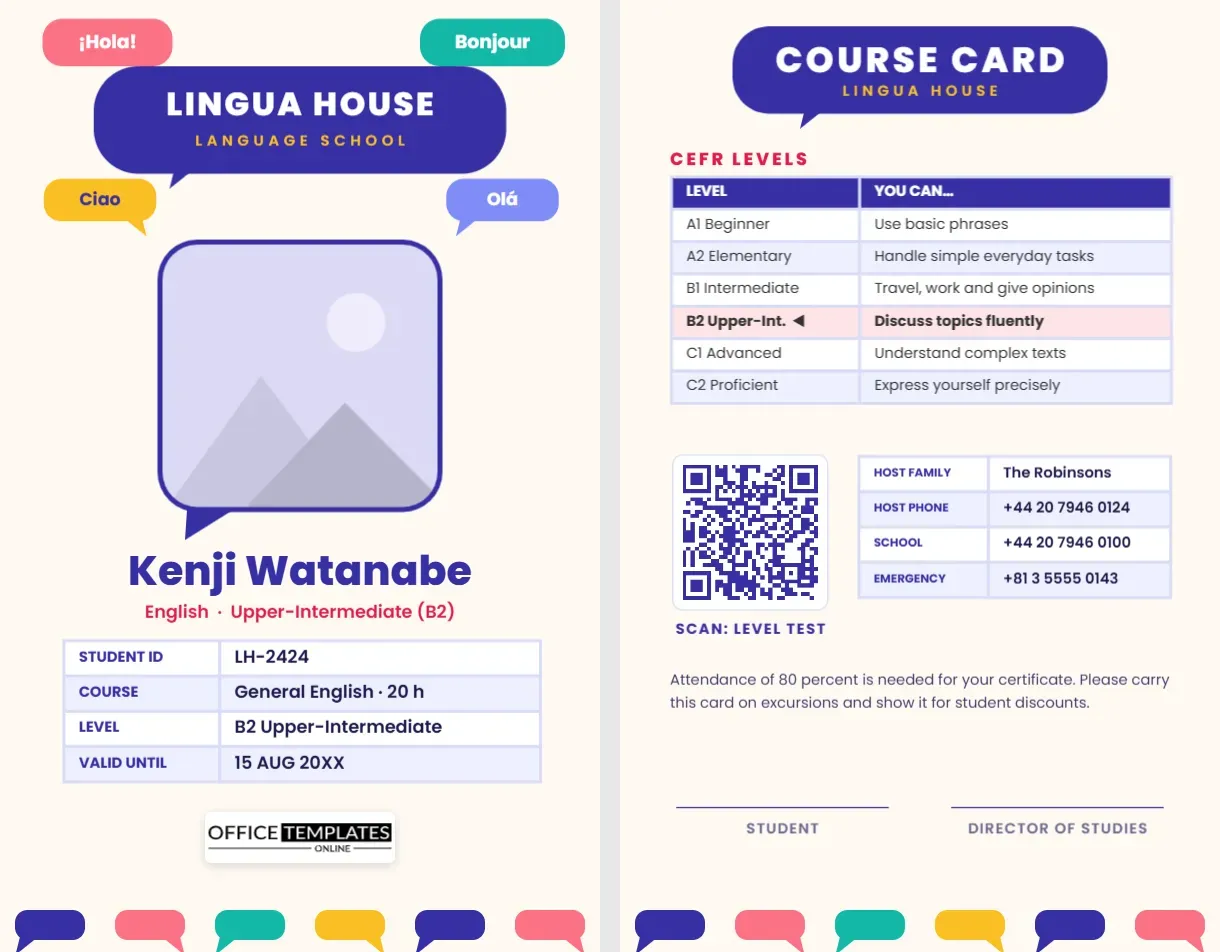
Language schools welcome students from all over the world, often for a few weeks or months, and those students need a card for everything from class registration to museum discounts and host family details. Because many are far from home and still learning the local language, the card should be friendly, clear, and easy to understand. This Language School Student ID Card is built around the very act of speaking: colourful speech bubbles say hello in several languages, and the student’s photo sits in a bubble of its own.
Hello in Many Languages
The top of the card is a cheerful cluster of speech bubbles on a warm cream background. A large indigo bubble in the middle carries LINGUA HOUSE in bold white Poppins with LANGUAGE SCHOOL in yellow. Around it, smaller bubbles say ¡Hola! in coral, Bonjour in teal, Ciao in yellow, and Olá in periwinkle, each with a little tail pointing toward the centre, as if a conversation were happening in the corridor between classes.
The student’s photo is a rounded square with an indigo border and a small tail at the bottom-left, so the whole portrait looks like a speech bubble. Below it, the student’s name, Kenji Watanabe on the sample, is set in bold indigo, with English · Upper-Intermediate (B2) in red. A table lists the student ID, course (General English, 20 hours), level, and validity date. Our logo sits on a white plate, and a row of small coloured bubbles runs along the bottom edge.
It is a CR80 card in portrait format, 2.125 by 3.375 inches.
A CEFR Guide on the Back
The back opens with an indigo bubble reading COURSE CARD. The main table is a short guide to the Common European Framework of Reference (CEFR), the scale most language schools use, with the student’s current level highlighted:
| Level | You can… |
|---|---|
| A1 Beginner | Use basic phrases |
| A2 Elementary | Handle simple everyday tasks |
| B1 Intermediate | Travel, work and give opinions |
| B2 Upper-Intermediate | Discuss topics fluently |
| C1 Advanced | Understand complex texts |
| C2 Proficient | Express yourself precisely |
can link to a placement or progress test. A contact table lists the host family, host phone, school phone and an emergency number in the student’s home country, which is invaluable for international students. A note about attendance and excursions and signature lines for the student and director of studies complete the card.
Updating the Lingua House Card
- Bubble photo: click the rounded portrait with the tail; Replace Image fills it with the student’s photo.
- School name: retype LINGUA HOUSE and the subtitle, for example, Spanish Institute or French Language Centre.
- Greetings: the words in the small bubbles are editable text; use the languages your school teaches or your students speak, such as Hallo, Merhaba, or Hej.
- Tables: course details, the CEFR guide, and contacts are Tables; Edit Data changes them, and highlighting another level is a matter of changing that row’s cell colour.
- QR code: link to a placement test, timetable, or student portal in the Barcodes & QR panel.
- Colours: the bubble colours are simple shapes; match them to your brand.
Why Host Family Details Matter
Many language students stay with host families, often in a city they have never visited. In the first days, remembering an address or a host’s phone number can be surprisingly hard, especially when tired or stressed. Printing the host family’s name and number on the student card means that if the student gets lost, a taxi driver, police officer, or shop assistant can call the host immediately. An emergency number in the student’s home country helps the school contact family abroad if something serious happens.
Student Life Beyond the Classroom
Language schools usually run social programmes: city tours, museum visits, day trips and conversation evenings. The student card often gets discounts at museums, attractions and public transport, and it identifies the student to group leaders on excursions. Encourage students to carry the card at all times during their stay and to show it wherever a student price is offered; many attractions accept school cards alongside international student cards.
Tracking Progress Through the Levels
Moving from one CEFR level to the next usually takes a significant number of study hours, and schools often test students every few weeks to place them in the right class. Highlighting the student’s current level on the back of the card gives them a sense of progress; reprinting it when they move up is a small but motivating moment. Teachers can also use the table to explain what the student needs to be able to do to reach the next level.
Language Schools, University Centres and Summer Programmes
Private language schools, university language centres, English for academic purposes programmes, summer language camps for teenagers, adult community classes and corporate language training programmes can all use the design. It also works for teachers and activity leaders with a small change to the role line.
Printing Bright Bubbles
The five bubble colours are bright and print well on white card or PVC. Check that the yellow bubble text in indigo is still readable and that the cream background does not look grey. Laminate cards for students staying longer than a few weeks.
Attendance and Certificates
Most language schools issue a certificate at the end of a course showing the level reached and hours studied, and many require a minimum attendance, often around 80 percent. Students on study visas may have stricter attendance rules set by immigration authorities. The note on the back of the card keeps this in view. Teachers can also use the card to check students into excursions, which count toward social programme participation in some schools.
Language Student Questions
Can the card show two languages?
Yes. Change the course line to English and French and use the table to show a level for each.
Can I use non-Latin scripts in the bubbles?
Many Google Fonts support other scripts. Choose a font that includes the characters you need and check the preview before printing.
What if my school uses a different level system?
Edit the table rows to match your scale, such as beginner to advanced or level 1 to 6.
Open the template, put the student in the speech bubble, highlight their level, and help every new arrival say hello with confidence.