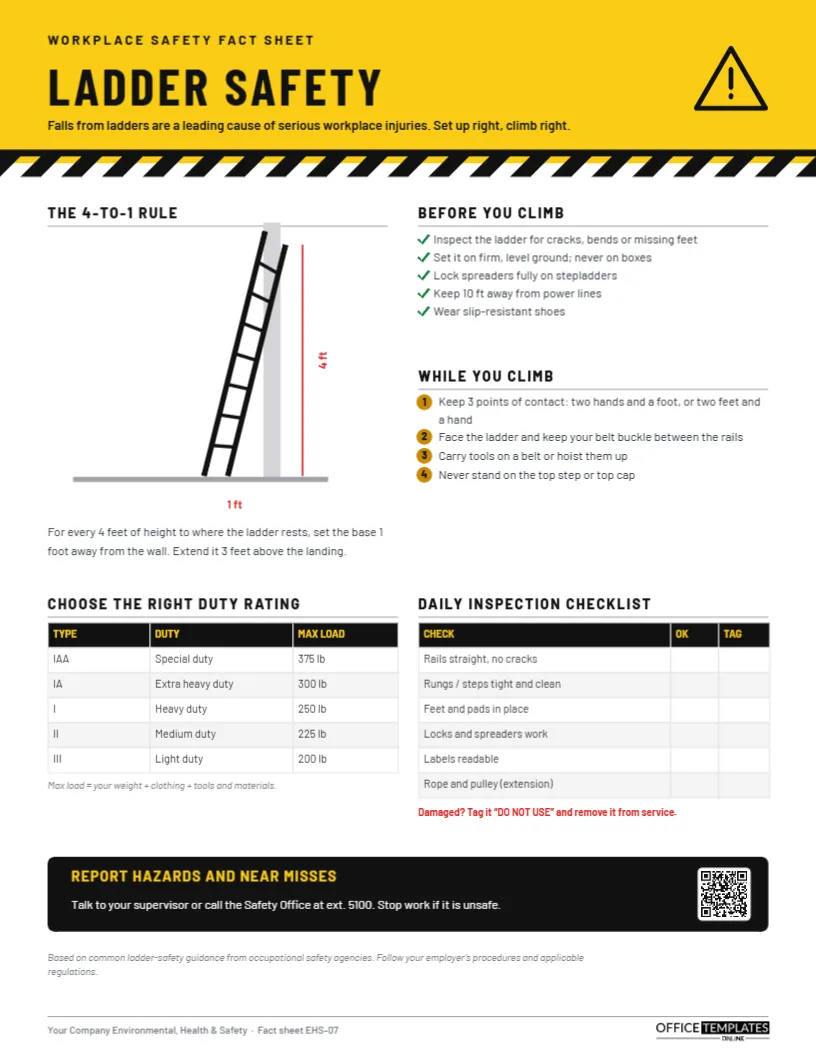
Ladders are among the most familiar tools at work, and that familiarity is the problem. Falls from ladders cause a large number of serious workplace injuries every year, and many happen on short climbs during routine jobs. Most could be prevented with a few habits: choosing the right ladder, setting it up at the right angle, inspecting it, and climbing with three points of contact. This Ladder Safety Fact Sheet puts those habits on one page. It is designed for toolbox talks, safety boards, new-hire orientation, and contractor briefings.
Toolbox Talk in Ten Minutes
Supervisors can use the fact sheet to lead a short safety talk at the start of a shift:
| Minutes | Topic | Use this part of the sheet |
|---|---|---|
| 0-2 | Why ladder falls happen | Header statement |
| 2-4 | Setting up an extension ladder | 4-to-1 rule diagram |
| 4-6 | Checks before climbing | Before you climb |
| 6-8 | Three points of contact and safe habits | While you climb |
| 8-9 | Choosing the right ladder for the load | Duty rating table |
| 9-10 | Inspection and reporting | Checklist and reporting bar |
Hazard Yellow and a Diagram That Teaches
The page looks like safety signage. A bright yellow header carries WORKPLACE SAFETY FACT SHEET, the title LADDER SAFETY in large black Barlow Condensed, the message Set up right, climb right, and a black warning triangle. A band of black and yellow hazard stripes runs beneath the header.
The left side shows the 4-to-1 rule as a clear diagram: an extension ladder leaning against a grey wall, with red dimension lines marking 4 feet up and 1 foot out, and a short explanation that also reminds workers to extend the ladder three feet above the landing. On the right, Before you climb lists five checks with green checkmarks, and While you climb gives four numbered rules, starting with three points of contact. Below, Choose the right duty rating is a table of ladder types IAA to III with their duty names and maximum loads, and a Daily inspection checklist table has OK and TAG columns for each check, followed by a red instruction to tag and remove damaged ladders. A black bar with yellow text says REPORT HAZARDS AND NEAR MISSES with the safety office extension and a QR code. The page is set on portrait US Letter, 8.5 x 11 inches.
The 4-to-1 Rule Explained.
An extension ladder is most stable at an angle of about 75 degrees. The simple way to get there without a protractor is the 4-to-1 rule: for every four feet of height up to where the ladder rests against the wall, move the base one foot out. A ladder that reaches a point 16 feet up should have its feet about 4 feet from the wall. Too steep and it can tip backwards; too shallow and the feet can slide out. When the ladder is used to reach a roof or platform, it should extend at least three feet above the landing so the climber has something to hold when stepping on and off.
Understanding Duty Ratings
Every ladder has a duty rating on its label, showing the maximum weight it is designed to carry. That weight includes the climber, clothing and boots, tools, and any materials carried up. A 220-pound worker with a 30-pound tool bag needs a ladder rated for at least 250 pounds, which is Type I. The table on the sheet lists the common ratings used in the United States. When in doubt, choose a higher rating.
Customising for Your Workplace
- Replace Your Company Environmental, Health & Safety and the fact sheet number in the footer.
- Update the reporting bar with your safety office’s extension or hotline.
- Select the duty rating or inspection table and use Edit Data; add checks with + Row, for example, for fibreglass ladders near electrical work.
- Rewrite the lists if your procedures differ, such as company-specific rules for ladder use on scaffolds or roofs.
- Translate the sheet for multilingual crews by duplicating the page.
- Link the QR code in the Barcodes & QR panel to your ladder safety training video or a near-miss reporting form.
Common Ladder Mistakes to Discuss
Ask the crew which of these they have seen: standing on the top step of a stepladder, over-reaching instead of moving the ladder, using a stepladder folded and leaning against a wall, setting a ladder on a pallet or truck bed to gain height, carrying materials in one hand while climbing, and using a metal ladder near power lines. Each one maps to a line on the sheet, which makes the talk practical rather than abstract.
Standards and Regulations
Ladder requirements are set by occupational safety regulators and product standards. In the United States, OSHA’s walking-working surfaces and construction ladder rules apply, and ladder duty ratings come from ANSI standards. The sheet is based on common guidance and carries a note to follow your employer’s procedures and applicable regulations. Have your safety professional review it against the rules that apply to your industry and country.
Other Topics in the Same Series
Use this layout to build a series of safety fact sheets with a consistent look: scaffold safety, fall protection harnesses, forklift safety, lockout/tagout, heat stress, manual lifting, eye protection, hand tools and electrical safety. Keep the yellow header and hazard stripes, change the diagram and lists, and number each sheet in the footer.
Posting It Where It Counts
Print in colour and post it where ladders are stored, in tool cribs, break rooms and job-site trailers. Laminate copies for outdoor sites. Give each new worker a copy during orientation and keep signed attendance for toolbox talks.
Safety Manager FAQs
Can I use it for stepladders only?
Yes. Replace the 4-to-1 diagram with a stepladder diagram showing locked spreaders and the “do not stand” steps.
Can workers fill in the checklist?
Yes. Print copies and have workers tick OK or TAG for each item before use, then file them.
Is this enough training?
It supports training but does not replace hands-on instruction required by regulations.
Open the template, add your company details and procedures, and give every crew a clear, memorable guide to climbing safely.