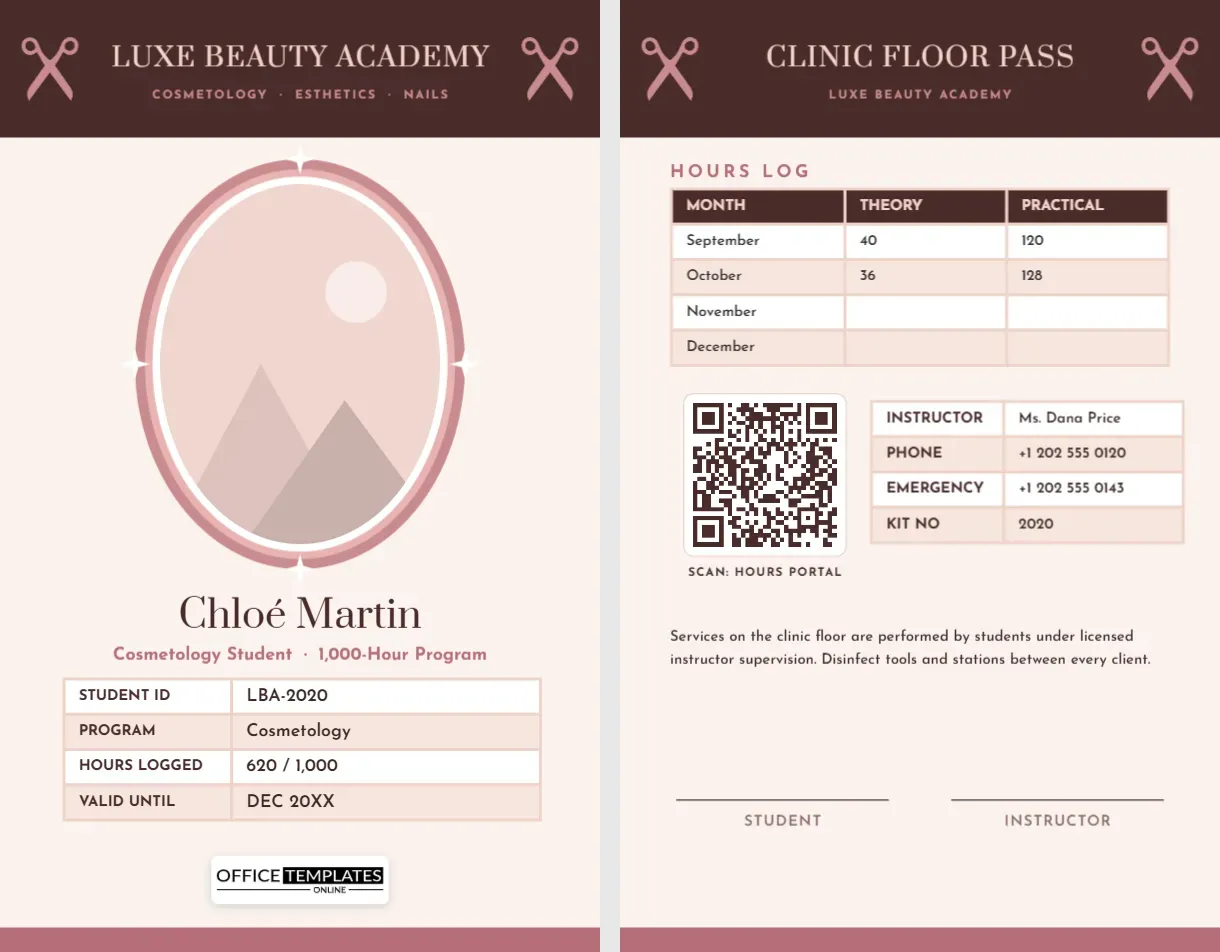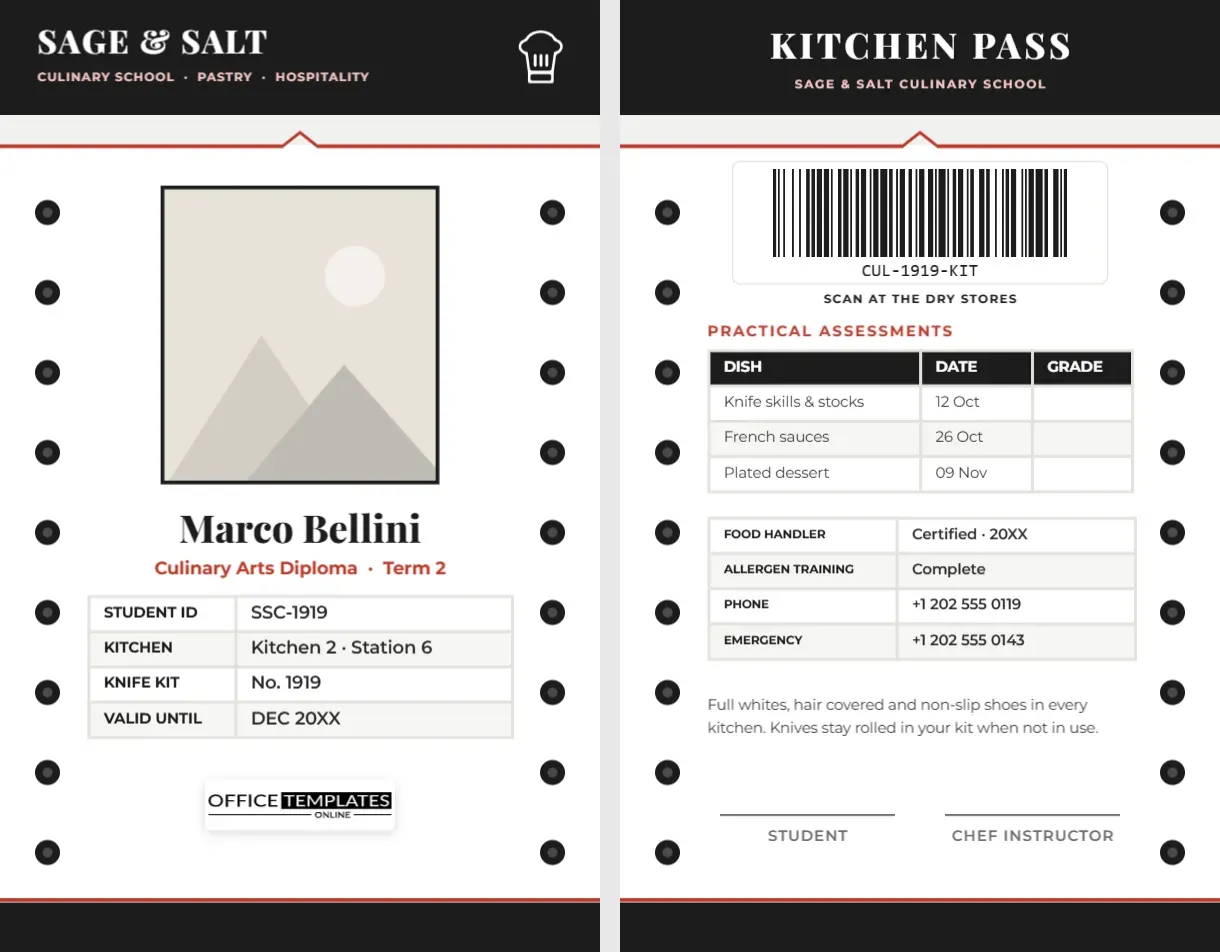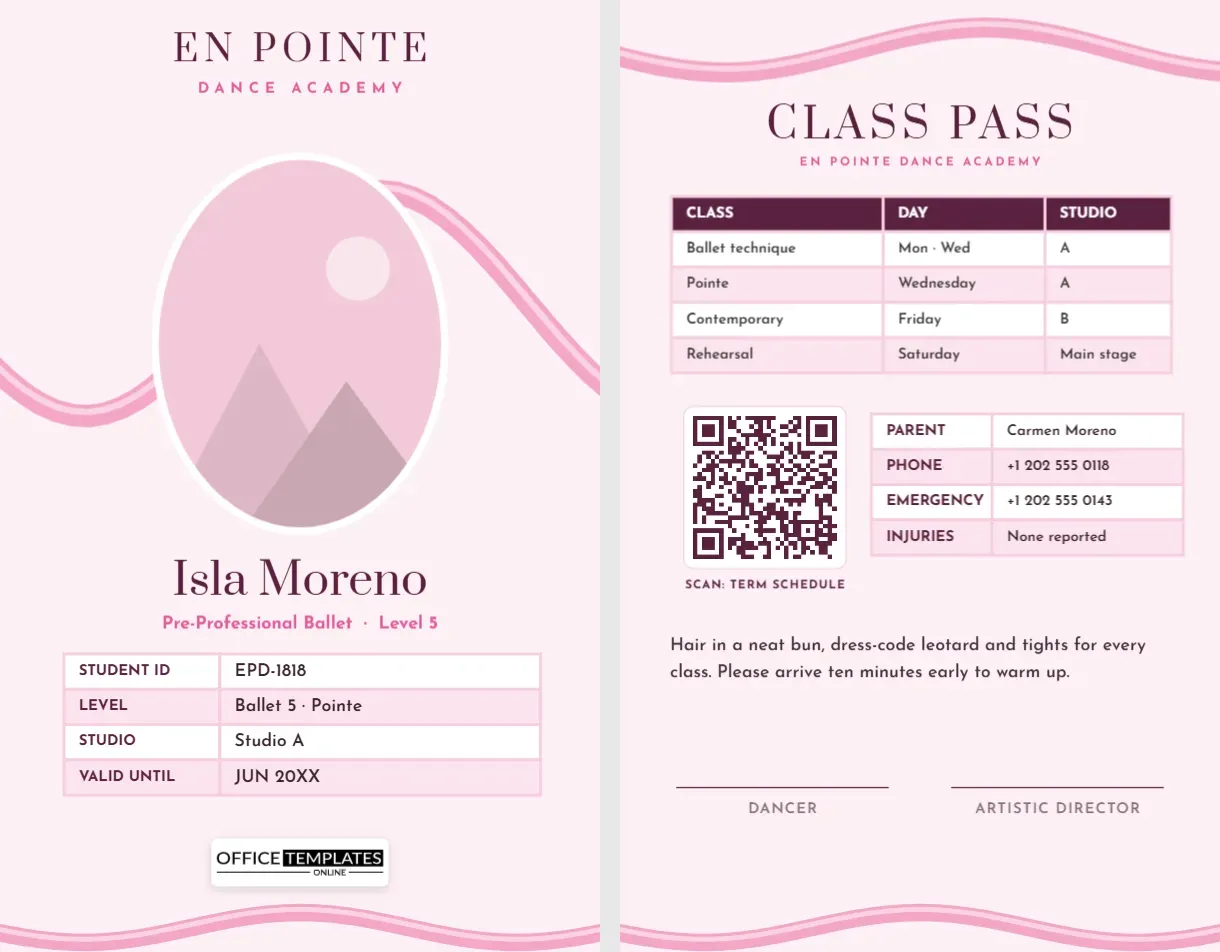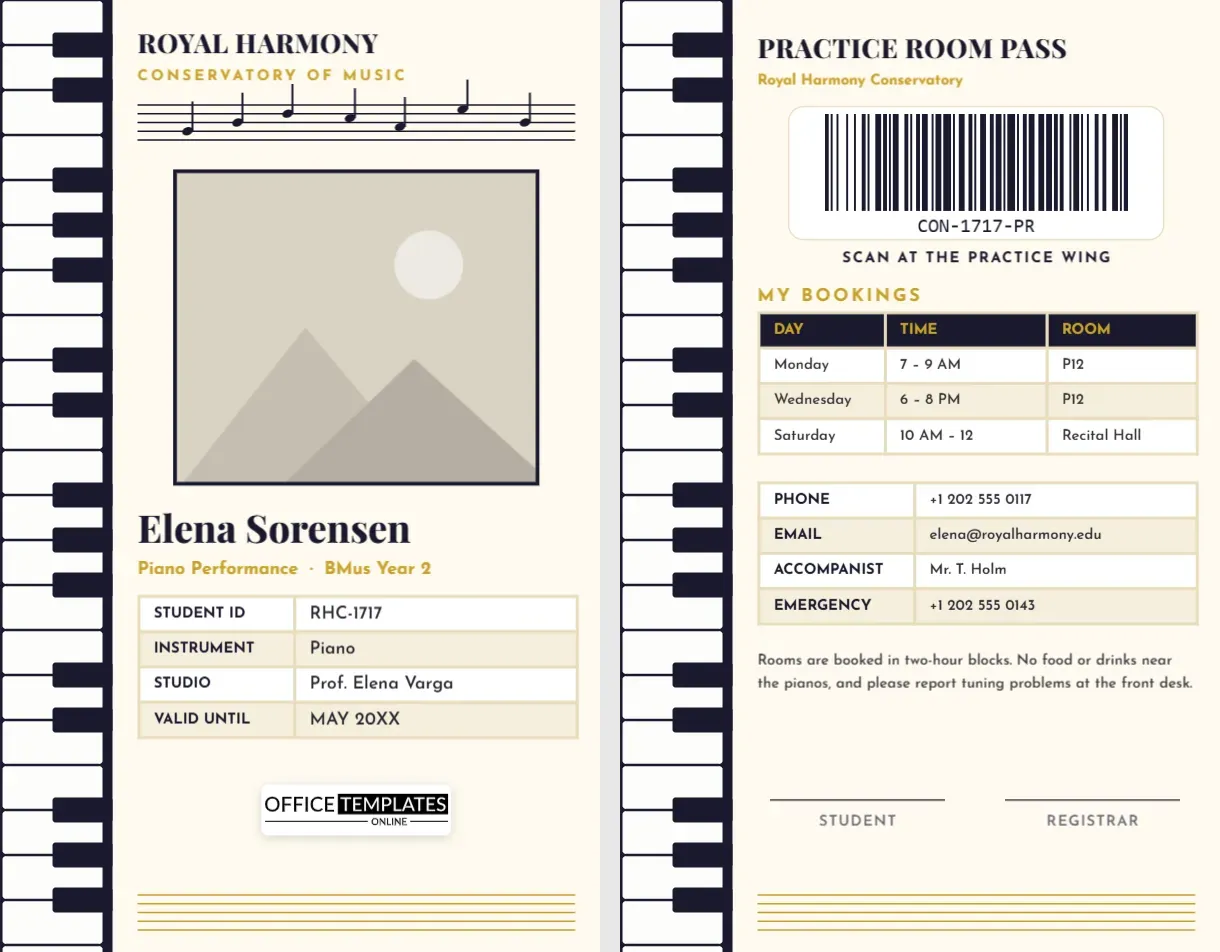
Art students collect keys the way other students collect textbooks: the printmaking studio, the woodshop, the darkroom, the digital lab, the locker full of half-finished canvases. At most art schools, the student ID card opens many of those doors and proves the student has been inducted on the equipment. It should also look like it belongs to an artist. This Art School Student ID Card places the student’s photo on a wooden painter’s palette surrounded by fresh blobs of paint, under a bold yellow brush swash.
A Palette, Paint and a Brush Stroke
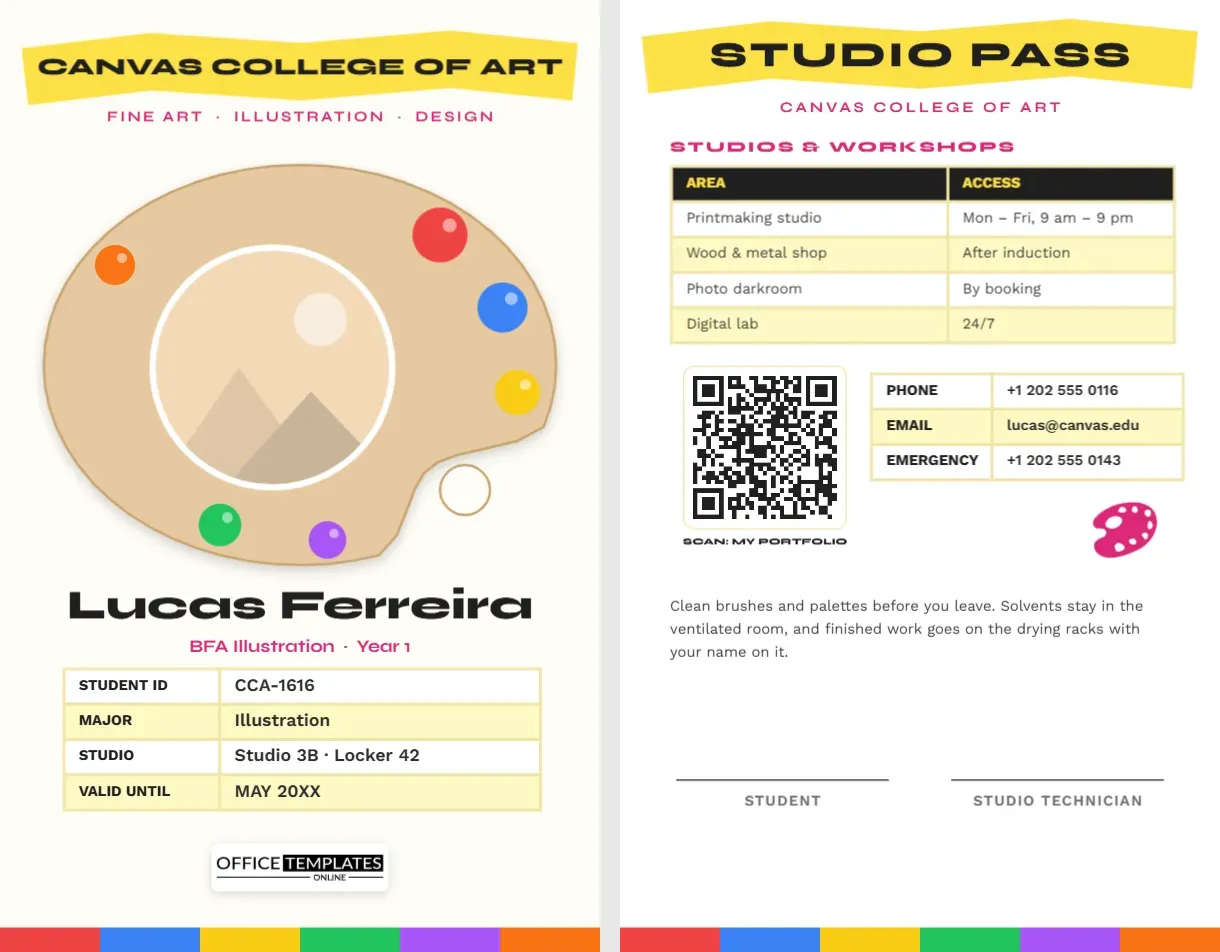
The top of the card carries a thick yellow brush stroke, as if someone had swept a loaded brush across the paper, and on top of it, CANVAS COLLEGE OF ART is set in Syne, a bold, contemporary display typeface popular with design studios. Beneath the stroke, Fine Art · Illustration · Design appears in pink.
The centrepiece is a wooden artist’s palette with a curved outline, a thumb hole, and a soft shadow. Blobs of red, blue, yellow, green, purple and orange paint sit around its edge, each with a small highlight so it looks wet. The student’s photo is a circle with a white border, placed on the palette where the artist would mix colours. Below, the student’s name is set large in Syne, Lucas Ferreira on the sample, with BFA Illustration · Year 1 in pink. A table lists the student ID, major, studio, locker, and validity date. Our logo sits on a white plate, and a stripe of six paint colours runs along the bottom edge.
The card measures 2.125 by 3.375 inches (CR80), portrait.
The Studio Pass
On the back, the yellow swash returns behind the words STUDIO PASS. The main table lists studios and workshops with their access rules: the printmaking studio on weekdays from 9 am to 9 pm, the wood and metal shop after induction, the photo darkroom by booking, and the digital lab 24/7. A QR code labelled SCAN: MY PORTFOLIO links to the student’s online portfolio, and a contact table lists phone, email, and emergency number. A pink palette icon sits beside a note about cleaning brushes and palettes, keeping solvents in the ventilated room and labelling work on the drying racks. Signature lines for the student and studio technician complete the card.
Studio Inductions at a Typical Art School
| Space | What the induction covers | Why it matters |
|---|---|---|
| Printmaking | Presses, inks, solvents, acid baths for etching | Heavy machinery and chemicals |
| Wood and metal shop | Saws, sanders, welding, dust extraction | Serious injury risk without training |
| Ceramics | Wheels, glazes, kiln loading | Silica dust and high temperatures |
| Darkroom | Chemistry, enlargers, safelight rules | Chemical handling and shared space |
| Digital and fabrication lab | Laser cutters, 3D printers, large-format printers | Fire risk and expensive equipment |
Painting In Your Own Details
- Photo on the palette: tap the round portrait in the middle of the palette and pick Replace Image for the student’s picture.
- College name: retype the name over the swash. Longer names can drop a point size so they stay on one line.
- Programme: change BFA Illustration to painting, graphic design, fashion, animation, sculpture, or photography.
- Tables: ID details and studio access are both editor Tables; open Edit Data to rewrite them, and use + Row for a ceramics or textiles studio.
- QR code: link it to Behance, a personal website, or the school’s online gallery in the Barcodes & QR panel.
- Palette and paint: the palette and its paint blobs are grouped. Change a blob’s colour, or ungroup to move them around.
A Portfolio in Your Pocket
Art students are constantly showing work: at critiques, open studios, degree shows, internship interviews and gallery visits. A QR code on their ID that links to an up-to-date portfolio makes networking easy. Encourage students to keep their portfolio short, with only their strongest ten to fifteen pieces, include process images alongside finished work, and add a short artist statement. Update the link before every show; the QR code stays the same if it points to a page the student controls.
Studio Etiquette Every Art Student Learns
Shared studios work when everyone respects them. Clean your space before you leave; wash brushes and palettes and never pour solvents or paint down the sink. Label everything you leave behind, from canvases on the drying rack to boxes in your locker. Ask before borrowing tools or materials. Keep noise and music to headphones unless the whole studio agrees. And never touch another student’s work in progress without permission, even to move it.
Art Schools, Ateliers and Community Studios
Art and design colleges, university fine art departments, high school art academies, ateliers teaching classical drawing and painting, community art centres with membership, design schools and animation academies can all use this design. Summer art camps for teenagers can print it as a camper card with the studio sessions on the back.
Getting Paint Colours to Print Richly
The design uses six saturated paint colours, a warm wood tone and a yellow swash. Print on bright white stock or PVC for the richest colour, and check that the yellow swash does not print too pale behind the college name. A matte laminate gives a nice, paper-like feel that suits an art school. Punch the slot above the swash, where it will not cut through any paint.
Keeping the Card Clean in a Messy Studio
Art studios are messy by nature. Keep the card in a clear holder on a lanyard or retractable reel so it stays out of paint, clay slip, and printing ink. Wipe PVC cards with a damp cloth; avoid solvents, which can dissolve the printed surface. If your card gets splattered anyway, students often say it adds character.
Art Student Questions
Can I add a second studio locker?
Yes. Edit the STUDIO row or add another with + Row.
Can the photo be a self-portrait painting?
For an ID, a clear photo is best, but some schools allow a photographed self-portrait for studio passes. Check your college’s rules.
Can I change the swash colour?
Yes. The swash is a single shape; pick any colour, such as your school’s brand colour.
Open the template, put the student’s photo on the palette, list the studios they can use, and let every art student carry a card that looks like it came out of their own sketchbook.