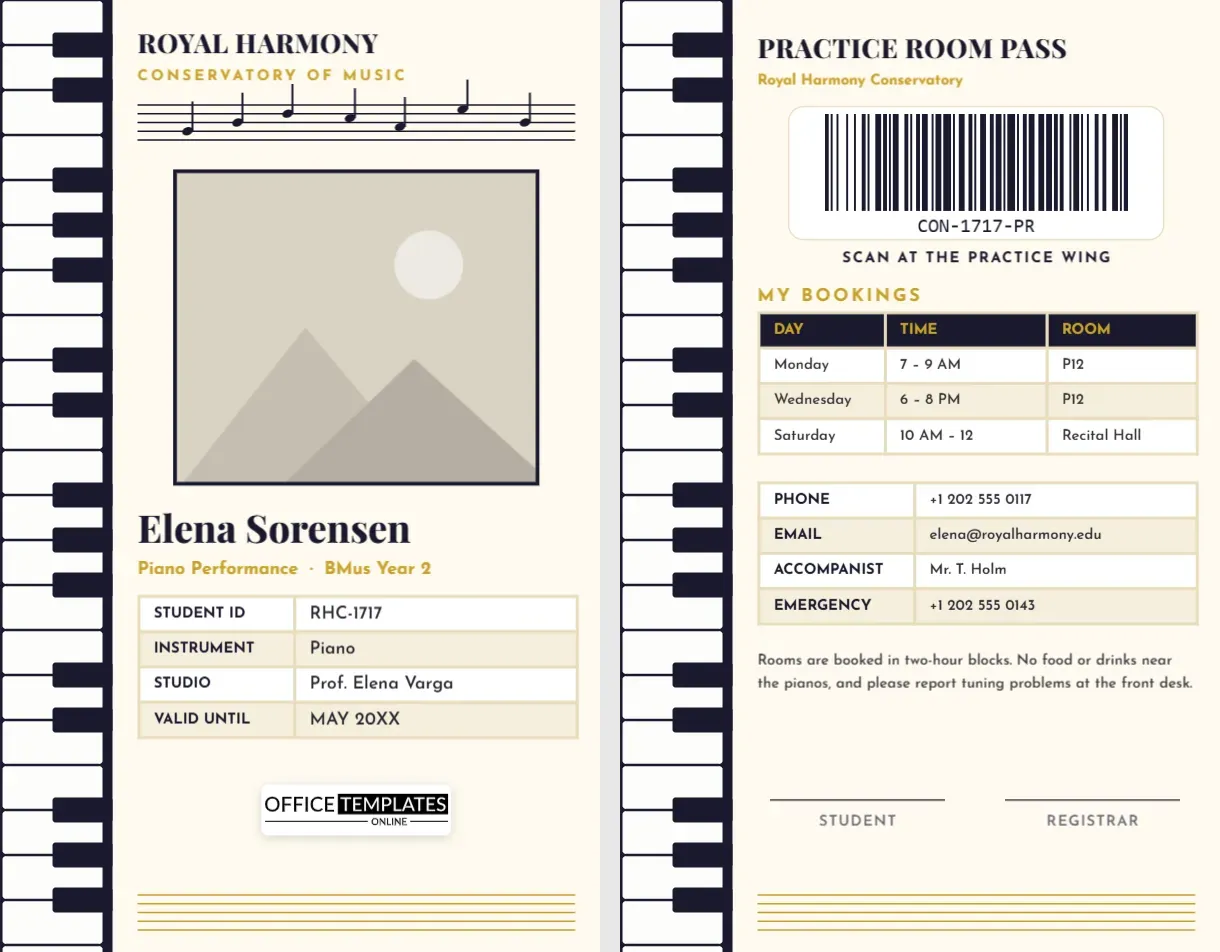
Music students practise for hours every day, and the practice room is the most fought-over space in any conservatory. Access usually runs through the student ID: scan in to book a room, sign out a studio key, borrow an instrument, or enter the concert hall for a rehearsal. This Music Conservatory Student ID Card is designed around the instrument most students learn first: a full-height piano keyboard runs down the left edge of the card, and a musical staff with notes crowns the header.
Keys Down One Side, Notes Across the Top
The keyboard sidebar shows white keys stacked from the top of the card to the bottom, with the black keys grouped in the familiar pattern of twos and threes, as if a piano had been turned on its side. On the ivory background to the right, ROYAL HARMONY is set in bold Playfair Display with CONSERVATORY OF MUSIC in gold capitals. Beneath it, a five-line musical staff carries a short phrase of notes with stems, a small melody written across the card.
The student’s photo sits in a black-framed rectangle. Below it, the name is set in Playfair Display: Elena Sorensen on the sample, with Piano Performance · BMus Year 2 in gold. A table lists the student ID, instrument, studio teacher, and validity date. Our logo sits on a white plate, and five gold staff lines run along the bottom edge, echoing the header.
The card uses the portrait CR80 size, 2.125 inches wide and 3.375 inches high.
Practice Room Pass on the Back
The keyboard continues down the back, beside the heading PRACTICE ROOM PASS. A large barcode, Scan at the practice wing, is designed for booking and door systems. A bookings table shows day, time, and room: Monday 7-9 am in P12, Wednesday 6-8 pm in P12, and Saturday 10 am to noon in the recital hall. A contact table lists phone, email, accompanist, and emergency number, and a note explains that rooms are booked in two-hour blocks, that food and drinks stay away from the pianos, and that tuning problems should be reported at the front desk. Signature lines for the student and registrar sit above the gold staff lines.
A Practice Week That Works
| Day | Focus | Where |
|---|---|---|
| Monday | Technique: scales, arpeggios, études | Practice room |
| Tuesday | Repertoire, slow practice of hard passages | Practice room |
| Wednesday | Lesson with studio teacher | Teacher’s studio |
| Thursday | Chamber music rehearsal | Ensemble room |
| Friday | Sight-reading and theory homework | Library or practice room |
| Saturday | Run-through in the performance space | Recital hall |
Use the bookings table on the card for the sessions that need a specific room, and keep the rest in your practice diary.
Personalising the Conservatory Card
- Photo: the black-framed rectangle is the portrait slot; select it and use Replace Image. A photo with the student’s instrument is a lovely touch.
- School name: retype ROYAL HARMONY and the subtitle, for example, School of Music or Music Academy.
- Instrument and degree: change the gold line and INSTRUMENT row to violin, voice, composition, jazz guitar, or conducting.
- Tables: ID rows and room bookings update through Edit Data; weekly slots can be added with + Row.
- Barcode: enter the student number used by your room booking system in the Barcodes & QR panel.
- Keyboard and staff: the keyboard is one group, and each staff member (with its notes) is another; recolour them or remove the notes for a quieter header.
Looking After Practice Rooms and Instruments
Practice rooms are shared, and pianos in particular suffer from careless use. Keep drinks outside, never place bags or cases on the piano lid, and close the lid over the keys when you leave. Report sticking keys, buzzing strings, or tuning problems promptly so technicians can fix them. If you borrow a school instrument, check it out and in with your card, keep it in its case when not playing, and never leave it in a car. These habits protect instruments that often cost more than a year’s tuition.
Juries, Recitals and Masterclasses
Conservatory life is built around performance: end-of-term juries, degree recitals, studio classes and masterclasses with visiting artists. Many schools use the student ID to confirm registration for juries and to control backstage access at recitals. Keep your jury time and recital date in the bookings table as they approach, and bring your card to every performance so the stage manager can check you in.
Conservatories, Music Schools and Youth Orchestras
Conservatories, university music departments, community music schools, pre-college programmes for young musicians, youth orchestras, choirs and summer music festivals can all use the card. Private music teachers with a studio of students can also print cards for recitals, listing the recital date and piece on the back.
Printing Piano Keys Cleanly
The keyboard uses crisp black and white shapes, which print sharply on any printer. Check that the thin gaps between the white keys remain visible. The ivory background and gold accents look elegant on matte PVC or cardstock. Punch the slot at the top of the card, to the right of the keyboard, so the keys stay complete.
Borrowing School Instruments
Conservatories often lend harps, double basses, tubas, percussion, and period instruments to students who cannot bring their own. Loans are usually logged against the student ID, with a condition report at checkout and return. Keep the loan form with the instrument, store it in its case at a steady temperature, and report any damage immediately; repairs on fine instruments are expensive, and honesty keeps borrowing privileges intact. Add a row to the card’s table for any long-term instrument loan so it is easy to check.
Music Student FAQs
Can I write a real melody on the staff?
The notes are simple shapes you can move up or down the staff. Arrange them into the opening of a favourite piece, or remove them.
Can the card show two instruments?
Yes. Write both in the INSTRUMENT row, such as Piano · Harpsichord.
Can teachers and accompanists have cards too?
Duplicate the template and change the role line to FACULTY or STAFF ACCOMPANIST.
Open the template, add the student’s photo and instrument, book the practice rooms on the back, and let the music begin.