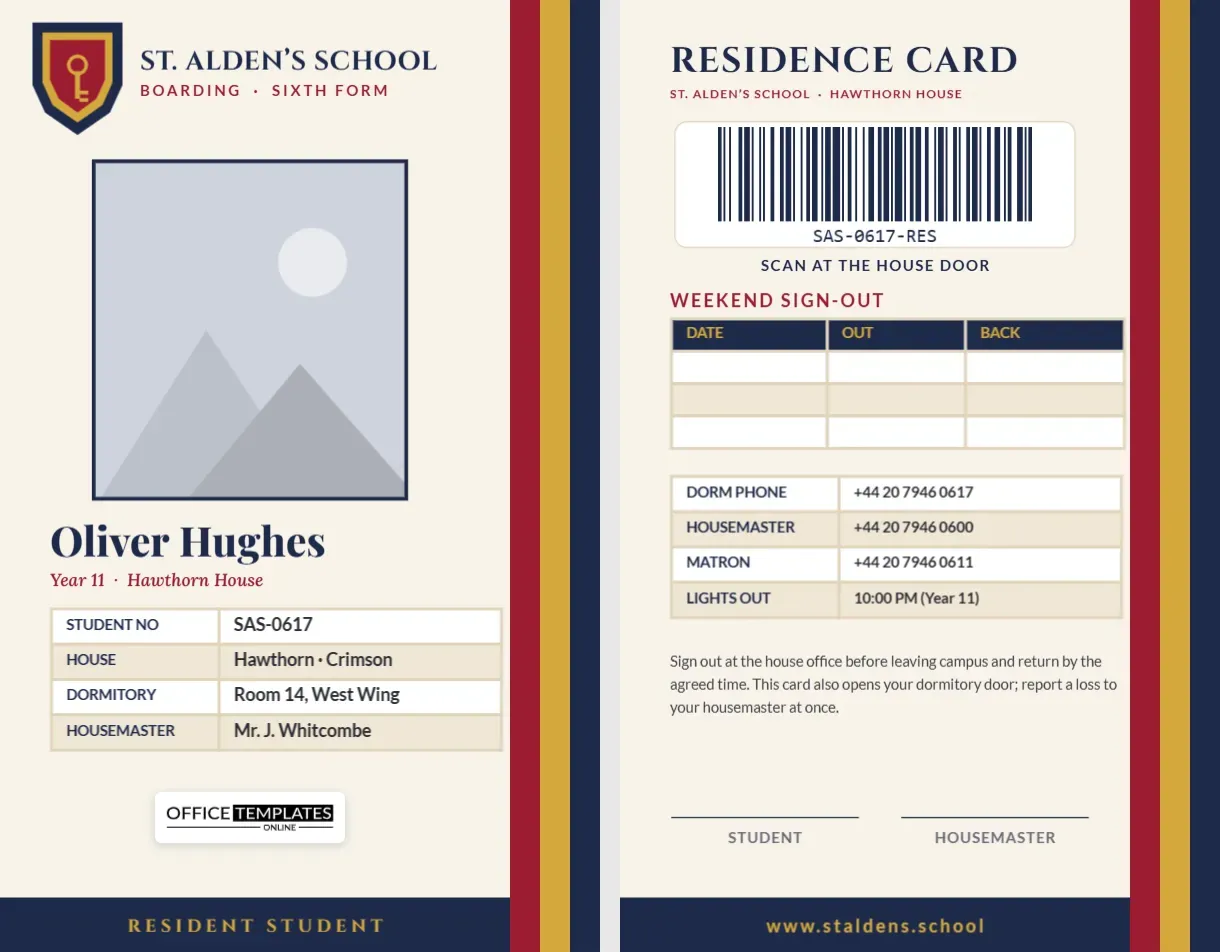
At a boarding school, a student ID card does far more than get a student into the library. It opens the house door at night, confirms who is allowed to sign out for the weekend, tells a visiting coach which house a pupil belongs to, and gives matrons and housemasters the details they need in a hurry. This Boarding School Student ID Card is designed with that residential life in mind. It carries the traditions boarders love, house colours and a school crest, and its back is a practical residence card with a weekend sign-out log.
Crest, Stripes and a Parchment Background
The card has a warm parchment background, like the paper of an old school register. Down the right-hand edge run three vertical stripes in crimson, gold and navy, the colours of the student’s house, rather like the stripes on a house scarf or tie. In the top-left corner sits a shield-shaped crest in navy, gold and crimson with a gold key at its centre, a symbol of the student’s place in the residence.
ST. ALDEN’S SCHOOL is set beside the crest in Cinzel, a classical capital typeface, with Boarding · Sixth Form in crimson. The student’s photo sits in a navy-framed rectangle below. Under it, the name is set in bold Playfair Display, Oliver Hughes on the sample, with Year 11 · Hawthorn House in crimson italic. A four-row table lists the student number, house and colour, dormitory room, and housemaster. Our logo sits on a white plate, and a navy band across the bottom reads RESIDENT STUDENT in gold.
It is a vertical card in the CR80 format, 2.125 inches across by 3.375 inches tall.
The Residence Card
The reverse keeps the house stripes and becomes a working document for boarding staff and students:
- RESIDENCE CARD heading with the school and house name.
- A barcode labelled Scan at the house door, suitable for residence access systems and sign-in points.
- A weekend sign-out table with date, time out and time back, to be filled in by the house office.
- Contacts: dormitory phone, housemaster, matron, and the lights-out time for the student’s year group.
- A note about signing out before leaving campus and reporting a lost card straight away, since it also opens the dormitory door.
- Signature lines for the student and housemaster.
How Boarding Houses Use Student IDs
| Moment | What staff check | Part of the card |
|---|---|---|
| Evening roll call | Every boarder is present | Photo, name, house |
| Weekend exeat | Permission and return time | Weekend sign-out table |
| House door at night | Only residents enter | Barcode or chip |
| Medical visit | Who to call, which house | Matron and housemaster numbers |
| Away fixtures and trips | Student identity away from school | Front of the card |
House Traditions on a Card
Houses are the heart of many boarding schools. Students compete for house cups, sing at house suppers and wear house colours with pride. A card that shows those colours gives students something to be proud of and makes it easy for staff to see which house a student belongs to across a busy dining hall. If your school has four or more houses, make a version of the card for each, changing the stripe colours and house name; the rest of the design stays the same, so the cards still feel like one family.
Personalising the St. Alden’s Card
- Photo: select the navy-framed portrait and pick Replace Image; the frame stays in place around the new photo.
- School and crest: retype the school name and subtitle. The crest is one group, so you can recolour it or replace it with your school’s official crest if you have permission to use it.
- House stripes: the three stripes are grouped; recolour each to match the house.
- Tables: with a table selected, Edit Data lets you rewrite rows; for longer weekends, add sign-out rows with + Row.
- Barcode: in the Barcodes & QR panel, enter the number your door system reads.
- Year and lights-out: change the lights-out time for each year group; younger boarders usually have earlier times.
Weekend Sign-Out Done Properly
Every boarding school has a system for letting students leave campus for weekends, day trips and appointments. The key facts are the same everywhere: who the student is leaving with, where they are going, when they leave and when they will be back. The sign-out table on the back of this card gives each boarder a personal record of their weekends, while the house office keeps the official log. Some schools stamp or initial the card each time, which gives parents and staff a quick overview of how often a student has been away.
Day Pupils and Flexi-Boarders
Many boarding schools also have day pupils and flexi-boarders who stay a few nights a week. You can adapt the card easily: change RESIDENT STUDENT to DAY PUPIL or FLEXI-BOARDER, remove the dormitory row for day pupils, and keep the barcode for library and dining hall use. International boarders may need their guardian’s details; add a row for the UK or local guardian’s phone number.
Printing for Residential Life
Boarding IDs are used every day for years, so PVC cards with a card printer are the sensible choice, often with a proximity chip if your doors use them. The parchment, navy, and crimson palette prints richly; test the gold, which can look brownish on some printers. Offer students a lanyard in their house colours, which makes the card easy to spot and hard to lose.
Boarding Questions From Parents and Staff
Can the card show the student’s guardian?
Yes. Add a row on the back with + Row for the guardian’s name and phone number.
What if a student moves dormitory?
Update the dormitory row and reprint the card; the barcode can stay the same if it is linked to the student.
Can the design be used for a university hall of residence?
Yes. Change the school to the hall’s name, the house to the block or floor, and HOUSEMASTER to RESIDENT ADVISER.
Open the template, add the boarder’s photo, house colours and room, and give every resident a card that feels like part of the house.