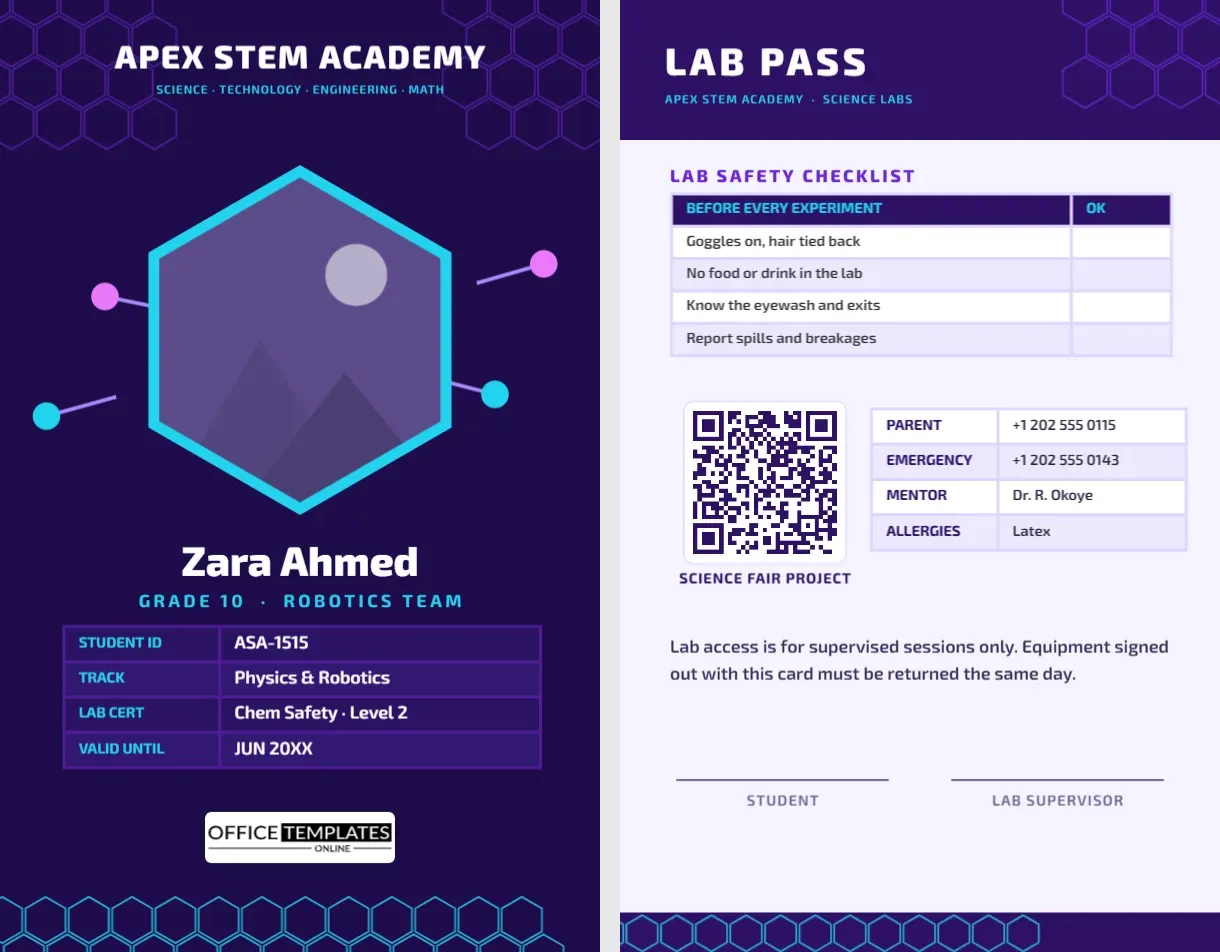
STEM academies, magnet schools and science-focused programmes want students who think like scientists and engineers, and they give those students access to labs, robotics workshops and competitions that ordinary classrooms rarely offer. The ID card that opens those doors should look the part. This STEM Student ID Card puts the student’s photo in a glowing hexagon, the shape of carbon rings and honeycomb structures, with molecular bonds branching out to coloured atoms, on a deep space-purple background.
Hexagons, Bonds and a Honeycomb Frame
The front is a rich dark purple. In the top corners, clusters of hexagon outlines form a honeycomb pattern, and APEX STEM ACADEMY is set in bold Exo 2 with Science · Technology · Engineering · Math in cyan. The student’s photo is cut into a large hexagon with a bright cyan border. From its sides, lavender bonds reach out to four atoms, two magenta and two cyan, so the photo reads as the centre of a molecule.
Under the hexagon, the student’s name is set in white, Zara Ahmed on the sample, with GRADE 10 · ROBOTICS TEAM in cyan capitals. A dark table lists the student ID, track (Physics & Robotics), lab safety certification, and expiry date. Our logo sits on a white plate, and a row of cyan hexagon outlines runs along the bottom edge.
The card is a vertical CR80 badge, measuring 2.125 inches across and 3.375 inches tall.
The Lab Pass Side
The back switches to a light lavender background with a purple header reading LAB PASS. A lab safety checklist table lists four checks with an OK column: goggles on and hair tied back; no food or drink in the lab; know the eyewash and exits; report spills and breakages. A QR code labelled SCIENCE FAIR PROJECT can link to the student’s project page or lab notebook. A contact table lists parent, emergency number, mentor, and allergies (latex on the sample, an important detail in labs), followed by a note that equipment signed out with the card must be returned the same day and signature lines for the student and lab supervisor.
Lab Safety Levels Many Schools Use
| Level | Allowed activities | Typical requirement |
|---|---|---|
| Level 1 | Basic experiments with teacher present | General lab safety lesson and quiz |
| Level 2 | Chemistry with common reagents, robotics tools | Chemical safety training |
| Level 3 | Independent research, power tools, 3D printers | Mentor approval and extra training |
Use the LAB CERT row on the front to show the student’s level, so teachers can check it before an experiment begins.
Customising the Apex Card
- Hexagon photo: pick the hexagon and choose Replace Image; the new picture is cut to the six-sided shape automatically.
- School name and focus: retype APEX STEM ACADEMY and the subtitle; a biotech academy might write Biology · Chemistry · Health Science.
- Team or track: change GRADE 10 · ROBOTICS TEAM to the student’s grade and club, such as SCIENCE OLYMPIAD or MATH CIRCLE.
- Tables: the ID rows, the checklist, and the contacts all open in Edit Data; add safety checks with + Row.
- QR code: link it to a science fair board, project video, or digital lab notebook in the Barcodes & QR panel.
- Molecule and honeycomb: each is a single group; recolour the atoms to your school colours or delete them.
Why Hexagons?
Hexagons appear all over science and engineering: the benzene ring in chemistry, graphene’s single-atom sheets, honeycomb structures that give strength with little material, snowflakes and the columns of basalt at the Giant’s Causeway. Engineers use honeycomb cores in aircraft panels because they are light and stiff. Using the hexagon for the photo and the patterns makes the card feel scientific without needing any formulas.
Competitions and Science Fairs
STEM students often travel to robotics tournaments, science fairs, math competitions, and hackathons, where they must show ID at registration. The front of this card is clear enough for that, and the QR code on the back can take judges straight to a project page. Teams can print matching cards for every member, with the team name in the grade line, so they look organised when they arrive at a competition.
Magnet Schools, Olympiad Teams and Science Camps
STEM and magnet high schools, science and technology academies, middle school STEM programmes, robotics clubs, science olympiad teams, university outreach programmes for teenagers, summer science camps and makerspaces for young people all fit this design.
Printing Dark Purple and Neon Accents
The dark purple background and bright cyan accents look vivid on PVC and glossy cardstock. Print a test to make sure the purple does not turn almost black and that the honeycomb outlines remain visible. Laminate the card for lab use; chemicals and water are everyday hazards.
Keeping a Proper Lab Notebook
Real scientists record everything, and STEM students should too. A good lab notebook includes the date, the question being tested, materials and methods, raw observations and measurements, and conclusions, with mistakes crossed out neatly rather than erased. Many academies now use digital notebooks, which is where the QR code on the back of this card can point. Judges at science fairs often ask to see the notebook, and a clear, dated record shows how the student’s thinking developed from the first idea to the final result.
Mentors and Research Partnerships
Many STEM academies connect students with mentors at universities, hospitals, and companies for research projects. Visiting a partner lab usually means showing school ID at reception and following that lab’s safety rules. List the mentor on the back of the card and add the partner lab to the student’s lab certification row once they have completed its induction.
STEM Student Questions
Can I show two lab certifications?
Add a row with + Row on the front table, for example, one for chemistry and one for the machine shop.
Can the atoms be removed?
Yes, the molecule is one group behind the photo; delete it for a cleaner hexagon.
Can teachers use the design?
Yes. Duplicate it, change the grade line to the subject taught, and the back to lab responsibilities.
Open the template, put the student at the centre of the molecule, and give your future scientists a card built for the lab.