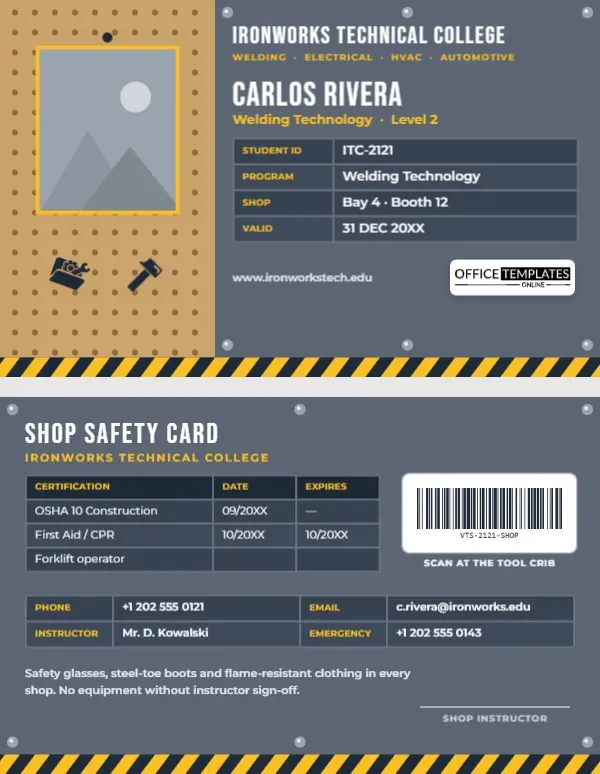
Trade school students learn in workshops that look a lot like real job sites: welding bays, electrical labs, HVAC training rooms, and auto shops full of lifts and power tools. In those spaces, the student ID card is also a safety document. It shows who is enrolled, which shop they belong to, and which safety certifications they have earned before they touch equipment. This Vocational Trade School Student ID Card looks like it was made in the shop itself, with a tool pegboard, a riveted steel plate, and a strip of yellow and black hazard tape.
Pegboard, Rivets and Hazard Tape
The card is horizontal, 3.375 by 2.125 inches. The left section is a tan pegboard with rows of small holes, the kind that hangs above every workbench. The student’s photo hangs on it from a peg with a safety-yellow frame, and below it, a wrench and a hammer hang on the board. The rest of the card is a grey steel plate with rivets in the corners and along the top and bottom edges.
On the plate, IRONWORKS TECHNICAL COLLEGE is set in tall Bebas Neue letters with Welding · Electrical · HVAC · Automotive in safety yellow. The student’s name follows in large capitals, CARLOS RIVERA on the sample, with Welding Technology · Level 2 in yellow. A dark table lists the student ID, programme, shop bay and booth, and validity date. The college website and our logo sit below, and a band of diagonal yellow and black hazard stripes runs along the bottom edge.
The Shop Safety Card
The back is a full steel plate headed SHOP SAFETY CARD. A certification table lists the safety training the student has completed, with date and expiry: OSHA 10 Construction, First Aid/CPR, and forklift operator (not yet completed on the sample). A barcode labelled Scan at the tool crib is designed for tool checkout systems. A contact grid gives the student’s phone, email, instructor, and emergency contact, and a note reminds students that safety glasses, steel-toe boots, and flame-resistant clothing are required in every shop and that no equipment may be used without instructor sign-off. A shop instructor signature line and the hazard stripe complete the design.
Safety Credentials by Trade
| Trade | Common certifications |
|---|---|
| Welding | OSHA 10, welding safety, hot work permit training |
| Electrical | OSHA 10, lockout/tagout, arc flash awareness |
| HVAC | OSHA 10, EPA Section 608 refrigerant handling |
| Automotive | Shop safety, lift operation, hazardous materials handling |
| Construction and carpentry | OSHA 10 or 30, fall protection, powered tools |
Add or remove rows on the card to match the certifications your programme teaches.
Updating the Ironworks Card
- Photo: the yellow-framed picture hanging on the pegboard is the slot; click it and use Replace Image. A photo in work clothes with safety glasses pushed up looks right at home.
- College and trades: retype the college name and the trades line.
- Programme and level: change the yellow line and PROGRAM row to the student’s trade and year.
- Tables: for new certifications, select the table, press Edit Data, and fill in the date; + Row adds another credential.
- Barcode: enter the student’s tool crib number in the Barcodes & QR panel.
- Tools and pegboard: the pegboard is one group, and the wrench and hammer are editable vectors you can swap for trade-specific icons.
The Tool Crib System
Most trade schools keep expensive tools and consumables in a tool crib staffed by a technician. Students check out what they need for a project and return it at the end of the session. Scanning a barcode on the student ID makes this fast and creates a record of who has which tool, which reduces losses and helps instructors see who is actually practising. Return tools clean and on time; a tidy tool crib is a sign of a professional shop.
Working Safely in the Shop
Every trade has its hazards: sparks and fumes in welding, live circuits in electrical work, refrigerants in HVAC, heavy vehicles on lifts in the auto shop. The basics are the same everywhere. Wear the required personal protective equipment every time, not just when an instructor is watching. Inspect tools before use. Never work alone on hazardous equipment. Keep floors clear of cords and offcuts. Report injuries and near misses straight away. Employers look for these habits as much as technical skill.
Apprenticeships and Job Sites
Many trade students spend part of their programme on real job sites through apprenticeships or co-operative placements. Site supervisors may ask to see proof of enrolment and safety training before letting a student work. The back of this card puts that information in one place. Add the employer’s name to the table while the student is on placement, and keep a copy of each certificate on your phone as well.
Technical Colleges and Career Centres
Technical and vocational colleges, community college trade programmes, high school career and technical education centres, union apprenticeship schools, adult retraining programmes and military transition training can all use this card. Change the trades line to match your programmes, from plumbing and carpentry to diesel technology and robotics maintenance.
Printing a Card That Survives the Shop
Shop environments are hard on cards: grease, dust, sparks and water. Print on PVC and use a sturdy holder, or laminate with a thick pouch. The grey plate and yellow accents print strongly; check that the pegboard holes are visible and that the hazard stripes are crisp. Keep the card on a retractable reel clipped to your belt, never on a loose lanyard near rotating machinery.
Trade Student FAQs
Can I show my apprenticeship employer?
Yes. Add a row to either table with + Row for the employer and supervisor.
Can the hazard stripe be another colour?
It is one group; recolour it to your school colours, though yellow and black read as safety instantly.
What if my certification has no expiry date?
Leave the expiry cell blank or type a dash, as the sample does for OSHA 10.
Open the template, hang the student’s photo on the pegboard, record their safety training, and get them ready for the shop floor.