Planning for three- and four-year-olds looks nothing like planning for older students. There are no worksheets to grade or tests to schedule. Instead, the week revolves around a theme, a circle time, a handful of learning centres, songs, stories, outdoor play, and snack. This preschool lesson plan template is built around exactly those parts, and it is as bright and friendly as the classroom it describes.
A Rainbow Over the Week’s Theme
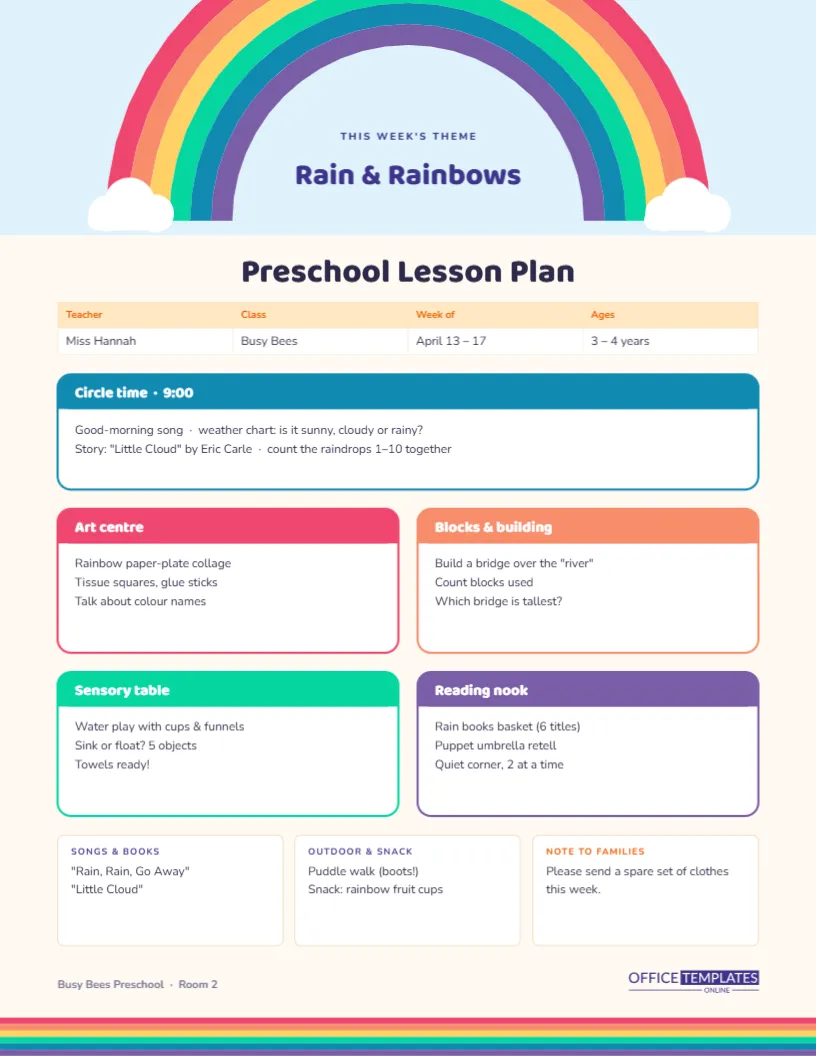
The top of the page is a soft sky-blue band with a big six-colour rainbow arching across it, and a fluffy white cloud at each end. Inside the arch sits the theme of the week: the sample reads Rain & Rainbows. Below the rainbow, Preschool Lesson Plan is set in rounded Baloo 2, the kind of friendly lettering that suits early years. A matching six-colour stripe runs along the bottom edge, so the page begins and ends with a rainbow.
Class Details in One Row
A four-column strip records teacher, class, week and ages. The sample class is the Busy Bees, aged three to four, taught by Miss Hannah during the week of April 13 to 17. Edit it in a click to match your own group.
Circle Time Comes First
A wide blue card holds the circle time plan for the week: the good-morning song, a weather chart (sunny, cloudy or rainy?), the story Little Cloud by Eric Carle, and counting raindrops from one to ten. Circle time sets the tone for the whole morning, so it gets the most space.
Four Learning Centres
Below circle time, four colourful cards with rounded corners describe the week’s centres. Each card has a coloured header with the centre name and three short lines for the activity:
| Centre | Card colour | Sample activity |
|---|---|---|
| Art centre | Pink | Rainbow paper-plate collage with tissue squares |
| Blocks & building | Coral | Build a bridge over the river, count the blocks |
| Sensory table | Mint | Water play with cups and funnels, sink or float |
| Reading nook | Purple | Rain books basket, and a puppet umbrella; retell |
Rename the centres to match your room: dramatic play, small world, playdough, science table, or writing corner all fit the same cards.
Songs, Books, Snack and Outdoors
Three smaller cards close the plan. Songs & books list Rain, Rain, Go Away and Little Cloud. Outdoor & snack plans a puddle walk (boots!) and rainbow fruit cups. Note to families asks parents to send a spare set of clothes, which, with a water-play week ahead, is wise advice.
Planning Around a Theme, Step by Step
- Pick a theme children can see, touch, or experience this week.
- Choose one or two books that carry the theme.
- Give every centre a link to the theme, but keep it open-ended.
- Add one song and one movement game.
- Think about what families can do at home, and write it in the note.
Theme Ideas Through the Year
- Autumn: apples, leaves, pumpkins, community helpers.
- Winter: snow and ice, animals in winter, kindness week.
- Spring: rain and rainbows, seeds and plants, bugs.
- Summer: the beach, ice cream, camping, the five senses.
Softening the Arch to Pastels
The rainbow arch is one group made of six rings. If you prefer a calmer pastel palette, select the group and pick softer colours from its swatches. The bottom stripes are a separate group, so remember to change both for a matching look.
Display It for Parents
Many preschools post the weekly plan by the door or in the parent newsletter. Families love knowing what their child did today, and it gives them something to talk about on the way home: Did you build a bridge in the block corner? Download as a PNG to share it in a parent app or class group.
Licensing and Curriculum Records
Some childcare regulators and early years frameworks ask settings to keep written plans. A dated, tidy plan for each week makes inspection preparation easier and shows the thought behind play-based learning.
Printing the Plan
Use Download As PDF and print in colour on plain or light card. The rainbow looks best in colour; in black and white it turns into soft grey bands that still frame the page neatly.
Observing Children at the Centres
In early years, assessment happens by watching. While children work at the centres, carry a clipboard and jot quick notes: who counted to ten without help, who shared the funnels, who chose the reading nook every day. These observations feed developmental records and parent conferences, and they tell you which centre activities are working and which need a rethink next week.
Keeping Plans Flexible
A preschool plan is a starting point, not a script. If the children discover a worm on the puddle walk and spend twenty minutes fascinated by it, that is learning worth following. Experienced teachers leave room to extend an interest, then add a note to the plan so the idea is not lost. A popular spontaneous activity can become next week’s theme.
Supporting Every Child
Think about children who need extra help to join in: a visual timetable for a child who finds transitions hard, a quieter spot for a child overwhelmed by noise, or simple sign language for songs. Jot these supports on the centre cards so every adult in the room knows them.
Preschool Plan FAQ
Can I add a daily schedule?
Yes. Insert a small table from the editor’s table tool in the space below the centres, or add a second page.
Is the rainbow editable?
Yes. It is a group of shapes you can recolour, resize, or delete.
What size is it?
US Letter, 8.5 x 11 inches, portrait.
Can I use it for a toddler room?
Yes. Simplify the centres to sensory play, music and movement, and keep circle time short, around five to ten minutes.
Does it work for a home daycare?
It does; mixed-age groups can use the same theme with simpler and harder versions of each centre activity.
Can the plan go home to families?
Yes. A PNG copy in your parent app helps families talk about the theme at home and send in items like rain boots or books.