When a Photographer Needs Proof at the Door
Editorial photographers are asked to show who they are all the time: at press areas, at events, at sports grounds, at council meetings. Organisers want to know that the person with the camera is genuine, and the photographer wants to be let in without a long explanation. A clear ID card with a photo, a name, a role and a validity date solves both problems. This two sided card is designed for freelancers, agency staff and publication photographers.
Photographer Card Front: Teal Swoosh on Charcoal
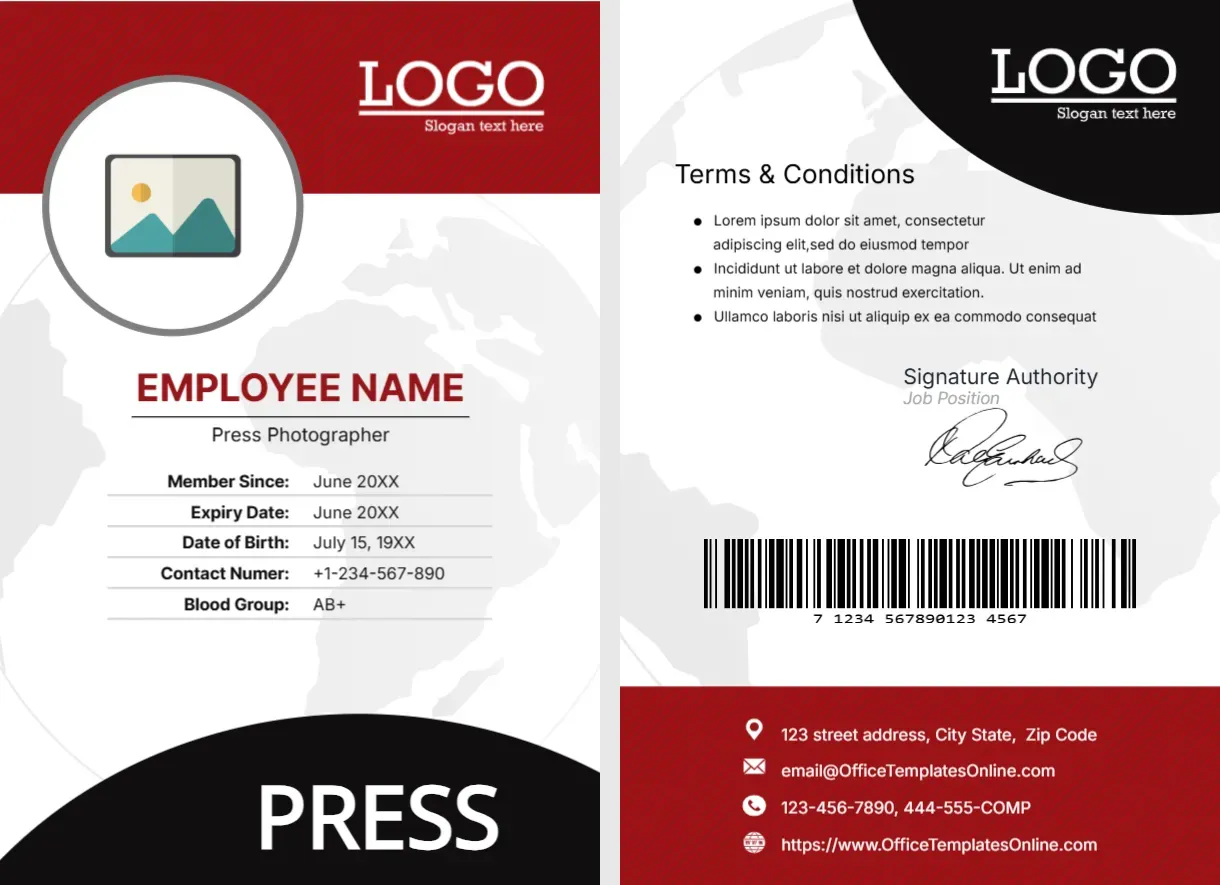
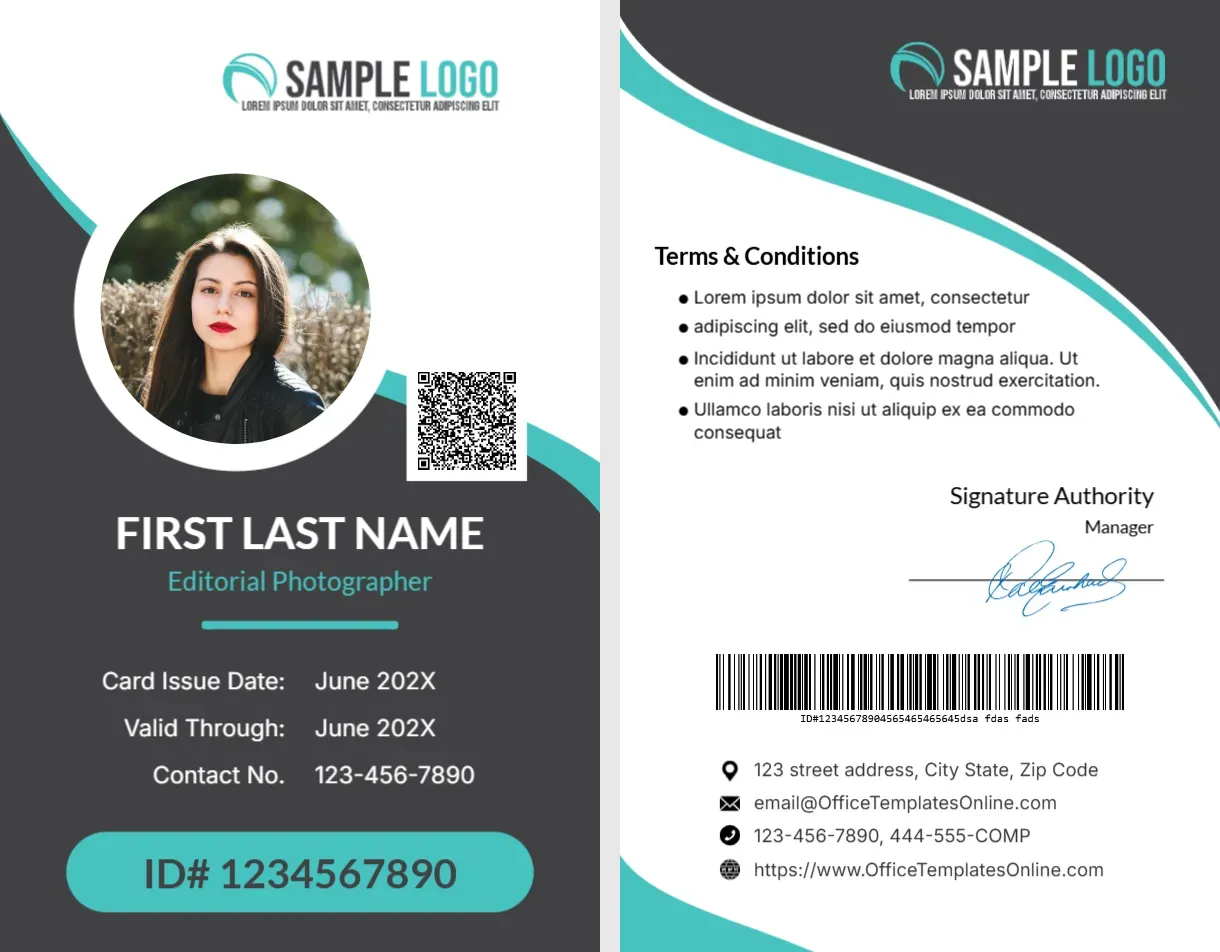
The card is portrait, 2.125 x 3.375 inches, the size of a credit card. The front is dark charcoal with a bright teal swoosh curling from the left edge. At the top, a SAMPLE LOGO in white and teal sits in the centre. A round photo, ringed in white, sits slightly left of centre, with a square QR code tile at its lower right. Below, FIRST LAST NAME is in large white capitals, with Editorial Photographer in teal and a short teal rule beneath. Three lines follow: Card Issue Date: June 202X, Valid Through: June 202X and Contact No. 1234567890. A teal pill at the bottom shows ID# 1234567890.
Photographer Card Back: Terms, Signature and Barcode
The back is white with a charcoal top corner and a flowing teal curve. SAMPLE LOGO appears again at the top right. Below it is a Terms and Conditions heading with four bullet points of placeholder text. Then comes a signature block labelled Signature Authority and Manager, with a sample handwritten signature, followed by a barcode picture and four contact lines: street address, email, two phone numbers and a website. The fonts are Lato and Inter.
Filling the Front
- Replace SAMPLE LOGO with the logo of the publication, agency or your own studio.
- Click the round photo and choose Replace Image to add the photographer’s portrait.
- Type the name and change the role if needed, such as Press Photographer or Staff Photographer.
- Enter the dates, and decide how long the card is valid, for example one year.
- Replace the ID number with your own numbering system.
Writing Terms That Mean Something
The placeholder terms are Latin filler, so replace them with real rules. Useful terms for a photographer ID include: The card is property of the issuing organisation. It must be shown on request. It does not grant access to restricted areas without permission. If found, please return it to the address below. Keep to four short bullet points, since the space is small.
The QR Code and the Barcode
Both codes are sample pictures. A QR code can link to a verification page, such as a profile on your agency’s website, and a barcode can match an ID in your system. Replace them with real codes you control, or delete them. A fake code that does not scan is worse than none, because security staff may try it.
Important Limits of a Printed ID
A printed ID card helps in many situations, but it does not give legal access or press accreditation by itself. Events and venues usually issue their own passes. Use this card as supporting identification, together with the accreditation you receive for each event.
Printing a Two Sided Card
Print the front and the back on 250 to 300 gsm card stock, aligned carefully, or ask a print shop to print both sides. A card printer on PVC gives the most durable result. Add a vertical slot for a lanyard clip with a slot punch, and check that the punch does not touch the photo or the text.
For other press cards, see the press reporter ID card and the photographer ID card. More are in ID cards.