Subject-Specific Progress Report Card Template
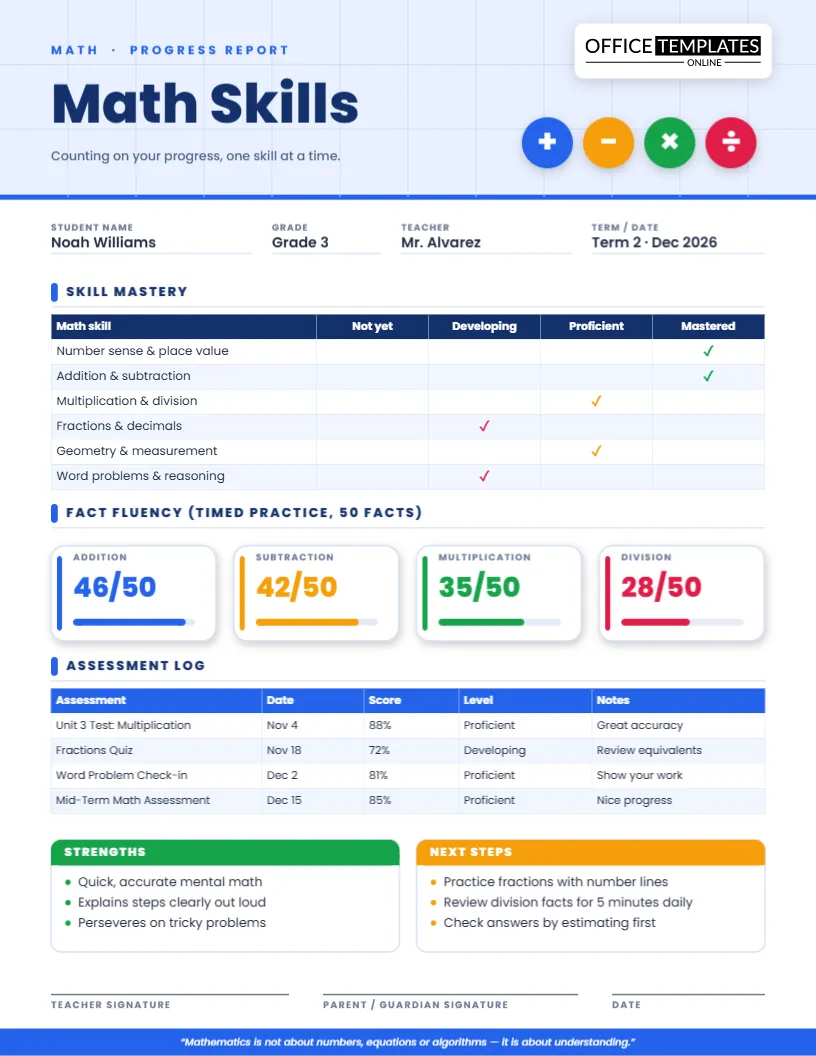
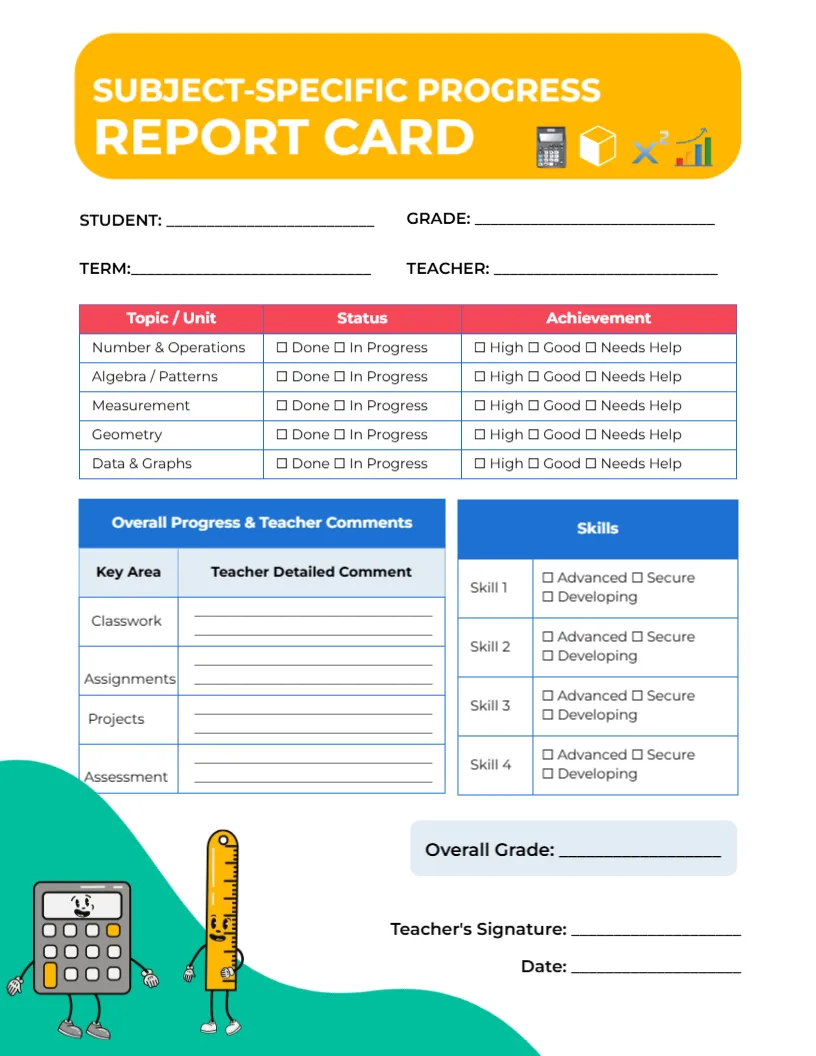
A Subject-Specific Progress Report Card Template gives teachers a dedicated space to document a student’s mathematical development in a clear and organized way. Unlike a general report card, this format concentrates only on Mathematics. Therefore, it allows educators to provide more meaningful information about numerical understanding, problem-solving, calculations, and mathematical reasoning.
The template can be used to review progress during a term, quarter, semester, or other reporting period. Its focused design makes it easier to record academic development while keeping the information relevant to the student’s Mathematics learning.
Mathematics at a Glance
A student’s Mathematics grade alone may not explain which concepts have been mastered or where additional practice is needed. This report card helps teachers provide that missing context.
Key Areas to Review
The report can be customized to monitor important mathematical areas, such as:
- Number sense and numerical operations
- Addition, subtraction, multiplication, and division
- Fractions, decimals, and percentages
- Measurement and units
- Geometry and spatial concepts
- Patterns and mathematical relationships
- Problem-solving strategies
- Data interpretation and basic statistics
- Mathematical reasoning
- Accuracy and calculation skills
Teachers can select the areas that match their curriculum and student level. As a result, the report remains useful across different Mathematics programs.
From Concepts to Application
Mathematical progress involves more than getting the correct answer. Students must also understand concepts and apply them in different situations.
This template provides an opportunity to comment on how effectively a student uses mathematical knowledge. For example, a teacher may document whether the student can select an appropriate strategy, explain a solution, interpret information, or complete multi-step problems independently.
Understanding
Record how well the student understands mathematical concepts introduced during the reporting period.
Accuracy
Note consistency when performing calculations, using formulas, and applying mathematical procedures.
Problem Solving
Evaluate the student’s ability to identify information, choose a suitable method, and work through a problem logically.
Reasoning
Document how clearly the student explains mathematical thinking and supports an answer.
Progress Beyond the Grade
A focused Mathematics report can show more than a final mark. It can capture changes in performance throughout the reporting period.
Teachers can use the editable sections to describe skills that have improved, concepts that remain challenging, and areas where the student is becoming more independent. This creates a clearer picture of progress over time.
For instance, a student may have improved considerably in multiplication but still require support with fraction operations. A specific observation like this provides useful information for both families and educators.
A Space for Teacher Insight
Strengths
Use comments to identify mathematical skills the student demonstrates confidently. These might include quick calculation, logical reasoning, accurate measurement, or successful problem-solving.
Areas to Develop
Teachers can identify concepts that need additional instruction or practice. Specific feedback makes it easier to plan appropriate classroom support.
Next Learning Steps
A short recommendation can explain what the student should continue practicing. This may include mastering a particular operation, reviewing a concept, improving calculation accuracy, or explaining solutions more clearly.
This combination keeps feedback constructive and action-oriented.
Built Around Editable Content
The Subject-Specific Progress Report Card Template can be modified to reflect the Mathematics curriculum used by your school. You can change assessment categories, terminology, grading criteria, student details, reporting periods, and teacher comments.
Furthermore, the editable format makes it suitable for different grade levels. Younger learners may need basic numeracy and calculation categories, while older students can be assessed on algebraic thinking, geometry, data analysis, and more advanced problem-solving.
You can also adapt the level of detail according to your reporting requirements. Keep the assessment concise for routine progress updates or expand the criteria when a more detailed Mathematics review is required.
Useful for Ongoing Assessment
This Mathematics report card can support several stages of the academic year. Teachers may use it for quarterly reporting, midterm reviews, parent-teacher meetings, intervention planning, or end-of-year documentation.
Because the report focuses on one subject, it can also be used alongside a broader school report. The general report provides an overall academic picture, while this document gives Mathematics its own detailed assessment space.
Make Mathematical Progress Easier to Explain
Clear reporting helps students and families understand more than a number or letter grade. It shows what the learner can do, where progress has occurred, and which mathematical skills need continued attention.
With editable assessment areas and space for personalized observations, this template gives educators a practical way to create focused Mathematics progress reports without building the document from the beginning.
Download the Subject-Specific Progress Report Card Template to create a customized Mathematics report that reflects your curriculum, assessment approach, and students’ learning needs. Edit the content, add your preferred criteria, and prepare clear mathematical progress records with greater efficiency.