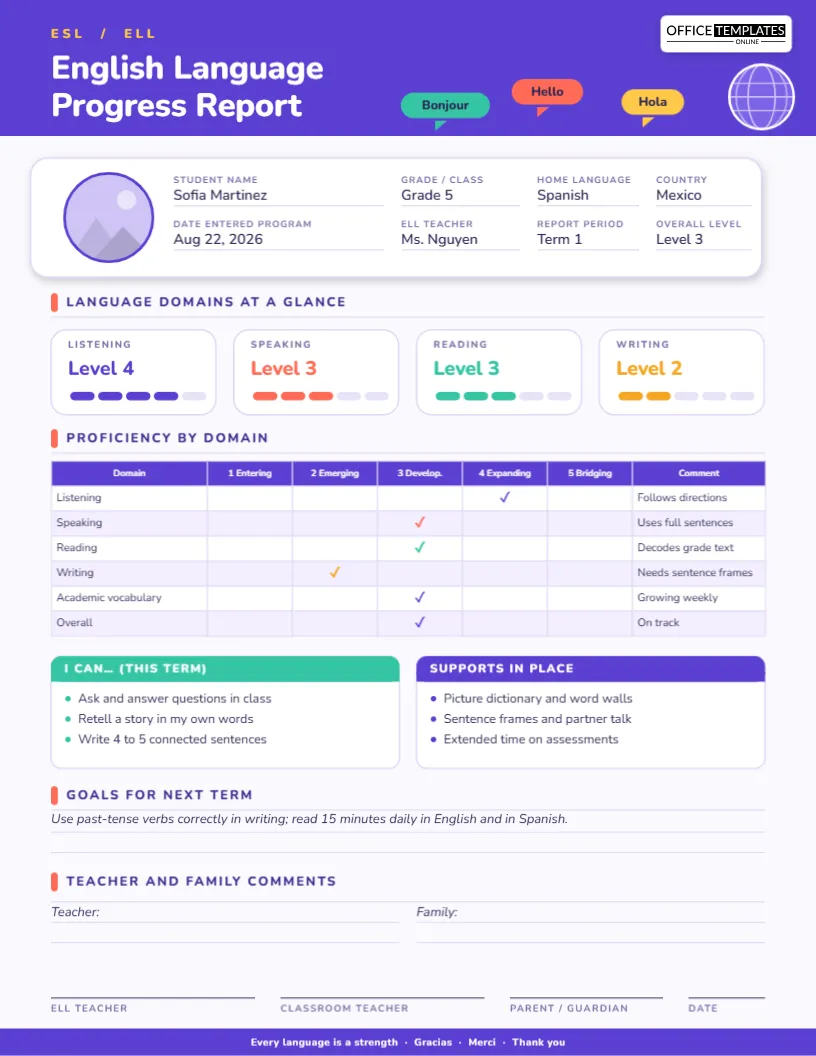
A child learning English is doing something remarkable: building a second language while learning everything else in it. Families and colleagues deserve a report that reflects that effort rather than reducing it to one grade. The ESL / ELL student progress report template below was designed with that respect in mind, and it uses the purple, coral and mint of a welcoming classroom rather than the gray of a form.
Start with what the student brings
The header greets the reader in three languages, “Hello”, “Hola” and “Bonjour”, beside a globe. It is a small detail with a clear message: home languages are assets. Below it, a student card records the child’s photo, name, grade, home language, country, date they entered the program, ELL teacher, report period and overall level.
Four domains, one glance
English proficiency develops unevenly. A student may listen at Level 4 while writing at Level 2. Four tiles show listening, speaking, reading and writing as a level number with a five-segment bar, each in its own color. Families see the shape of growth instantly, and the differences between domains become a conversation, not a worry.
A closer look at the levels
The proficiency table lists the same domains, plus academic vocabulary and an overall row, across five levels: Entering, Emerging, Developing, Expanding and Bridging. Each row has a tick and a short comment such as “Follows directions” or “Needs sentence frames”. The level names are generic, so you can rename them to match any district, state or program framework you already use.
Language a child can be proud of
An “I can” box turns levels into statements: I can ask and answer questions in class, retell a story in my own words, write four to five connected sentences. Beside it, a Supports in place box documents accommodations such as picture dictionaries, sentence frames, partner talk and extended time, so the next teacher knows what already works.
What this page does for each reader
For the ELL teacher
It replaces separate notes with one structured record, ready for meetings with classroom teachers and families.
For the classroom teacher
It shows what language demands a student can currently meet, so lessons can be scaffolded to match.
For the family
It celebrates growth in plain language and suggests a next goal, such as using past-tense verbs, along with a reminder that reading in the home language supports English.
For support teams and administrators
It documents entry dates, levels and supports in a consistent format for reviews.
Making it your own
Everything on the page is editable. Click the photo and choose Replace Image to add a portrait, or delete it if photos are not permitted. Retype the student card, change each tile’s number and recolor its bar segments, and move the ticks in the table. Rewrite the “I can” and Supports boxes with the student’s real statements, and add goals and comments in the ruled areas.
Communicating across languages
- Write comments in short, plain sentences; they translate more accurately.
- Offer a translated copy of the report when a family’s home language is not English.
- Use the greeting bubbles to show the family’s own language.
- Name the home language as a strength in the goals section.
Sample comments you can adapt
- “Sofia follows multi-step directions and asks clarifying questions.”
- “She uses full sentences in conversation and is beginning to use past tense.”
- “Sentence frames and partner talk help her write connected sentences.”
- “Please keep reading together in Spanish; strong home language skills support English.”
Printing and file formats
The report is US Letter, 8.5 x 11 inches, in portrait orientation. Print in color if you can; the segmented level bars are easiest to read that way. Download a PDF for print, or a PNG or JPG to send to a family’s phone.
Common questions
Does it follow a particular framework?
No. The five levels are generic and can be renamed.
Can I add a home language row?
Yes. The proficiency table accepts additional rows.
Is it only for K to 12?
It is designed for school-age learners, but the structure fits any English learner if you adjust the wording.
Three students, three snapshots
A newcomer in the first months
Most levels sit at Entering or Emerging, and the comments are about safety and belonging: follows routines, uses gestures and single words, enjoys picture books. The “I can” box might say “I can say my name, ask for help and follow classroom routines.” Goals stay small and joyful.
A long-term learner at a plateau
Speaking and listening may be at Level 4 while writing remains at Level 3. The tiles make that gap obvious and support a targeted plan, such as academic vocabulary, sentence variety and extended writing practice.
A student preparing to exit the program
Levels cluster at Bridging. The report becomes a celebration and a hand-off, with a supports box that lists what the classroom teacher should continue to offer.
Building a partnership with families
- Meet families with an interpreter when possible and hand them the translated page.
- Ask about language use at home and record it in the details.
- Explain the levels with one picture: the bar fills as language grows.
- Invite families to share a story, song or book from their culture with the class.
A term-by-term rhythm
Update the report at the same points each year, such as after the first month, the end of the first semester and the end of the year. Save each PDF so growth is visible across time. Between reports, jot quick notes in the comment column so evidence is ready when the next page is due, and remember to celebrate progress in every domain, including the ones that are moving more slowly.
Small wins worth writing down
Progress in a new language often arrives quietly: the first joke told in English, the first question asked without a translator, the first paragraph written without a frame. Use the comment column and the “I can” box to capture those moments. Families treasure them, and they remind colleagues that a level number is only part of the story.
Show families every step of their child’s English journey. Open the template, add your student’s levels and download a colorful progress report today.