A handbook for Hifz teachers, in one page
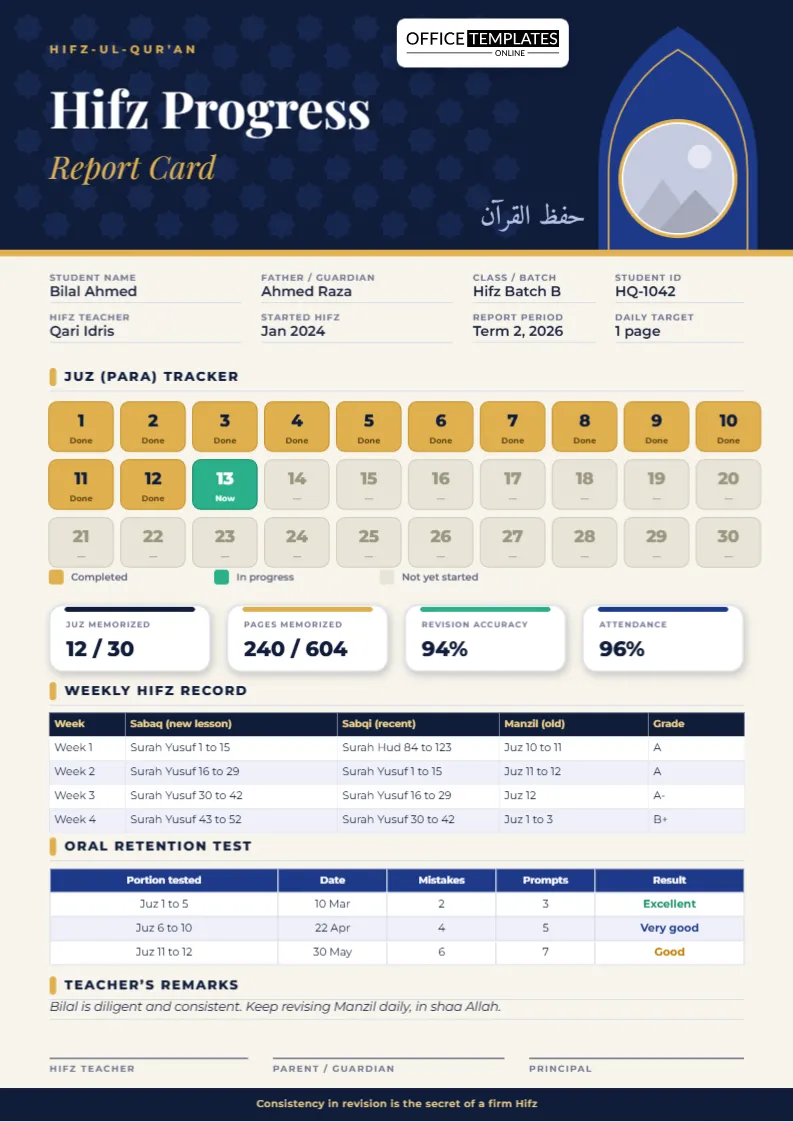
Memorizing the Qur’an is a long journey measured in years, and both students and parents need a clear map of how far they have come. This Hifz progress report card template gives you that map. A midnight-blue and gold design, an arch-framed photo and a thirty-square Juz tracker make the whole journey visible at a glance, while two tables record the weekly routine and the results of oral tests.
Three words every Hifz record needs
Most Hifz programs organize each day around three portions, and the card’s weekly table follows them exactly.
Sabaq: the new lesson
The new portion memorized this session, often a few lines or a page depending on the student and program. Write the Surah and Ayah range so anyone can follow the pace.
Sabqi: recent revision
The most recently memorized portions, revised daily until they settle. Recording the range shows parents that the new lesson is being consolidated, not just added.
Manzil: the older revision
Portions memorized earlier, revised on a rotating cycle so nothing fades. A Manzil column is what tells a family that the student is keeping what they have learned.
Why a Juz tracker motivates
Thirty rounded squares sit in three rows of ten, one for each Juz. Completed Juz are gold, the current one is green, and those to come are soft gray. Children love watching gold spread across the grid, and adults love how instantly it answers the question, “Where is my child now?” To update it, click a square and change its fill color; a small label beneath each number shows Done, Now or a dash.
Four numbers for the top of the page
Four tiles summarize Juz memorized, pages memorized, revision accuracy and attendance. The sample uses a 604-page Mushaf, which is one common standard, so twelve Juz equals about 240 pages. If your program uses another edition, simply change the total.
Reading the weekly record
The weekly table has five columns: week, Sabaq, Sabqi, Manzil and grade. Fill in one row per week, or per day if you prefer, by adding rows from the Table menu. A grade such as A or B+ works, and so do numbers or short words like “Strong”. Consistency matters more than the scale you choose.
The oral retention test: mistakes and prompts
Periodic oral tests are the truest measure of retention. The second table records the portion tested, the date, the number of mistakes, the number of prompts the teacher had to give and the result. Colored result labels (green for Excellent, blue for Very good, amber for Good) help parents see progress at a glance. Many teachers set simple thresholds, such as no more than three mistakes for an Excellent rating; write yours in the remarks.
A realistic month, to inspire your own
- Week 1: New lesson of fifteen ayahs, with revision of the previous day’s portion and a Juz from the Manzil cycle.
- Week 2: Fourteen ayahs, with steady revision and a grade of A.
- Week 3: Thirteen ayahs, with a slightly lower grade after a busy week.
- Week 4: Ten ayahs, with extra time given to Manzil; the teacher notes fatigue and adjusts.
Setting up your own targets
The header includes a daily target field, such as one page. Change it to the target you have agreed with the family. Talented students may move faster and others slower; the card supports both, because every field is editable text. What matters is that the family understands the plan and the teacher records honestly.
Using the card in a parent meeting
- Begin with the Juz tracker and celebrate what is complete.
- Move to the weekly table to explain what happens each day.
- Use the retention test to talk about strengths and areas to revise.
- Agree on home support, such as a quiet listening time each evening.
- Sign the card together and set the next review date.
Print, share and file
The card is A4, 210 x 297 mm. Print at actual size on standard white paper, or slightly heavier stock for a term-end version. Download a PDF for printing and a JPG or PNG to send by phone to parents. Keep one copy for the student’s file, and reuse the same file each term by updating the tracker and tables.
Questions we hear
Can I use it for part-time or weekend Hifz classes?
Yes. Adjust the daily target and the attendance figure, and record fewer weeks if you meet less often.
Can I add another revision column?
Yes. Because the table is editable, you can add columns or rows, or rename the headings to your own terms.
Does it work for a student who has completed Hifz?
You can fill all thirty squares gold and use the card as a completion record, or pair it with the Quran completion report card.
Supporting stamina and a healthy routine
Hifz demands patience, sleep and steady habits. Use the remarks area to note what helps the student most: an early start, a calm environment, listening to a reciter, or time for rest between sessions. When you record a lower grade in a week, add a short note explaining why, such as illness or exams. Parents respond well to honesty combined with a plan.
When a student falls behind
Every Hifz student has slower periods. Rather than worrying, use the card to spot the pattern: is the Sabaq too long, or has Manzil been neglected? Shorten the daily target, increase revision and record the change in the daily target field. A student who is not pushed beyond their capacity will usually come back stronger, and a card that shows a thoughtful adjustment reassures families.
Tracking a whole batch
Teachers with a group of students can duplicate the card for each child and keep a folder per batch. Because the tracker and tables are editable, updating a card takes only a few minutes at the end of each week or month. Some institutes print all the cards for a parents’ day and display them in a folder so families can browse and discuss progress together.
Give every Hifz student and family a clear map of the journey. Open the template, add your student’s progress and download it today.