The coach’s guide to writing a report card players will keep
Scouts write scouting reports. Teachers write report cards. Good youth coaches do a bit of both: they name what a player does well, show where the next gains are and give them something to chase. This sports progress report card template gives you the format, with a bold charcoal and lime design that feels like a real sports program.
The scouting-report mindset
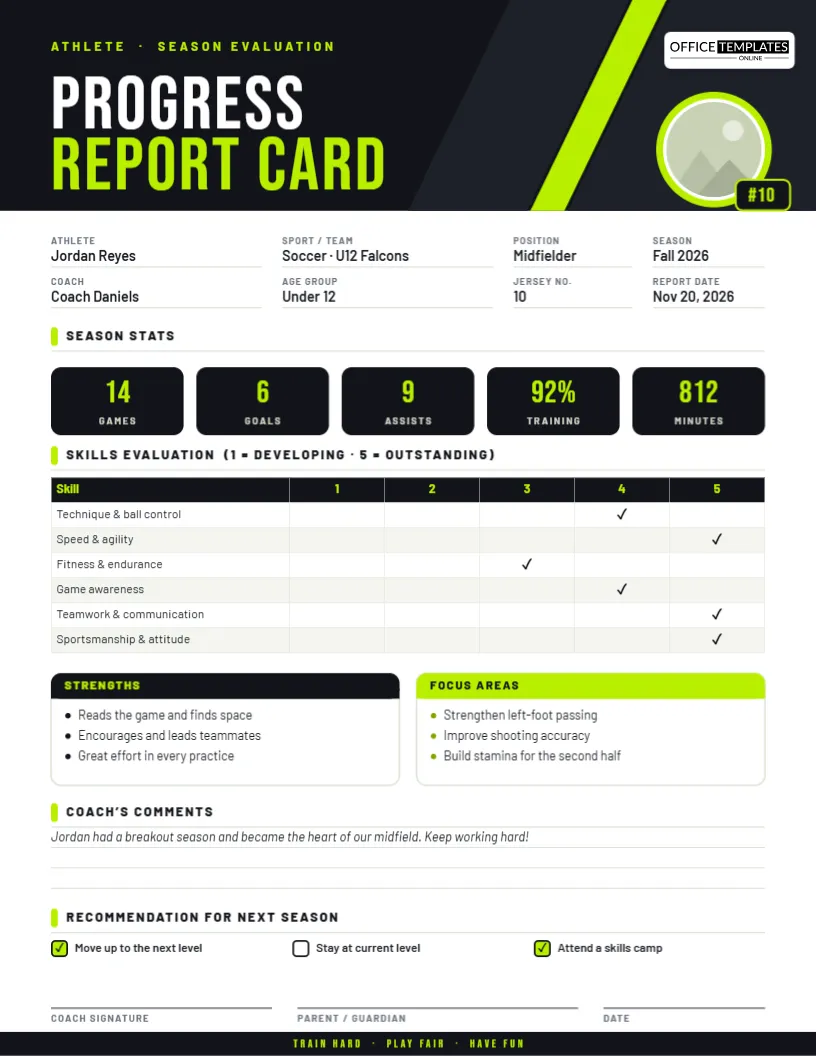
Start from the idea that a young athlete wants to be taken seriously. A dark stat strip, a jersey number badge and a round action photo do exactly that. The header carries the athlete’s picture, and a small lime badge shows the jersey number. Underneath, fields cover the athlete, sport and team, position, season, coach, age group, jersey number and report date.
Stats that matter, by sport
Five dark tiles hold the season numbers. The sample shows soccer, but the labels are simple text you can rename.
Soccer
Games, goals, assists, training attendance and minutes played.
Basketball
Games, points per game, rebounds, assists and free-throw percentage.
Swimming and track
Meets, personal bests, laps or distance, attendance and improvement in seconds.
Martial arts and gymnastics
Classes, belts or levels earned, routines mastered and attendance.
The 1 to 5 rating scale, explained
The skills table lists six areas: technique and ball control, speed and agility, fitness and endurance, game awareness, teamwork and communication, and sportsmanship and attitude. A tick goes in the column from 1 (developing) to 5 (outstanding). Use the same scale all season so numbers are comparable, and remember that a 3 is a solid, useful rating, not a failure.
A feedback formula that works
- Praise something specific in the black Strengths box: “Reads the game and finds space.”
- Point to one growth area in the lime Focus box: “Strengthen left-foot passing.”
- Write a personal line in the coach’s comments, in your own voice.
- Tick the recommendation: move up a level, stay at the current level or attend a skills camp.
Setting it up before the season ends
Open the template and click the round photo to choose Replace Image. Type the athlete details and jersey number, update the stat tiles, place your ticks and write your comments. Recolor the lime and charcoal to match your club, or add your badge next to the title. All fonts are Google Fonts, so nothing needs installing.
Which teams and clubs is it for?
- Youth soccer, basketball, baseball and football coaches
- Swim, gymnastics, track and martial arts clubs
- School teams reporting to athletic directors
- Academies and development programs with player pathways
- Personal trainers and performance coaches
- Camps and clinics with end-of-week evaluations
Lines from real dressing rooms
- “Jordan reads the game well and finds space for teammates.”
- “He leads by example, encouraging others after mistakes.”
- “Work on left-foot passing and shooting accuracy in the off-season.”
- “Recommended to move up a level next season.”
Print it, hand it over, talk it through
The report is US Letter, 8.5 x 11 inches. Print at actual size in color, and hand it to the player in person at the end-of-season meeting. If the team uses a group chat, send the PNG or JPG version instead. Because the dark header uses more ink, some coaches print it on a laser printer for crisper blacks.
Straight answers
Is this only for soccer?
No. Rename the position, stats and skills for any sport.
Can I use it for a whole team?
Yes. Replace athlete fields with the team name and record team totals in the tiles.
How do I change the checkboxes?
Click a box and change its fill color and tick.
Common mistakes in youth sports feedback
- Only mentioning results. Goals and wins matter, but effort, attitude and improvement matter more for growing athletes.
- Comparing players. Rate each athlete against their own progress, not a teammate.
- Giving five improvements at once. Pick one or two focus areas the player can work on before next season.
- Waiting until the end. Use a mid-season version so players can act on feedback while there is still time.
Mid-season versus end-of-season
A mid-season report is a checkpoint. Tick the ratings, name one strength and one focus area and leave the recommendation boxes blank. The end-of-season report adds full stats, the coach’s comments and the recommendation for next season. Saving both shows how much a player has grown, and it makes for a more meaningful conversation at the final meeting.
A portfolio for tryouts and applications
Older athletes often need evidence for academy tryouts, school applications or scholarships. A stack of these report cards, one per season, is an organized record of stats, coach feedback and character. Ask a coach to sign each one, and store PDFs in a single folder labeled with the sport and year.
Talking to parents
Parents can be as competitive as players. Frame the report as a development tool: describe what their child can do now, what the next step is and how practice at home can help. Invite questions after the meeting rather than during, and keep the focus on the child’s experience of the sport. A confident, kind tone keeps athletes in the game for years.
Adapting the tiles and skills for your sport
A single design can serve many teams once the labels are changed. For basketball, try points per game, rebounds and free-throw percentage; for swimming, personal bests and attendance; for baseball, batting average and fielding plays; for martial arts, belt level and classes attended. The skills table can become ball handling, footwork, conditioning, strategy, teamwork and respect, or any six areas you coach.
Making feedback stick with young athletes
Children remember three things after a meeting: how they felt, one piece of praise and one thing to work on. Choose the strength and the focus area carefully, say them aloud as you point to them on the page and hand over the report at the end. A player who leaves smiling and knowing their next step is a player who returns next season.
Involving assistant coaches and parents
Ask assistant coaches to contribute a ranking or a comment for each player, and agree on how ratings will be assigned. Invite parents to write a short note on what they noticed at home, such as a player practicing in the yard. A team effort makes the report richer and reinforces that development belongs to everyone around the athlete.
Recognize effort and show players the path to improvement. Open the template, add your season’s data and download a report card they will keep.