A security guard is paid to notice things, and the record of what they noticed is as important as the hours they worked. A site owner wants proof that patrols happened at the stated times. A supervisor wants to know who was on duty. If something goes wrong, the written log is often the first document anyone asks for. This US Letter page combines both records: a timesheet for shifts and a patrol table for checkpoints on one sheet.
A Shield Badge in Navy
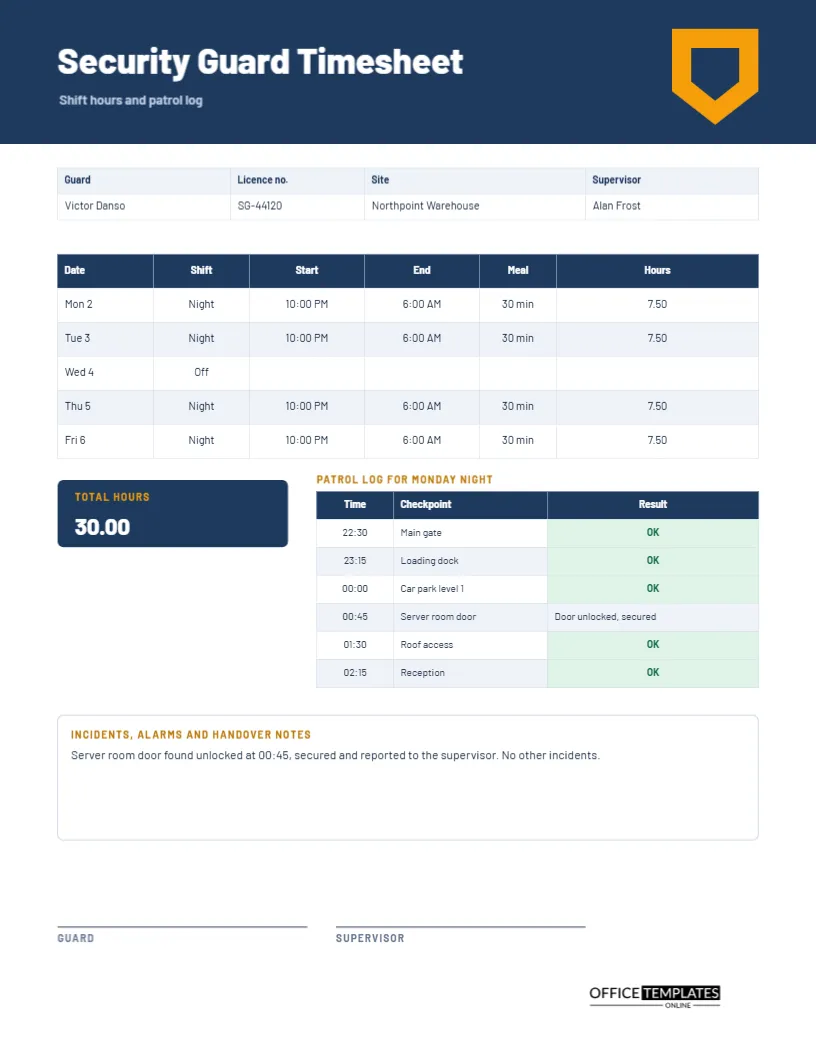
The header is navy with a gold shield at the top right, a smaller navy shield inside it. The title Security Guard Timesheet is set in heavy Barlow, with shift hours and patrol log underneath. The palette of navy and amber is the colour of uniforms, badges and warning lights, and it signals seriousness without looking harsh. Barlow carries every other piece of text.
Guard, Licence, Site and Supervisor
The strip lists the guard, the licence number, the site and the supervisor. The sample is Victor Danso, licence SG-44120, at Northpoint Warehouse, reporting to Alan Frost. Including a licence number matters in places where guards must be licensed, because the client can match the person on site to the one the contractor promised.
Five Nights on the Roster
| Date | Shift | Start | End | Meal | Hours |
|---|---|---|---|---|---|
| Mon 2 | Night | 10:00 PM | 6:00 AM | 30 min | 7.50 |
| Tue 3 | Night | 10:00 PM | 6:00 AM | 30 min | 7.50 |
| Wed 4 | Off | None | None | None | 0.00 |
| Thu 5 | Night | 10:00 PM | 6:00 AM | 30 min | 7.50 |
| Fri 6 | Night | 10:00 PM | 6:00 AM | 30 min | 7.50 |
The total in the amber tile reads 30.00 hours. Shifts are listed by the date they began.
The Patrol Log
A second table lists each checkpoint visited on Monday night, with time, place, and result. The sample covers six rounds from 22:30 to 02:15: main gate, loading dock, car park level 1, server room door, roof access and reception. A green OK badge marks a normal check. Using the 24-hour clock here avoids confusion between night and day entries.
Recording Exceptions Clearly
At 00:45, the sample notes that the server room door was unlocked and was secured. The result column shows the words rather than an OK badge, so the exception stands out. A good patrol note says what was found, what was done, and who was told. It leaves no room for doubt about the response.
Incidents, Alarms and Handover Notes
The large notes box with an amber heading holds longer comments. The sample repeats the unlocked door, says it was secured and reported to the supervisor, and states that no other incidents occurred. Writing no other incidents is as important as writing what happened, because it shows the guard looked and found nothing else.
Filling in a Night Shift Log
- Write your name, licence number, site, and supervisor.
- Record your start time when you take over from the previous guard.
- Log every patrol with time, checkpoint, and result as you go.
- Write any incident immediately, with times and actions.
- Record your end time and hand over, then sign.
Why Patrol Times Matter
Clients often pay for patrols. A log with times at each checkpoint is proof that the service was delivered. It also shows patterns: if the loading dock is checked at the same time every night, an intruder could learn the schedule. Many supervisors ask guards to vary the order and time of patrols, which the log can confirm.
Handover Between Guards
The best handover notes are short and specific: which alarms were active, which doors are known to be faulty, which visitors are expected. Use the notes box for handover and ask the incoming guard to read it before taking over. Where guards change at shift end, a signed handover reduces confusion about who was responsible when something happened.
Keeping Logs for Insurance and Investigations
Insurers, police and clients may ask for logs after a break-in or an accident. Keep the signed originals in a secure place for as long as your contract and local law require. Never alter an entry after the fact. If you must correct a mistake, strike it through with a single line and add your initials and the date.
Adapting the Checkpoints to Your Site
The six checkpoints in the sample belong to a warehouse. Replace them with the real points on your route, such as stairwells, plant rooms, or gate barriers. The patrol table is a real Table object, so you can add rows for longer patrols, or print a second page for a busier site.
Daytime and Mobile Patrol Shifts
The same sheet works for day shifts and for mobile patrols between several sites. Change the shift type, add the vehicle mileage in the notes, and list each site stop as a checkpoint. A mobile guard can show a client exactly when their site was visited.
Printing and Signatures
The guard and the supervisor sign at the foot. Print on US Letter and keep a clipboard copy at the post. The navy header prints well in colour, and the page remains clear in black and white.
Training New Guards to Write Good Log Entries
A new guard often writes too little or too much. Show them two examples: a vague entry such as all quiet, and a precise one such as checked loading dock at 23:15, door locked, no vehicles. Practise a few entries together and review the first week of logs. Good habits formed early make every later handover safer.
Using Patrol Data to Improve Site Security
After a month of logs, look for repeated findings: the same door left open, the same light out, the same gate not latched. Each repeat points to a fix for the site owner, such as a better lock or a timer. The log turns a guard’s observations into a list of practical improvements.
Security Guard Timesheet Questions
Is this an official patrol record?
No. It is a general log. Use any form your licence authority or client requires.
Can I record more than six patrols?
Yes. Add rows to the patrol table or print a second sheet.
Do I need the licence number field?
Only where licences apply. Delete the field or leave it blank otherwise.