Domestic work is often arranged with a handshake. A housekeeper comes three or four mornings a week, the household pays at the end of the week or month, and the details live in two memories that may not agree. A written record protects both sides. It shows days worked, hours, tasks, any advance taken, and the balance to pay, in a format that an employer and worker can sign without any dispute.
A Terracotta House on a Warm Page
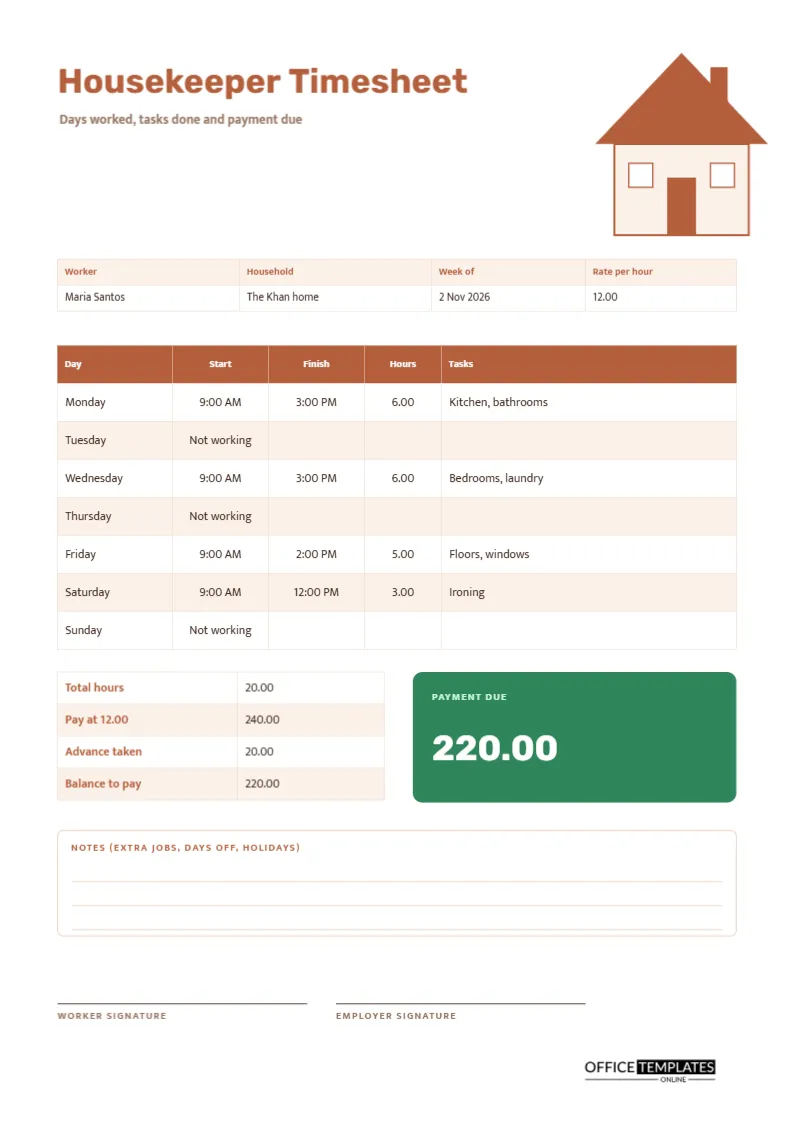
A small house drawn from shapes, with a terracotta roof, a door, two windows and a chimney, sits at the top right of the A4 page. The title Housekeeper Timesheet is set in warm terracotta Rubik, with a subtitle about days worked, tasks done, and payment due. Mukta supplies the smaller text. The palette of terracotta and green feels homely and respectful.
Worker, Household, Week and Rate
A strip lists the worker, the household, the week and the rate per hour. The sample records Maria Santos working for the Khan home in the week of 2 November 2026 at 12.00 an hour. The rate is on the page from the start, so that nobody has to ask what it was, and it is easy to update when it changes.
Seven Days, Some Not Working
| Day | Start | Finish | Hours | Tasks |
|---|---|---|---|---|
| Monday | 9:00 AM | 3:00 PM | 6.00 | Kitchen, bathrooms |
| Wednesday | 9:00 AM | 3:00 PM | 6.00 | Bedrooms, laundry |
| Friday | 9:00 AM | 2:00 PM | 5.00 | Floors, windows |
| Saturday | 9:00 AM | 12:00 PM | 3.00 | Ironing |
Tuesday, Thursday, and Sunday read: Not working. Writing it out is clearer than leaving a blank, because a blank row can later look like a forgotten entry.
The Payment Block
On the lower left, a short table lists total hours, pay, advance taken, and balance to pay. For the sample week, the total is 20.00 hours, the pay at 12.00 is 240.00, the advance is 20.00, and the balance is 220.00. Showing the advance on the same page keeps repayments transparent, and the worker knows exactly why the final payment is lower than the full amount.
A Green Tile for Payment Due
To the right, a rounded green tile shows payment due in large white numerals: 220.00. Green marks money received and gives the worker a clear target figure. If you pay in cash, this is the amount you count out. If you pay by bank transfer, it is the amount you send, and the signed sheet serves as your receipt.
Notes for Extra Jobs and Days Off
A ruled notes box invites entries such as deep cleaned oven on Friday, day off on 12 November, or paid public holiday on 25 December. Short comments avoid arguments later. If the household agrees to extra payment for a special task, write it here and add it to the pay before the sheet is signed.
Filling in the Page Weekly
- Write the worker, household, week, and rate.
- Enter start and finish times on each working day.
- Write the tasks done in a few words.
- Add the hours and work out the pay.
- Subtract any advance and write the balance.
- Both sign, and the worker keeps a copy.
Respecting the Worker’s Rights
Domestic workers are entitled to fair treatment, and many places set minimum wages, rest days, and paid leave for them. Check what applies where you live. The sheet is a record of hours and pay, not a substitute for a proper agreement, but it is a good habit that supports fair rules on both sides.
How to Record an Advance Properly
If the worker asks for money in advance, write the date and amount on the sheet and add it to the advance line. Agree whether it will be deducted in one go or over several weeks. When the balance is paid, both sides sign. This simple practice has prevented countless misunderstandings in households of all sizes.
Weeks With Public Holidays or Sick Days
Write the holiday or sick day in the notes and decide how it is paid. Some households pay holidays in full, others pay only worked hours. Whatever you decide, write it down so the next week starts with the same understanding. Consistent treatment is the sign of a good employer and builds loyalty.
Language and Accessibility
Some domestic workers read another language at home. Because every label in the template is editable, you can retype the headings in a language both of you understand, or add a translation under each heading. Simple words and clear numbers matter more than perfect layout.
Printing the A4 Housekeeper Sheet
The page is A4 portrait. Print one copy for the employer and one for the worker, or take a photo of the signed page. The terracotta and green print well in colour and remain readable in black and white.
Building a Good Working Relationship With a Weekly Record
A short weekly routine helps everyone relax. The worker fills in the hours, the employer reads and signs, and the money is paid on the day. Because the process is the same each week, nobody needs to raise the subject of pay awkwardly. Respect grows when promises are written and kept.
Keeping Housekeeper Records for the Year
File the signed weekly sheets in date order. At the end of the year, you can add up hours, pay, and advances in minutes, answer any question from a tax office or an insurer, and show the worker a clear summary if they need proof of income for a loan or a rental application.
Agreeing Tasks and Hours Before the First Cleaning Day
Sit down once and list what a normal visit includes, how long it should take, and what counts as extra. A shared list prevents the common complaint that the house is never quite clean enough, and the worker feels respected when expectations are clear. Update the list when the household changes.
Housekeeper Timesheet Questions
Can I use it for a monthly payment?
Yes. Fill in four weekly sheets and add the balances, or adapt the table for a full month.
What if the rate changes mid-week?
Write the change in the notes and calculate the two parts separately.
Is it suitable for a cleaner who works for several homes?
Yes. The worker can keep one sheet for each household.