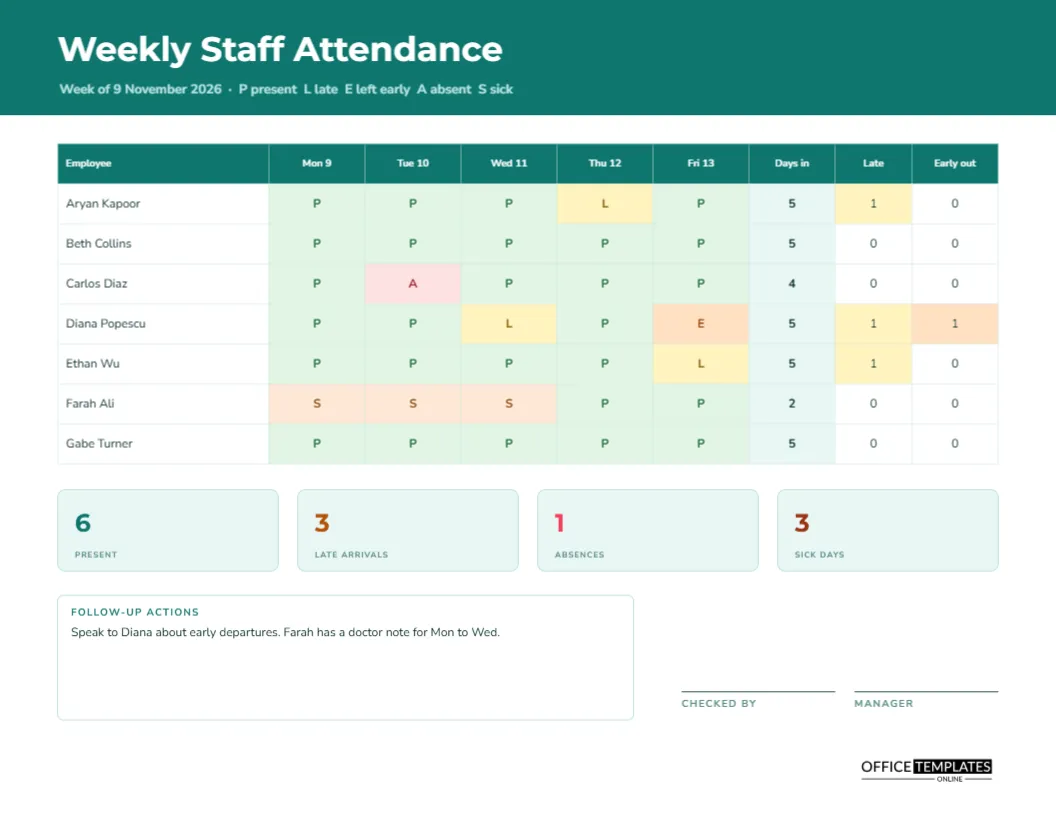
Some managers do not need to know what time each person arrived, only whether they came, whether they were late, and whether they left early. A weekly attendance sheet gives that overview on one page. Staff are down the side, the five working days run across the top, and each cell holds a single letter. At the right, three small columns count days in, late arrivals, and early departures. It is quick to fill in and easy to read.
Teal Header With a Rose Accent
A teal band holds the title Weekly Staff Attendance in Montserrat, with a line beneath it that spells out the codes: P present, L late, E left early, A absent, and S sick. The week is printed as the week of 9 November 2026. Nunito Sans sets the table text, and a rose accent colours the absences tile. The palette is fresh and calm, which suits a document about people.
Seven People, Five Days
| Employee | Mon to Fri codes | Days in | Late | Early out |
|---|---|---|---|---|
| Aryan Kapoor | P, P, P, L, P | 5 | 1 | 0 |
| Beth Collins | P, P, P, P, P | 5 | 0 | 0 |
| Carlos Diaz | P, A, P, P, P | 4 | 0 | 0 |
| Diana Popescu | P, P, L, P, E | 5 | 1 | 1 |
| Ethan Wu | P, P, P, P, L | 5 | 1 | 0 |
| Farah Ali | S, S, S, P, P | 2 | 0 | 0 |
| Gabe Turner | P, P, P, P, P | 5 | 0 | 0 |
Each letter is shown in its own coloured cell on the real page.
How Late and Early Out Count
An L means the person arrived late, and an E means they left early. Both still count as days in, since the person came to work. The final three columns then count total days in, the number of late arrivals and the number of early departures. A late or early day is a signal, not a mark of absence, and the sheet treats it that way.
Present, Late, Absent and Sick Tiles
Under the table, four tiles summarise the week: present (6 people with a full week of presence), late arrivals (3), absences (1) and sick days (3). The numbers give a fast reading of the team’s attendance, and the same four can be compared from week to week to find trends. Adjust the title labels to count whichever measures matter to you.
Follow-up Actions
A notes box records what needs to happen next. The sample reads: speak to Diana about early departures, and Farah has a doctor’s note for Monday to Wednesday. Attendance data is only useful when someone acts on it, whether that action is a supportive conversation, a note on file, or simply a check that paperwork is in place.
Marking the Sheet Each Day
- Write the week commencing date.
- List the staff in the first column.
- Each morning, mark every person with P, L, A, or S.
- If someone leaves early, change their letter to E and note the time.
- On Friday, count the three right-hand columns.
- Fill the tiles, add follow-ups, and sign.
Why Weekly Beats Monthly for Small Teams
A monthly register hides short-term patterns. A weekly sheet makes them visible while there is still time to act. If three people arrived late on Thursday, you notice that week, perhaps because of a train strike or roadworks, and can respond sensibly. Weekly review keeps attendance management gentle and timely.
Handling Sick Days Respectfully
An S in a cell tells the manager that someone was sick, which is sensitive. Share the sheet only with those who need it, and do not add diagnosis or private details. If your workplace needs a doctor’s note after a certain number of days, record that the note was received, not what it says.
Combining With the Daily Sign-in Sheet
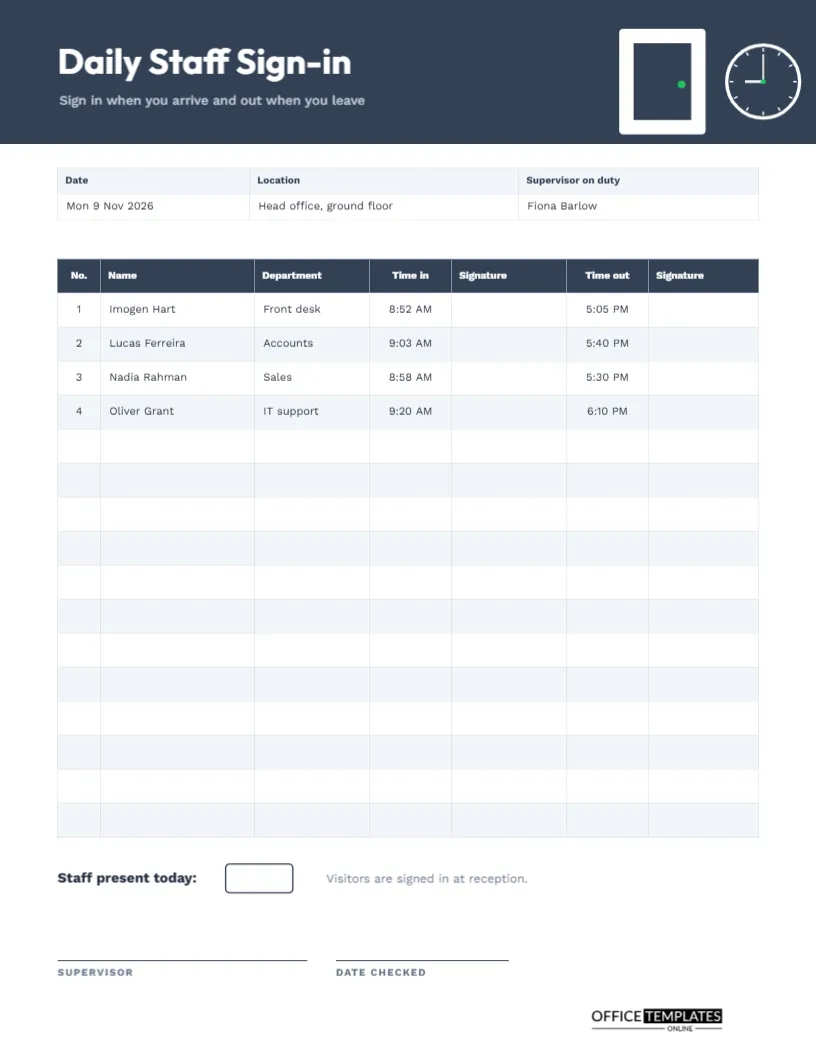
Many workplaces use the daily sign-in sheet at the door and summarise it here at the end of the week. The sign-in sheet gives times and signatures. The weekly sheet gives the overview. Keeping them together in one folder means you can always trace a letter back to the original record.
Using Attendance Data in One-to-One Meetings
When you meet staff, an attendance sheet lets you speak from facts. Praise reliability, ask about frequent lateness with curiosity, and offer help if a pattern suggests a problem at home. Facts delivered with kindness are far more effective than vague complaints, and they keep trust intact.
Editing Names, Days and Codes
The grid is a real Table object. Add rows for a bigger team, retype the names, and rename the day headings for a different week. Add a sixth column for Saturday if needed. After changes, retype the right-hand counts and the tiles.
Checked By and Manager Signatures
The person who checked the sheet and the manager sign at the foot. Print it sideways on US Letter at full scale. Colours become shades of grey in black and white, while the letters remain clear.
Setting a Fair Rule for What Counts as Late
Decide in advance how many minutes of grace people get before an L is written, and tell everyone. A rule of five or ten minutes is common, with a note for traffic or transport problems. When the rule is the same for everyone, the late column becomes a fair measure and not a source of arguments.
Looking Back Over Several Weeks of Attendance Sheets
Keep the weekly sheets together and read four in a row at the end of the month. Patterns that were invisible in a single week, such as a person who is late every other Thursday, appear on their own. These patterns are the best starting point for a kind and useful conversation.
Making the Sheet Work for Remote and Hybrid Teams
For hybrid teams, add a code such as R for remote and decide what counts as present. A shared sheet with the same codes for everyone gives you a clear picture of who is in the office on which day, which is also helpful when you plan desks and meeting rooms.
Weekly Attendance Questions
Can I use it for a six-day week?
Yes. Add a column for Saturday and narrow the others slightly.
Where do I record the time someone was late?
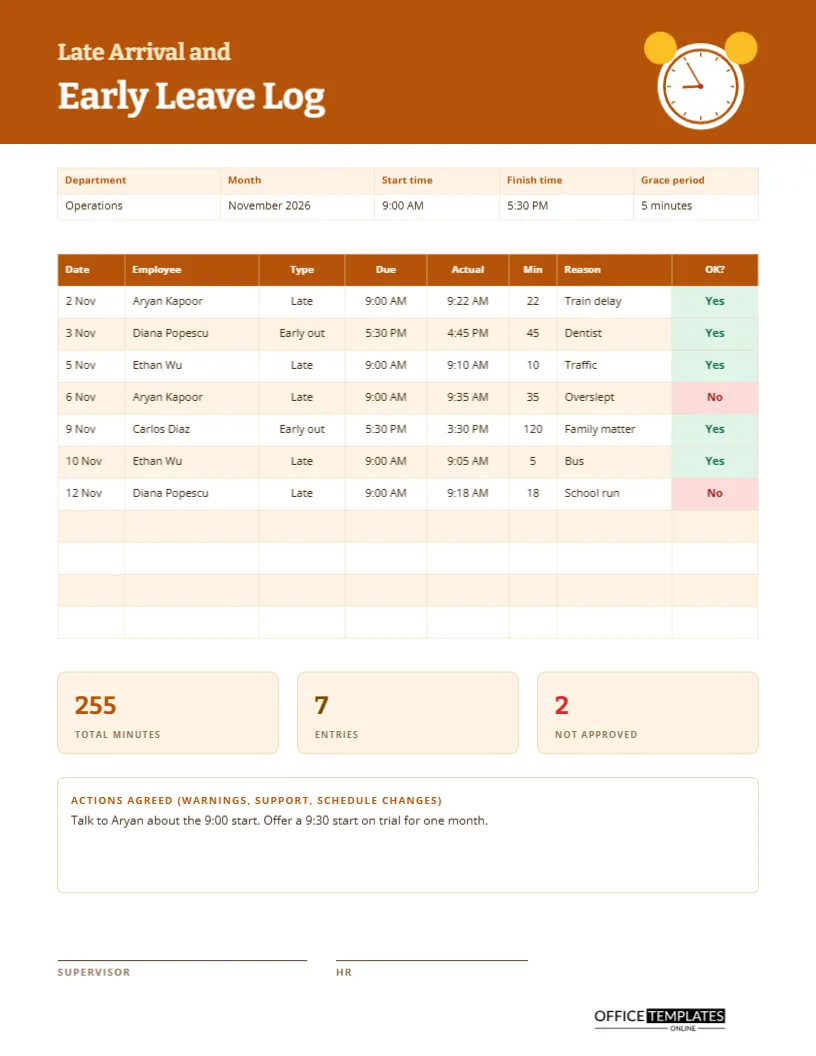
In the follow-up box, or on the late arrival and early leave log in this collection.
Does a late day count as present?
In this layout, yes. It counts in the days column.