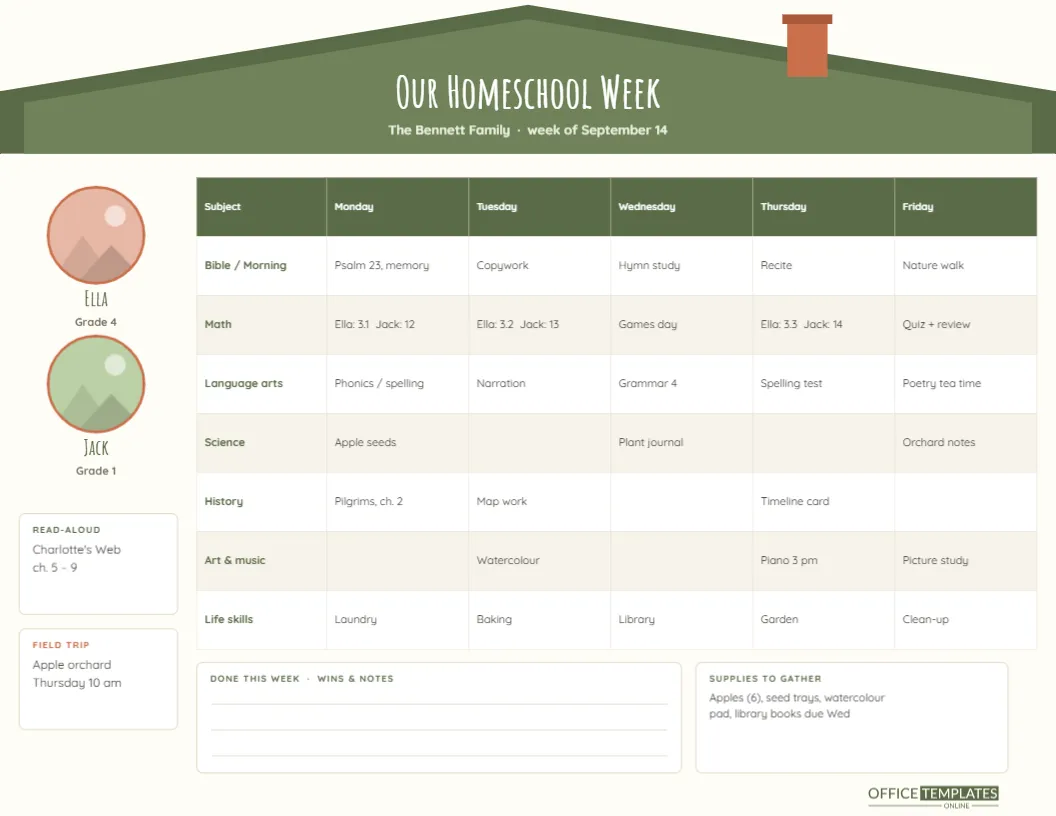
Homeschool planning is family planning. You are not organising thirty students in a classroom; you are juggling two or three children of different ages, a read-aloud, a field trip, piano lessons, and the laundry. A homeschool lesson plan needs to feel like home, show every child at a glance, and make the week realistic. This landscape template does that, with a house roof across the top and a photo of each child on the side.
A Roof Over the Week
The header is a wide gabled roof in olive green, with a lighter inner roofline and a terracotta chimney on the right. On the roof, Our Homeschool Week is written in tall, hand-lettered Amatic SC capitals, with the family name and the week underneath: The Bennett Family · week of September 14. It is a simple, warm motif that makes the page feel like it belongs on the fridge, not in a filing cabinet.
A Photo Badge for Every Child
On the left, a narrow sidebar holds a round photo frame for each child, with their name and grade below: Ella in Grade 4 and Jack in Grade 1. Select a frame and choose Replace Image to add your own child’s photo; it is cropped neatly to the circle. Younger children love seeing their own face on the plan, and it helps them find their tasks. Below the photos, two small boxes hold the week’s read-aloud (Charlotte’s Web, chapters 5 to 9) and the field trip (an apple orchard on Thursday morning).
The Subject by Day Grid
The main grid is a real editor table with a subject column and five day columns:
| Subject | Monday | Wednesday | Friday |
|---|---|---|---|
| Morning time | Psalm 23, memory | Hymn study | Nature walk |
| Math | Ella: 3.1, Jack: 12 | Games day | Quiz and review |
| Language arts | Phonics and spelling | Grammar 4 | Poetry tea time |
| Science | Apple seeds | Plant journal | Orchard notes |
| Life skills | Laundry | Library | Clean-up |
The full grid also has rows for history and for art and music. Notice how the sample combines both children in one row (Ella: 3.1, Jack: 12) for math, where each child works at their own level, and shares subjects like science and history, where siblings learn together. Edit the grid with Edit Table Data and Add Row for subjects like Spanish, coding, or co-op classes.
Wins and Supplies
Two boxes finish the page. Done this week · wins & notes has ruled lines for recording what you actually accomplished, which matters for homeschool record-keeping and for morale on hard weeks. Supplies to gather: list what you need for the week’s activities: apples, seed trays, a watercolour pad, and library books due on Wednesday.
Planning a Homeschool Week in Four Steps
- Fill in fixed commitments first: co-op, lessons, appointments, field trips.
- Choose the family subjects you will do together and place them.
- Add each child’s individual work, especially maths and reading levels.
- Leave at least one light afternoon for catch-up or a spontaneous outing.
Combining Siblings in Shared Subjects
One of the joys of homeschooling is learning together. History, science, art, music, read-alouds and nature study often work for several ages at once, with older children doing extra reading or writing. Maths and reading usually need to be individual. The grid lets you show both: shared activities in plain text, individual tasks with each child’s name.
Charlotte Mason, Classical, Unschooling and Everything Between
The sample has a gentle Charlotte Mason flavour, with nature walks, picture study and poetry tea time, but the template is not tied to any philosophy. Classical homeschoolers can rename rows to Latin, logic and memory work; eclectic families can mix online courses and unit studies; families with a relaxed approach can use the grid as a loose record rather than a plan.
Keeping Records for Your State
Many states and countries ask homeschooling families to keep evidence of instruction, such as attendance, subjects taught, or a portfolio. Saving one weekly plan per week, with the wins box filled in, builds that record without extra paperwork. Download as a PDF each Friday and keep the files in a folder for the school year.
Adding a Third Child
For a third child, duplicate a photo badge and move the read-aloud and field-trip boxes down slightly. In the grid, add the third child’s name to the individual rows. For large families, you may prefer one grid per child, using a copy of the file for each.
Farmhouse Olive or Something Else
The olive roof and terracotta chimney give a cosy farmhouse feel. Recolour the roof to navy, slate blue or brick red to match your family’s taste, and the grid headers will follow if you change their colour in the table settings.
Printing the Family Plan
The page is US Letter landscape, 11 x 8.5 inches. Print it in colour and pin it on the fridge or a cork board in your schoolroom. Older children can tick off their own tasks; younger children like adding a sticker to each finished cell.
When the Week Does Not Go to Plan
Sick days, visiting grandparents, and rabbit holes of curiosity are part of homeschool life. Rather than feeling behind, move unfinished cells to next week’s plan and note what happened instead in the wins box. A morning spent watching a bird build a nest is science, even if the grid said plant journal. Flexibility is one of homeschooling’s great strengths.
Involving Your Children in Planning
Older children can help plan their own week: choosing the order of their subjects, picking a read-aloud or suggesting a field trip. Giving them a say builds independence and makes the plan feel like theirs. Some families sit down together on Sunday evening with the printed grid and a cup of cocoa.
Homeschool Plan FAQ
Can I use a family photo instead of individual ones?
Yes. Delete one badge and use Replace Image on the other with a family photo.
Can I add a Saturday column?
Yes. Add a column in the table settings and resize the grid.
What size is it?
US Letter landscape, 11 x 8.5 inches.