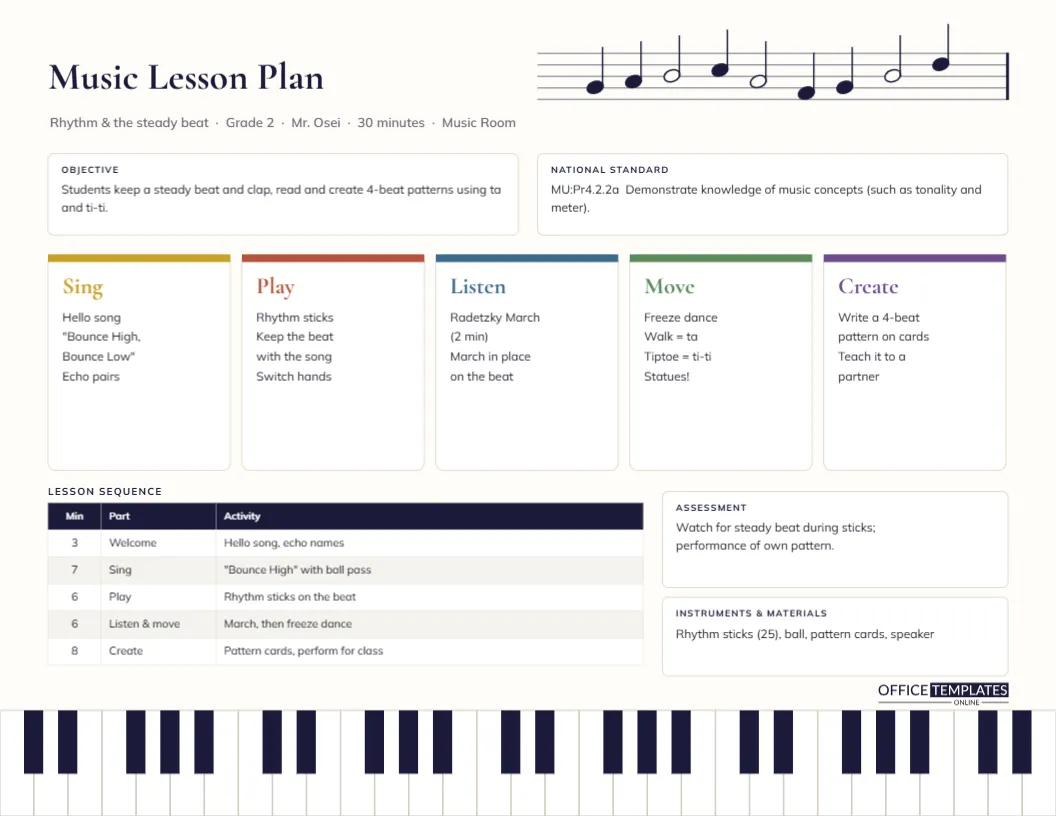
Elementary music lessons are short, active, and full of variety. In thirty minutes, a class might sing, play rhythm instruments, listen to a recording, move around the room, and create a pattern of their own. A music lesson plan needs to show that variety at a glance and keep the sequence moving. This landscape template gives each kind of music-making its own column and wraps the page in music, with notes on a staff at the top and a piano keyboard at the bottom.
Staff Lines and Piano Keys
Across the top-right of the page, five navy staff lines carry a short melody of filled and open note heads with stems, ending at a bar line. The title, Music Lesson Plan, sits to the left in elegant Cormorant Garamond, with the lesson focus, grade, teacher, length, and room underneath. Along the bottom, a piano keyboard runs the full width of the page: white keys with fine outlines and black keys in the familiar pattern of twos and threes. Staff at the top, keyboard at the bottom, and the whole page reads as music before anyone reads a word.
Objective and Standard
Two boxes record the lesson objective (keep a steady beat and clap, read and create four-beat patterns using ta and ti-ti) and the national standard it addresses, MU: Pr4.2.2a. Replace them with the objective and standard for your own lesson.
Five Ways to Make Music
The heart of the page is a row of five cards, each topped by a coloured stripe and named in large serif type:
| Card | Colour | Sample plan |
|---|---|---|
| Sing | Gold | Hello song, Bounce High, Bounce Low, echo pairs |
| Play | Rust | Rhythm sticks keeping the beat, switch hands |
| Listen | Blue | Radetzky March, marching in place on the beat |
| Move | Green | Freeze dance: walk is ta, tiptoe is ti-ti |
| Create | Purple | Write a four-beat pattern and teach it to a partner |
The five cards reflect the main strands of most music curricula. Not every lesson needs all five, but planning with the five in view helps you notice when a class has gone weeks without creating or listening.
The Lesson Sequence
Below the cards, a real editor table puts the activities in order with minutes: welcome (3), sing (7), play (6), listen and move (6), and create (8), exactly thirty minutes. Edit the rows with Edit Table Data; the order matters, because moving between active and calm activities keeps young students focused.
Assessment and Instruments
Two boxes on the right record how you will assess (watching for a steady beat during the stick activity and listening to each child perform their own pattern) and the instruments and materials needed: 25 rhythm sticks, a ball, pattern cards, and a speaker.
Pacing a 30-Minute Music Class
Young children need a change of activity every five to eight minutes. Alternate sitting and standing, loud and quiet, group and individual. Start with something familiar (a hello song), introduce the new learning in the middle, and end with something students make themselves, so they leave with a sense of achievement.
Rhythm Syllables and Notation
The sample uses Kodály rhythm syllables: ta for a quarter note and ti-ti for two eighth notes. Teachers using other systems can change the wording to du and du-de or simply long and short-short. The Create card is where students start to connect sound to symbols, writing their own four-beat patterns on cards.
For Choir, Band and Private Lessons
Older ensembles can rename the cards Warm-up, Sight-reading, Repertoire, Sectionals, and Performance. Private instrument teachers can use Technique, Scales, Pieces, Theory, and Practice plan. The structure stays the same: five strands, one sequence table, one assessment box.
Changing the Melody
The notes on the staff are a group of ellipses and stems. Move them, delete some, or replace the whole group with a melody that suits your lesson. The keyboard is also a group; if you prefer a guitar or drum theme, delete it and add an instrument from the editor’s library.
Printing Landscape Music Plans
The page is US Letter landscape, 11 x 8.5 inches. Download as PDF and print with landscape orientation. The navy black keys use some ink; print in draft mode for everyday copies.
Building a Music Curriculum Binder
Music teachers often see every class in the school each week. Make one copy of the plan per grade, keep them in a binder by month, and you build a year-long record of songs, pieces, and skills taught to each grade. When report-card time comes, the assessment boxes show what you observed.
Choosing Songs and Listening Pieces
Good classroom songs have a small range, a strong beat, and plenty of repetition. Folk songs and singing games are ideal for young singers. For listening, choose short pieces with a clear pulse and contrasts students can hear: the Radetzky March works because the audience traditionally claps along. Keep a running list of repertoire in the Sing and Listen cards so you can see what each class has learned.
Classroom Management in the Music Room
Instruments are exciting, and excitement can get loud. Teach a rest position for rhythm sticks (on the floor, hands on knees) and practise it before the first beat. Use music itself as the signal: a short phrase on the piano means freeze, a chord means sit. Writing these routines into the plan for the first lessons of the year saves a lot of voice later.
Music Plan FAQ
Can I add a sixth card?
Yes. Narrow the five cards slightly and duplicate one for a sixth strand such as Read.
Are the cards tables?
No, they are shapes with text; the lesson sequence below them is a real table.
What size is it?
US Letter landscape, 11 x 8.5 inches.
Can I use it for secondary music?
Yes. Rename the cards to suit ensemble or theory lessons, and lengthen the timings in the sequence table.
Is the keyboard to scale?
It is decorative, but the pattern of black keys follows a real keyboard.
Does it suit a kindergarten music class?
Yes. Shorten each activity to four or five minutes and add more movement.