High school lessons run on the bell. Fifty-five minutes: a do-now while attendance is taken, direct instruction, a task, practice in exam style, and an exit ticket at the door. Teachers at this level need a plan that respects the clock, keeps the essential question in view, and shows how each segment checks understanding. This A4 template does all three with a sharp, grown-up design.
A Sidebar That Holds the Big Picture
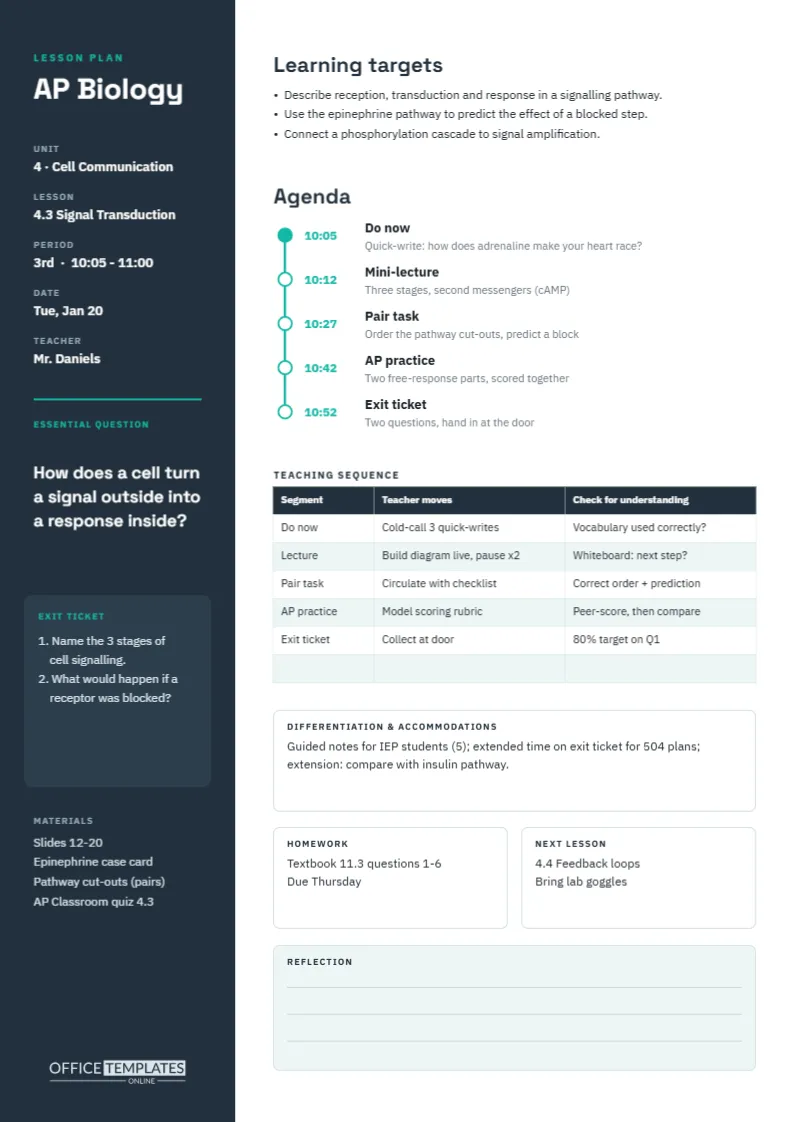
A charcoal sidebar runs down the left of the page. At the top, the course name, AP Biology, appears in white Space Grotesk. Below it, small teal labels introduce the unit (4 · Cell Communication), lesson (4.3 Signal Transduction), period (3rd, 10:05 to 11:00), date, and teacher. A teal rule then introduces the essential question in large white type: How does a cell turn a signal outside into a response inside? Lower down, a dark panel holds the exit ticket questions, and the materials list closes the sidebar.
The Agenda as a Timeline
On the right, the agenda is drawn as a vertical timeline: a teal line with a node for each segment, the start time in teal, and a short description. The sample period moves through five segments:
| Start | Segment | Description |
|---|---|---|
| 10:05 | Do now | Quick-write on how adrenaline makes your heart race |
| 10:12 | Mini-lecture | Three stages, second messengers (cAMP) |
| 10:27 | Pair task | Order pathway cut-outs, predict a block |
| 10:42 | AP practice | Two free-response parts, scored together |
| 10:52 | Exit ticket | Two questions handed in at the door |
Projected at the start of class, this timeline doubles as the agenda students see.
Learning Targets That Can Be Measured
Three bullet targets sit at the top of the main column. They use verbs you can assess: describe, use a pathway to predict, connect. Vague verbs like understand or learn about make poor targets because you cannot see them happen.
Teaching Sequence and Checks for Understanding
A three-column table pairs each segment with your teacher moves and the way you will check understanding. For the lecture, the move is to build the diagram live, pause twice, and the check is a whiteboard response: what comes next? For the exit ticket, the target is 80% correct on question one. Planning the check alongside the move is what turns a lecture outline into a teaching plan. Edit the rows with Edit Table Data, or use Add Row for a lab or a quiz.
Differentiation and Accommodations
A wide box records support for students with IEPs and 504 plans: guided notes for five students, extended time on the exit ticket, and an extension comparing the epinephrine pathway with insulin signalling. Writing accommodations into the plan makes them part of the lesson rather than an afterthought.
Homework, Next Lesson and Reflection
Two boxes record homework (textbook 11.3 questions 1 to 6, due Thursday) and the next lesson (4.4 Feedback loops, bring goggles). A tinted reflection box with three ruled lines finishes the page.
For AP, IB and Exam Courses
The AP practice segment is a reminder that exam courses need regular, short exam-style practice. IB teachers can rename it Paper 2 practice, and GCSE or A-level teachers can use Exam question. The sidebar’s course name and unit fields adapt to any syllabus.
Using It Across Departments
- English: essential question about a theme; agenda with a Socratic seminar.
- History: do-now with a primary source; pair task analysing two accounts.
- Maths: do-now retrieval practice; worked examples then independent problems.
- Languages: target-language agenda; exit ticket as a short translation.
Changing the Sidebar Colour
The sidebar is a single rectangle; choose a department colour (deep green for science, burgundy for English) and the white text stays readable. Change the teal accents to a lighter tint of the same colour family for a coordinated look.
Why A4?
This plan uses A4 paper, 210 x 297 mm, the standard in the UK, Europe, Asia, Africa and Australia. The extra height compared with US Letter gives the reflection box a little more room. If you print on Letter, choose fit to page in your print dialog.
Printing the Charcoal Sidebar
Download as PDF and print. On an inkjet, the dark sidebar uses noticeable ink; for daily copies, consider recolouring it to a light grey with dark text, and keep the charcoal version for observation days and portfolios.
Writing a Strong Essential Question
An essential question is open, worth arguing about, and connected to the big ideas of the unit. What is signal transduction? has one textbook answer; How does a cell turn a signal outside into a response inside? invites explanation and reasoning. Keep the same essential question for several lessons, return to it at the end of each one, and use it as the prompt for the unit’s final written task.
Do-Now Ideas That Settle a Class
The first seven minutes of a period decide how the rest goes. Good do-now tasks are short, independent, and ready on the board before students sit down: a retrieval question from last week, a quick-write linking the topic to daily life, a graph to interpret, or an exam-style multiple-choice item. They give you a calm window to take attendance and check homework.
Planning for a Block Schedule
Schools on 80- or 90-minute blocks can use the same layout with more agenda nodes. Add a lab or a station rotation in the middle, a movement break, and a second short practice segment. Keep the exit ticket as the final node so the block still ends with evidence of learning.
High School Plan FAQ
Can I change the timeline times?
Yes. Each time and description is a text box beside the timeline nodes.
Can I add a sixth agenda segment?
Yes. Duplicate a node and its text, and move the exit ticket down.
What size is it?
A4 portrait, 210 x 297 mm.
Can I use Letter paper instead?
Yes. Change the document size in the editor to US Letter and nudge the bottom boxes up slightly so they fit.
Is the sidebar text editable?
Every label and value in the sidebar is a separate text box you can retype or restyle.