You are home, the homework question makes no sense, and you cannot remember which teacher’s email address ends in what. Or you missed a day and need someone to tell you what happened in science. A contact list is one of the simplest pages in a school diary, and one of the most useful. It puts every person you might need to reach in one place, from subject teachers to the school office to the friend who is brilliant at maths.
Messages in Flight
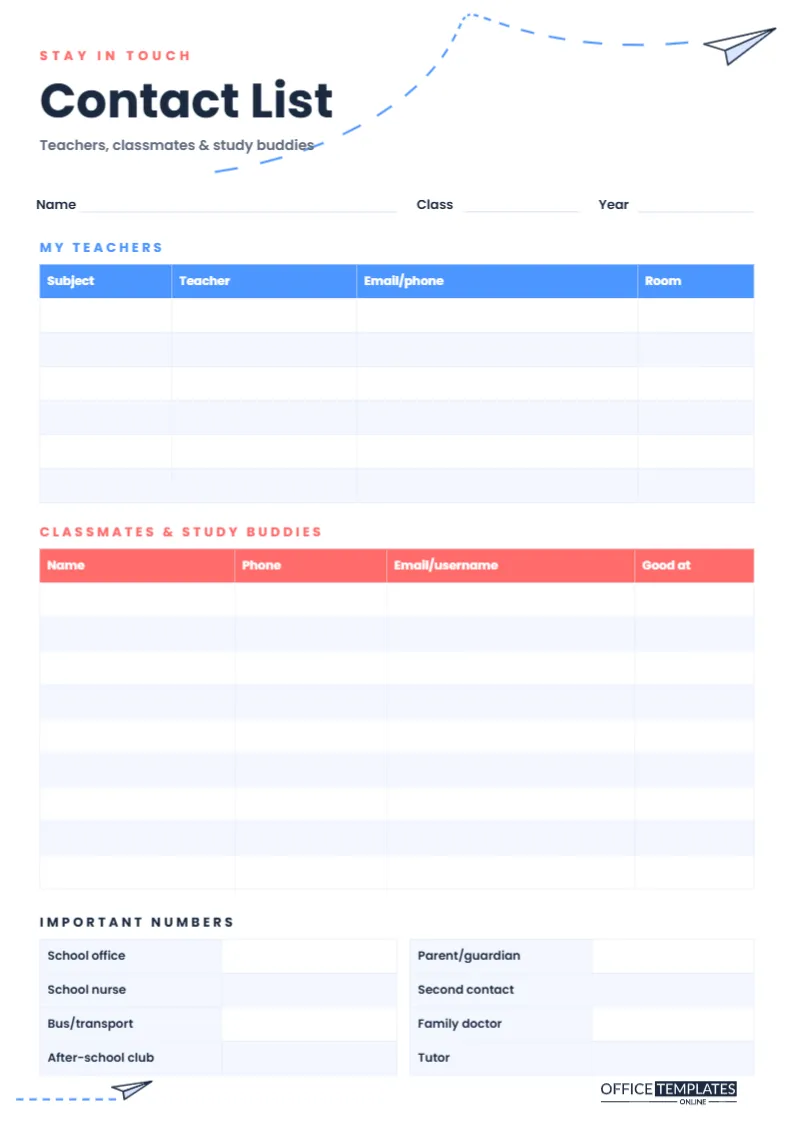
The design of this A4 portrait page (210 x 297 mm) is built around a paper aeroplane, the oldest way to pass a message across a classroom. In the header, a white paper plane with a pale blue fold flies towards the top right corner, trailing a dashed blue flight path that loops across the top of the page. A smaller paper plane with its own short dashed trail flies along the bottom left corner, echoing the one above.
A coral Stay in touch label sits above the title Contact List in bold Poppins, with the line Teachers, classmates & study buddies beneath it and lines for Name, Class and Year.
Three Kinds of Contacts
My Teachers
A blue-headed table with six rows and four columns: Subject, Teacher, Email/phone, and Room. It is the page to check when you need to send a question, find a classroom, or remember a new teacher’s name in September.
Classmates & Study Buddies
A coral-headed table with nine rows: Name, Phone, Email/username, and Good at. That last column is the clever one: noting that a friend is good at chemistry or essay writing tells you exactly who to ask when you are stuck.
Important Numbers
Two small tables side by side list the contacts families most often need: School office, School nurse, Bus/transport, and After-school club on the left; Parent/guardian, Second contact, Family doctor, and Tutor on the right.
Setting Up a Study Buddy System
The Good at column makes it easy to create a small network of study buddies. It works best with a few simple agreements:
- Pair up or form a group of three with classmates in the same classes.
- Agree that if anyone is absent, a buddy shares the homework and a photo of the notes that evening.
- Swap strengths: you help with the subject you are good at, they help with theirs.
- Keep questions to reasonable hours, so help stays welcome.
Study buddies mean nobody falls behind after a sick day, and explaining something to a friend is one of the best ways to learn it yourself.
Keeping Contact Details Safe
Phone numbers and emails are personal information, so a contact list deserves a little care.
| Do | Avoid |
|---|---|
| Ask before writing down a classmate’s number | Copying numbers from group chats without asking |
| Use school email addresses for teachers | Personal phone numbers for teachers unless they give them |
| Keep the page inside your diary or binder | Pinning it on a public noticeboard |
| Use usernames on school platforms | Sharing passwords, even with good friends |
| Tell an adult if someone misuses your details | Keeping online problems to yourself |
Writing Good Emails to Teachers
Having a teacher’s email address is only half the job; using it well is the other half. Keep messages short and polite. Start with a greeting and the teacher’s name, say which class you are in, and ask one clear question: Dear Ms Patel, I’m in 8B. I was absent on Tuesday. Could you tell me which pages of the textbook I should read to catch up? Thank you, Sam. Use your school email account where there is one, check your spelling, and allow a day or two for a reply, since teachers have many students. Save the address in the table the first time a teacher shares it, so you are never searching through old messages when you need it most.
When to Update the List
A contact list is only helpful if it is current. Check it at the start of each term, when teachers and classes often change, and whenever a friend gets a new number. If you fill it in using the editor, open your saved design, change the cells, and download a new copy; a typed list is also much easier to read in a hurry than hurried handwriting.
Customizing the Contact Page
- Double-click any table to open Edit Table Data. Add rows to the teachers or classmates tables, or rename columns, for example, Class instead of Good at.
- Change the labels in the Important Numbers tables to suit your family, such as Grandparents or Neighbour.
- The large paper plane and its looping trail are grouped; move or recolour them as one piece.
- Rename the page Class Directory if a teacher is making one list for the whole class, with families’ permission.
Printing the List
Print on A4 at Actual size. The page is mostly white with blue and coral headers, so it is cheap to print and easy to photocopy. Keep one copy in the front of your school diary and another at home by the family phone or on the fridge, where parents can find the school office number quickly. A PNG saved on your phone is handy too, as long as the phone has a passcode.
Contact List Questions
How many classmates can I list?
Nine rows are printed; add more in Edit Table Data or use a second page.
Should younger children have their own contact list?
For young children, a parent usually keeps the list. The Important Numbers section is especially useful in a younger child’s bag, with a trusted adult’s number clearly written.
Can teachers give this to a new class?
Yes. Pre-fill the My Teachers table with the class’s teachers and rooms, and let students add classmates themselves.
Send a Paper Plane
Fill in your teachers today, ask two friends to be study buddies, and keep the page where you can find it. The next time a question can’t wait until tomorrow, you will know exactly who to ask.