Madeline Hunter’s model of direct instruction, often called the Instructional Theory Into Practice (ITIP) model, has been taught in teacher-preparation programmes since the 1970s. Its seven steps give a clear structure for lessons that teach a skill explicitly: tell students what they will learn, connect it to something they know, teach and model, practise together, check, close, and practise alone. Many student teachers are still asked to submit plans in this format, and many experienced teachers return to it whenever a skill needs careful, step-by-step teaching.
A Staircase of Seven Steps
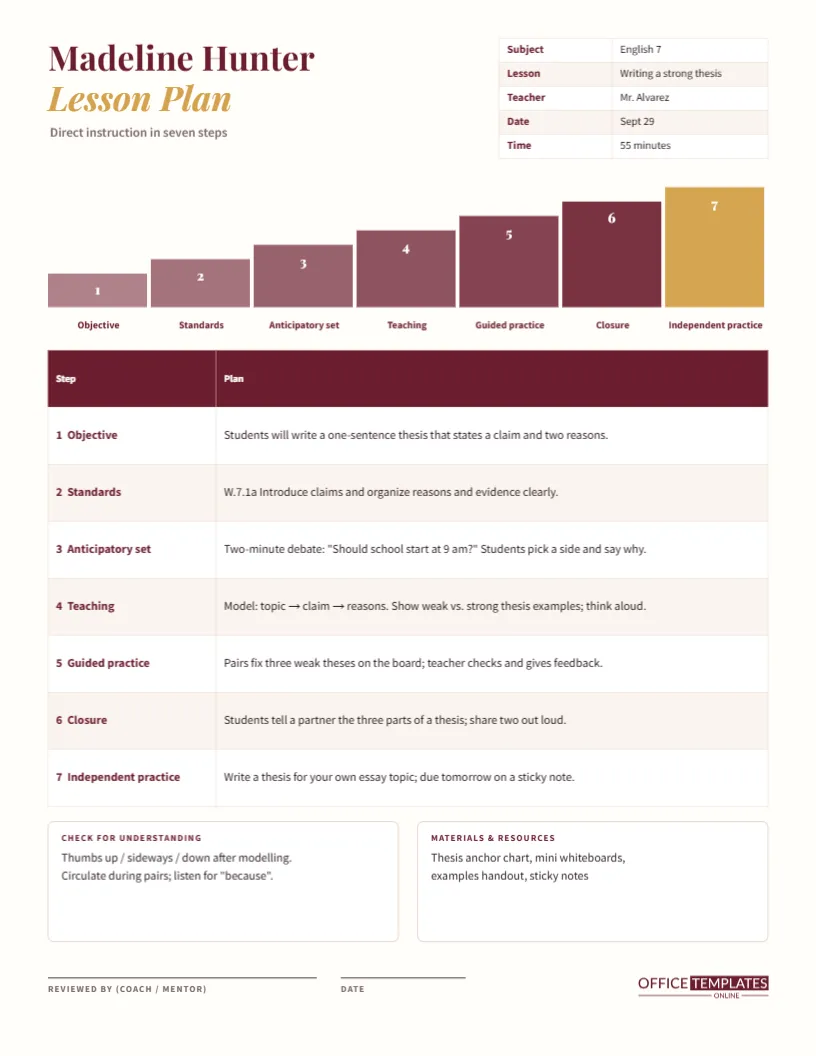
The motif on this template is a staircase. Seven blocks rise from left to right below the title, each a little taller and a little deeper in colour than the last, from a soft burgundy for step one to a solid gold block for step seven, independent practice. Under each block, its name is printed in small bold type. The staircase is a reminder of what direct instruction is meant to do: move students up, one secure step at a time, until they can climb the last step without you.
Classic Typography
The title pairs Madeline Hunter in burgundy Playfair Display with Lesson Plan in gold italic, giving the page the feel of a well-made academic handout. A small table in the top-right corner records subject, lesson, teacher, date, and time. The sample is a 55-minute Grade 7 English lesson on writing a strong thesis statement, taught by Mr. Alvarez.
The Seven-Row Plan Table
The main table has one row per step, with the step name in bold burgundy and plenty of room for your plan:
| Step | Plan in the sample lesson |
|---|---|
| 1 Objective | Write a one-sentence thesis that states a claim and two reasons |
| 2 Standards | W.7.1a Introduce claims and organise reasons and evidence clearly |
| 3 Anticipatory set | Two-minute debate: should school start at 9 am? |
| 4 Teaching | Model topic, claim, and reasons; strong vs. weak examples |
| 5 Guided practice | Pairs fix three weak theses on the board |
| 6 Closure | Tell a partner the three parts of a thesis |
| 7 Independent practice | Write a thesis for your own essay topic |
Edit the rows with Edit Table Data. The step names are already in place, so you only type the plan.
Understanding Each Step
The objective states exactly what students will be able to do. Standards anchor the lesson to the curriculum. The anticipatory set is a short hook that focuses attention and links to prior knowledge. Teaching combines input (the information students need) with modelling (showing them how). Guided practice lets students try with your support. Closure asks students to pull the learning together in their own words, and independent practice gives them a chance to do it alone, often as homework.
Checking for Understanding Throughout
In Hunter’s original model, checking for understanding is not a single step but something that happens during teaching and guided practice. That is why the template has a separate box, Check for understanding, under the table. The sample uses thumbs up, sideways, or down after modelling, and listening for the word because while pairs work. Plan at least two checks; if most students are not ready, guided practice is where you reteach.
Materials and Resources
A second box lists what you need: a thesis anchor chart, mini whiteboards, an examples handout, and sticky notes. Short lists like this save you hunting for things in the minutes before class.
Signed Off by a Mentor
At the bottom of the page are two signature lines: Reviewed by (coach/mentor) and Date. Student teachers and new teachers in induction programmes often need plans initialled by a mentor before teaching. If you do not need them, delete the lines and use the space for a reflection note.
When to Use Direct Instruction
Direct instruction is especially effective for teaching skills and procedures that have a clear correct method: writing a thesis, solving an equation, using a microscope, forming the past tense or citing a source. For open-ended inquiry, a model like the 5E (also in this set) may suit better. Many teachers use both, choosing the structure to fit the learning goal.
Adapting the Steps for Younger Students
With younger classes, keep the anticipatory set very short and concrete, model with a think-aloud, and make guided practice physical: whiteboards, finger counting, or moving cards. Closure can be as simple as: Tell your neighbour one thing you learned.
Recolouring the Staircase
The seven step blocks are a single group. Change the burgundy to navy or forest green from the group’s colour swatches; keep the last step in a contrasting accent so independent practice still stands out as the goal.
Printing for a Student-Teaching Portfolio
Download as a PDF and print on bright white paper; the cream background prints as a warm off-white. For a portfolio, print the plan, attach the student work samples from independent practice, and add your reflection on the back.
A Worked Example: Teaching a Thesis
To see how the steps connect, follow the sample lesson. The anticipatory set gets everyone arguing about school start times, which gives students a ready-made claim. During teaching, Mr. Alvarez shows a weak thesis (School should start later) next to a strong one (School should start at 9 am because teenagers need more sleep and late starts reduce absences) and names the three parts aloud. In guided practice, pairs repair three weak examples. Closure asks students to repeat the three parts, and independent practice transfers the skill to each student’s own essay. Every step leans on the one before it.
Madeline Hunter Plan FAQ
Can I add a “Check for understanding” row to the table?
Yes. Use Add Row and type it between Teaching and Guided Practice if your programme lists it as a separate step.
Is the staircase editable?
Yes. It is a group of rectangles and numbers; resize or recolour it freely.
What size is it?
US Letter, 8.5 x 11 inches.
Is this the same as the ITIP model?
Yes. Madeline Hunter’s seven-step lesson design is often called ITIP, Instructional Theory Into Practice.