The 5E instructional model was developed by the Biological Sciences Curriculum Study in the 1980s and is now one of the most widely used frameworks for inquiry-based science teaching. Its logic is simple: students meet a puzzling phenomenon before they get an explanation, investigate it themselves, then build on what they found. Planning a 5E lesson on a blank page is hard, because each phase has a different job. This template gives every phase its own coloured row so you can see the whole arc of the lesson at once.
Five Chevrons Down the Page
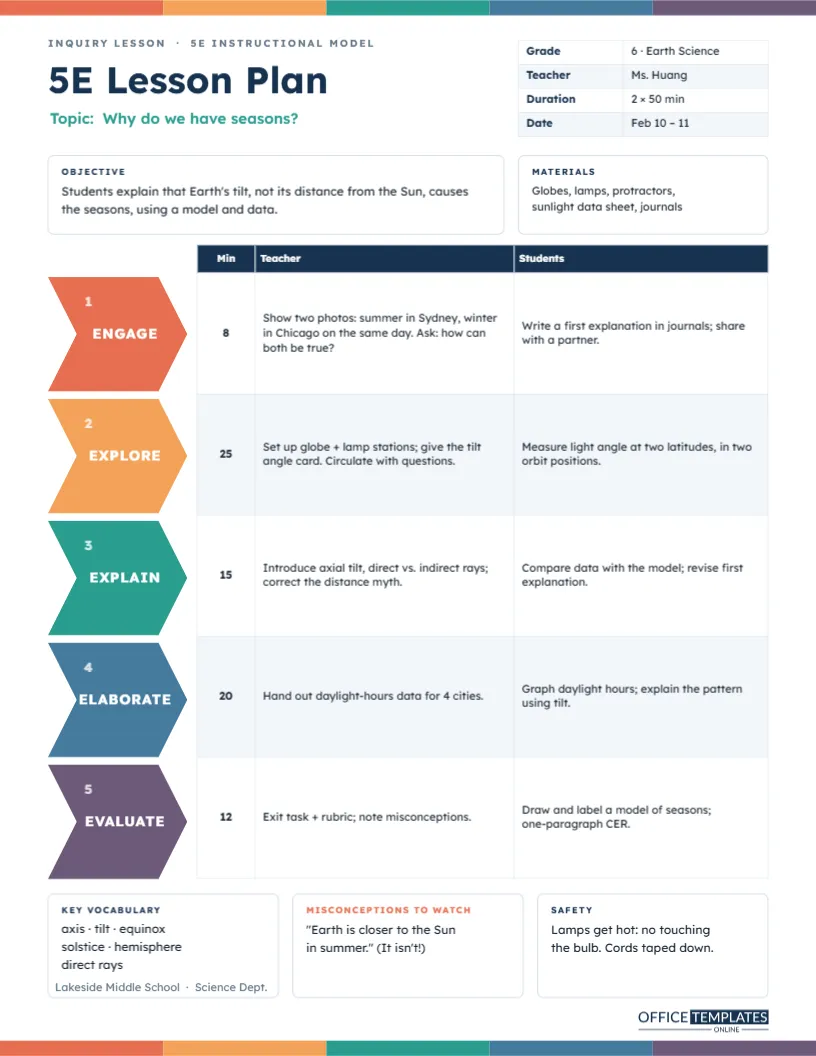
The structure of the page is a spine of five arrow-shaped chevrons running down the left side, each a different colour and numbered: Engage in coral, Explore in warm orange, Explain in teal, Elaborate in steel blue and Evaluate in plum. Each chevron points into a row of the planning table, so the lesson visually flows from one phase into the next. The same five colours form a thin striped band across the top of the page and again along the bottom edge, which frames the plan and makes it instantly recognisable in a binder.
Header and Lesson Details
The title 5E Lesson Plan is set in bold navy Lexend, a typeface designed for readability, with the topic underneath in teal: Why do we have seasons? A small table to the right records grade (6, Earth Science), teacher, duration (two 50-minute periods), and dates. Below, an objective box and a materials box sit side by side.
What Each Phase Is For
| Phase | Purpose | Sample activity |
|---|---|---|
| Engage | Spark curiosity and surface prior ideas | Two photos: summer in Sydney, winter in Chicago, same day |
| Explore | Hands-on investigation before any explanation | Globe and lamp stations, measuring light angle |
| Explain | Introduce vocabulary and the scientific model | Axial tilt, direct and indirect rays |
| Elaborate | Apply the idea to a new situation | Graph daylight hours for four cities |
| Evaluate | Show what was learned | Labelled model and a claim-evidence-reasoning paragraph |
The Planning Table
To the right of the chevrons is a real editor table with three columns: minutes, what the teacher does, and what students do. The minutes column is narrow and bold so the timing stands out; the sample adds up to 80 minutes across the two periods. Because the table rows are tall, you have room for two or three lines in each cell. Click the table and choose Edit Table Data to replace the sample text with your own lesson.
Planning a 5E Lesson Backwards
Experienced 5E teachers often plan from the end. Decide first what students should be able to explain in the Evaluate phase. Then choose an Explore activity that will give them the evidence they need, and an Engage hook that makes them want to find out. The Explain phase comes after you know what students will have discovered, so you can connect your explanation directly to their data. Elaborate then stretches the idea to a new context.
Keep Explain After Explore
The most common mistake with the 5E model is explaining the concept before students explore it. If you tell students that Earth’s tilt causes the seasons and then ask them to explore, the activity becomes a confirmation exercise rather than an investigation. The chevrons are numbered to remind you: explore first, explain second.
Vocabulary, Misconceptions and Safety
Three boxes along the bottom finish the plan. Key vocabulary lists axis, tilt, equinox, solstice, hemisphere, and direct rays. Misconceptions to watch, headed in coral, notes the classic error that Earth is closer to the Sun in summer. Safety reminds students that lamps get hot and that cords should be taped down. Anticipating misconceptions is one of the most powerful planning habits in science; writing them down makes you listen for them during the Explore phase.
Using the 5E Model Outside Science
Although it was designed for science, the 5E structure works in other subjects. In maths, Engage with a puzzling pattern, Explore with manipulatives, Explain the rule, Elaborate with word problems, and Evaluate with a short task. In social studies, Engage with a primary source photograph, Explore a set of documents, Explain the historical context, Elaborate by comparing with another period, and Evaluate with a short argument.
One Lesson or Several Days?
A full 5E cycle often takes more than one period. The sample runs over two 50-minute lessons; some units stretch a single cycle over a week. Use the minutes column to show where each day ends, for example by writing Day 2 in the first cell of the Explain row.
Matching the Five Phase Colours to Your School
The five chevrons are separate shapes, and the top and bottom bands are groups. If your school uses its own colour scheme for the 5Es, or you prefer a single colour with five shades, select the chevrons and pick new fills. Keep enough contrast for the white phase names.
Supporting Every Learner Through the Phases
The Explore phase works well in mixed-ability groups with clear roles: materials manager, recorder, measurer and reporter. In the Explain phase, provide a partially completed diagram for students who need support. For Elaborate, offer a choice of data sets at different levels of difficulty so every student applies the idea at the right challenge.
Printing the 5E Plan
Download as PDF and print in colour; the chevrons are what make the page work. Many science departments keep a 5E plan for every lesson in a unit in one binder, which makes it easy to share and refine lessons year after year.
For Coaches and Teacher Training
Instructional coaches and teacher-training programmes often introduce the 5E model with a blank template. This page is ready to be printed as a training handout: delete the sample entries in the table and the boxes, and trainees can plan their own lesson in the coloured rows.
5E Planner Questions
Can I add a sixth E, such as Extend?
Yes. Duplicate a chevron, add a row to the table with Add Row, and move the bottom boxes down slightly.
Is the table a real table?
Yes. It is the editor’s table object, so cells are edited with Edit Table Data.
What size is the page?
US Letter, 8.5 x 11 inches.
Does the 5E model suit younger grades?
Yes. Shorten each phase and use pictures in Engage; even kindergartners love to explore before being told the answer.