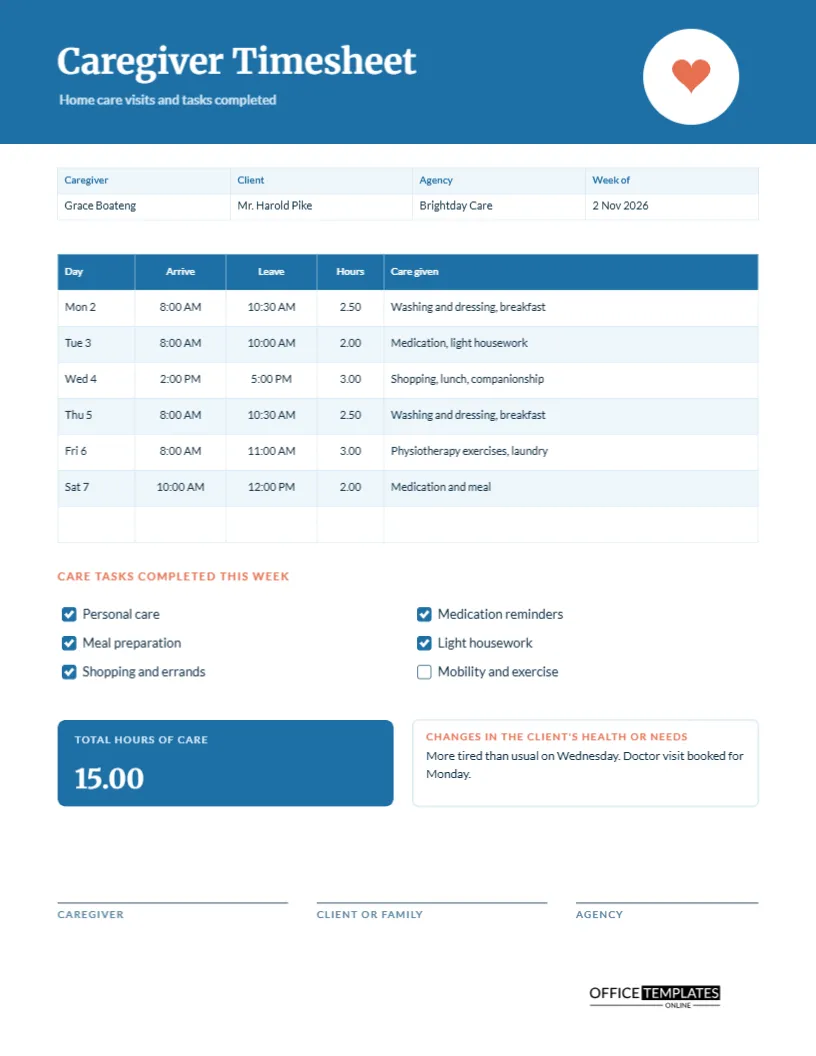
Home care is built on trust, and a clear visit record helps keep it. Families need to know who came, when, and what was done. Agencies need proof of visit times for payroll and for inspections. Caregivers need a way to show that they did everything on the care plan. This US Letter timesheet gathers all of it on one page: the visit times, the care given, a checklist of tasks, and a space for changes in the client’s health.
A Blue Band With a House and a Heart
The page opens with a blue band carrying a white circle, a small house shape, and an orange heart. The title Caregiver Timesheet is set in Merriweather, a sturdy serif that reads well and feels dependable. Lato carries the remaining text in friendly, clean letters. The tone is reassuring and professional, never clinical.
Caregiver, Client, Agency and Week
The strip beneath the header lists the caregiver, the client, the agency, and the week. The sample is Grace Boateng caring for Mr. Harold Pike through Brightday Care in the week of 2 November 2026. Including the agency name makes the sheet suitable for both agency staff and private carers, who simply write their own name or leave it blank.
The Visit Table
| Column | Meaning | Sample Monday |
|---|---|---|
| Day | Date of the visit | Mon 2 |
| Arrive | Start of the visit | 8:00 AM |
| Leave | End of the visit | 10:30 AM |
| Hours | Length of the visit | 2.50 |
| Care given | What was done | Washing and dressing, breakfast |
The sample covers six visits from Monday to Saturday, with a total of 15.00 hours.
Care Tasks Completed This Week
Below the table is a checklist of six care tasks in two columns: personal care, medication reminders, meal preparation, light housework, shopping and errands, and mobility and exercise. In the sample, five boxes are ticked, and mobility and exercise is left open. A glance at the list tells a family what has been done and what has not, and prompts a conversation if something is missing.
The Total Hours Tile
A blue tile shows total hours of care in large white numerals: 15.00. Agencies often pay by the hour, and families may be billed by the hour, so this figure must be accurate. Add the hours column carefully and compare with the visit length written in the care plan. A difference of ten minutes on each visit adds up quickly across a month.
Changes in the Client’s Health or Needs
An orange-headed box asks for changes in the client’s health or needs. The sample records more tiredness than usual on Wednesday and a doctor visit booked for Monday. Caregivers see small changes before anyone else, and writing them down gives family and nurses an early warning. Keep notes factual: what you saw, not what you assume.
Why Care Sheets Carry Three Signatures
The page has lines for the caregiver, the client or family, and the agency. Each plays a different role. The caregiver confirms the visits, the client or family confirms they took place, and the agency approves the sheet for payroll. Where the client cannot sign, a family member or representative may do so, noted beside the signature.
How to Complete a Visit Record
- Write your arrival time as you come in.
- Note what you did in short, plain words.
- Write your leaving time before you go.
- Tick the tasks you completed this week.
- Add any changes in health and get the sheet signed.
Privacy and Respect in Care Records
A care sheet contains personal information. Use first names or initials if the family prefers; store the sheets where visitors cannot read them, and never post a photo on social media. Write kindly, because the client or their family may read the notes. Respectful language protects dignity and keeps relationships strong.
Using the Sheet for Private Carers
A private carer hired directly by a family has no agency to lean on. This sheet provides the same structure: a weekly record that can be signed, shared, and filed. Leave the agency line blank or use it for the payer. Agree on the hourly rate in writing, and keep the signed sheets as evidence for both sides.
Adapting the Task List
The six tasks are examples. Replace them with the items on your client’s care plan, such as continence care, wound dressing, or transport to appointments. Each task is a check box with a text label, so you can retype the label and tick or untick the box by changing its fill.
Reading the Sheet as a Family Member
If you are the family, look for patterns. Are visits shorter than planned? Is the same task missed every week? Is the care given column getting vague? Raise concerns early and kindly with the caregiver or agency. A clear record helps you do this without accusation, because you can point to the page.
Printing and Keeping Home Care Sheets
US Letter portrait. Print one sheet per week and keep it in the client’s home folder, with a copy for the agency. Agencies often keep records for a set number of years, so ask what applies. For digital storage, scan the signed page and name it with the week date first.
Using Completed Sheets for Care Reviews
Care plans are reviewed from time to time, and the weekly sheets are the best evidence of what was really delivered. Bring a month of them to a review meeting. Patterns such as longer visits, more tiredness, or a repeatedly skipped task show up quickly and help the family and the agency sensibly adjust the plan.
Reporting Concerns Through the Sheet
The notes box is not a replacement for calling a nurse or a manager when something is serious. Use the sheet for ordinary changes and phone for anything urgent. Over time, the written notes and the calls together build a full picture, and each supports the other if there is ever a question about what was known and when.
Caregiver Timesheet Questions
Can I add a second visit on the same day?
Yes. Add a row through Edit Table Data and enter the second visit separately.
Is this a medical record?
No. It records visit times and care given. Medical records follow the rules of your care provider.
Can the client sign for themselves?
Yes, if they are able. Otherwise, a family member signs and notes the relationship.